Showing posts with label Economics. Show all posts


'How Innovation Works' by Matt Ridley, offers a systematic examination of this incredibly important but poorly understood phenomenon. What is innovation? According to Ridley, it is much more than invention (something often mistaken for innovation). Invention is the act of discovering an idea; it is merely a beginning, an inception point. Innovation is much more, it is when the invention is taken into the world and made practical. Innovation is the creative reconfiguration of multiple inventions and ideas into something new. Innovation is the act of fully exploring the consequences of that new thing and disseminating and integrating it into society and general use. 

Matt Ridley argues that we need to see innovation as an incremental, bottom-up, fortuitous process that happens as a direct result of the human habit of exchange, rather than an orderly, top-down process developing according to a plan. Innovation is crucially different from invention, because it is the turning of inventions into things of practical and affordable use to people. It speeds up in some sectors and slows down in others. It is always a collective, collaborative phenomenon, involving trial and error, not a matter of lonely genius. It still cannot be modelled properly by economists, but it can easily be discouraged by politicians. Far from there being too much innovation, we may be on the brink of an innovation famine.

Matt Ridley, 5th Viscount Ridley, is a British science writer, journalist and businessman. He is best known for his writings on science, the environment, and economics.


Key learnings

Innovation isn’t an instantaneous creative act practiced by lone geniuses. It’s actually a long, messy, and complicated process. Innovation occurs when chance encounters and serendipitous insights are shared, remixed, and built upon by countless individuals. New inventions are slowly and incrementally improved over time as people find practical uses for novel ideas. If we want more innovation in the future, we need to foster the open exchange of knowledge and take big risks as individuals, organizations, and nations.


Innovation is a complex, messy, and collective process

The Industrial Revolution – the giant leap in productivity that kicked off the modern era – began when humans first harnessed the power of steam to automate work. To do this, they used a new machine called the atmospheric steam engine. So, who do we thank for this astounding achievement? A man named Denis Papin. Or, wait, maybe we should thank Thomas Savery. Or, hold on, maybe a fellow called Thomas Newcomen deserves our praise? The truth is, all three men deserve some credit, but none of them can claim all of it. That’s because, around 1700, Papin, Savery, and Newcomen all produced their own working models of the atmospheric engine. To this day, it’s unclear who was truly first or how much each inventor influenced the others.

We often associate a new invention with a single creator. However, that’s an oversimplification of how innovation operates. Even the most creative people don’t work in a vacuum. They’re always influenced by the tools, technologies, ideas, and social structures that surround them. This often means multiple forces contribute to an innovation, even when one person takes the credit. Let’s consider the case of the atmospheric steam engine. This relatively simple device heats and cools water in a metal cylinder. The changing pressure caused by steam creates movement that can be used for work, like pumping water out of mines. Could Papin, Savery, or Newcomen have invented this completely on their own? Not really. The basic ideas behind the device were already hot topics of discussion in scientific circles at the time. Papin and Savery, both educated men, refined their thinking by exchanging letters and papers with other inventors. Moreover, Newcomen, who built the most successful version of the engine, relied on previous advances in blacksmithing technology to complete his machine. Thus, each man’s invention was also a product of their backgrounds and influences.

This principle applies to all innovation. While Thomas Edison gets credit for inventing the light bulb in 1879, the truth is, more than 20 other creators patented similar contraptions in earlier decades. All these thinkers were responding to ideas and technologies circulating at the time. Of course, some of these attempts were better than others, but none of these innovations happened in complete isolation.


Medical innovations offer high risks and even higher rewards

While the atmospheric steam engine kicked off the Industrial Revolution, medicine evolved with its own innovative procedures, like the following: Step one: Find someone recovering from smallpox. Carefully scrape some pus off one of the many open lesions caused by the disease. Step two: Using a knife or needle, cut an open wound into your own skin. Not too deep, but deep enough to draw blood. Step three: Rub the infected pus into your wound.

This technique is called engraftment. In most cases, it’ll make you immune to smallpox. If it seems gross and dangerous now, just imagine how it appeared to a European in the 1700s. They didn’t have a scientific understanding of why it worked, yet it did work. So, as the century progressed, the practice caught on. It saved countless lives and eventually led to the discovery of modern-day vaccines.

An interesting fact about innovation is that the biggest revelations don’t always come from deliberate discovery or sound scientific theory. Instead, they develop piecemeal over time through random chance, as well as trial and error, as people look for practical solutions to their problems. In the medical field, this is a particularly risky process, but it has resulted in many life-saving practices.

Consider Jersey City’s water supply. In 1908, rapid industrial development tainted the city’s water with unsanitary runoff. The result was serious outbreaks of cholera and other diseases. In a rush to fix the problem, Dr. John Leal added chloride of lime, a disinfectant, to the water. At the time, adding chemicals to drinking water was considered repulsive. Local citizens were outraged. But Leal had heard rumors of it working in European cities, so he tried it anyway. Within months, the experiment paid off, and disease rates plummeted. Soon, communities all around the country were following Jersey City’s example.

Are such open-ended experiments occurring today? Of course. Take the example of electronic cigarettes, also known as vaping. For many, picking up a vaping habit is the first step toward quitting smoking. Since tobacco use is a major cause of death, this could save many lives. Yet, we don’t fully know the health effects of vaping, so their use remains controversial. In some countries, like the United Kingdom, government agencies encourage their use. In contrast, other countries, like Australia, have banned it. Which country takes the right stance on this innovation? That remains to be seen.


Travel innovation is all about incremental improvements

The Salamanca, the Puffing Billy, the Sans Pareil. These names sound silly now, but in the early 1800s, each represented a small step toward improving the way we move. You see, at the dawn of the nineteenth century, the horse was the king of transportation. However, inventors believed a machine, the steam-powered locomotive, could take its place. The tricky part was figuring out how to build one. So, engineers tried a great deal of different designs, giving each new prototype a bold new name. Not every device succeeded, but some made subsequent improvements in speed, safety, or reliability. By 1829, the Rocket, a locomotive built by Robert Stephenson, was capable of transporting 13 tons of cargo at 30 miles an hour – and the world was on its way to a railway boom.

Throughout history, humans have always looked for faster, more reliable ways to travel. However, no new mode of transportation ever emerged in a completely perfect form. For example, the sleek, efficient machines that carry us around today are the result of countless individuals making innumerable small design improvements over time.

Look at the evolution of today’s automobiles. Most rely on the internal-combustion engine for power. Isaac de Rivaz, a Franco-Swiss artillery officer, built this machine’s earliest ancestor back in 1807. It ran on hydrogen and oxygen and was loud, clunky, and prone to explosions. In 1860, a Pennsylvanian man named Jean Joseph Lenoir updated the design to run on petroleum. This was a step-up, but the device was still very inefficient.

Next, in 1876, Nikolau Otto, a grocery salesman, refined the machine by adding a four-step cycle of compression and ignition. Dubbed the four-stroke engine, this model allowed for smoother operation. This design was adopted by the German inventor Karl Benz. In 1894, he amped up the engine’s power and used it to drive a three-wheeled machine called the Motorwagen.

While the Motorwagen was a hit with the rich, it remained a novelty. It took another inventor, Henry Ford, to bring the automobile to the masses. In 1909, his assembly-line manufacturing process made the Model T car affordable to more people. Soon, cars were one of the most popular forms of transportation around. It took decades of slow, steady improvement, but the engine had finally conquered the horse.


Some innovations aren’t solid things but simply good ideas

The humble potato is the basis for so many popular snacks and dishes we love today, but this wasn’t always the case. At least, it wasn’t in Europe. That took some innovation. First cultivated more than 8,000 years ago in the Andes Mountains of South America, the potato didn’t arrive in the Old World until the mid-1500s. However, for decades, Europeans regarded potatoes with suspicion. The church in England banned them. People in France believed they caused leprosy. Still, slowly, people learned to love this robust, nutrient-rich crop. The idea of eating potatoes first caught on in Belgium. Then the idea spread throughout the entire continent. By the 1800s, most European countries had made the potato a new staple of their cuisine.

Often, the concept of innovation gets reduced to invention. That is, we think of innovation as the process of making new tangible items like labor-saving machines or electronic gizmos. However, some of the most influential innovations of all time aren’t objects at all. Instead, they’re ideas that open up new ways to approach the world or solve problems.

One intangible innovation you use every day is the Arabic numeric system, more commonly known as numbers.
Yes, even the idea of using 1s, 2s, and 3s was once revolutionary. This counting system was first developed by Indian scholars around 500 AD. It was then adopted by Arab traders in the ninth century, and finally found a foothold in Europe in the 1200s thanks to an Italian author known as Fibonacci. Fibonacci advocated for using Arabic numerals because they were more practical than the Roman numerals popular at the time. Their key advantage was their positional system. While the Roman numeral V always means five, the Arabic five changes value based on its position in a sequence. So, a five followed by a zero means 50, a value ten times greater.

This seems like a small change, but it opens a whole new world for mathematics. With Arabic numbers, it’s possible to do more advanced calculations like multiplication, division, and algebra. It’s also much easier to keep financial records and do accounting. Adopting the idea of Arabic numbers was an innovation essential to launching Europe into a new age of trade, commerce, and scientific discovery.


Our desire to communicate drives rapid innovation

Baltimore, Maryland, 1843. The Whig Party holds a convention and nominates Henry Clay for president. It’s big news, and usually, it would take a train more than an hour to deliver the results to Washington, DC. But, this year, the message arrives in seconds. How? Thanks to the telegraph, a brand-new invention installed by Samuel Morse. It transmits information by sending electrical signals through a suspended wire. It’s the first practical innovation in the emerging field of electrified communication technology. The telephone arrives a few years later, in 1876. The wireless radio soon follows in the 1890s.

By the turn of the century, distant people are more connected than ever before. However, this is just the beginning. Over the following decades, innovations in communication and information technology will revolutionize the world. Before Morse tapped out the first dots and dashes through a telegraph, communication was either conducted face-to-face or through physical objects like letters and books. Ideas spread more slowly, and accessing information depended on which printed materials you could actually get your hands on. However, the advent of electronic communication like the telegraph, telephone, and eventually computers changed everything – and fast.

It’s hard to overstate how quickly new communication technology was adopted. The first telegraph line was completed in 1844. By 1855, there were 42,000 miles of lines in the United States alone. By the end of the 1870s, telegraph cables stretched across the Atlantic and Pacific oceans. Broadcast radio has a similar trajectory. It began with a single station in 1900 and grew to be the dominant form of public communication by the 1930s.

Computers also became an essential part of daily life at an astounding rate. This is partially due to how quickly computer technology improved and miniaturized. A computer’s processing ability is determined by how many transistors it has. Incremental improvements make transistors smaller and easier to produce, steadily allowing for more transistors to be housed in less space. This phenomenon is sometimes called Moore’s Law. So, in 1975, the average computer chip had 65,000 transistors. Today, that number is in the billions, and they’re much cheaper.

With the internet now connecting all the world’s computers, sharing information is easier than ever. This innovation has changed the political landscape by giving a huge amount of power to those who control communication technology. Now, the world’s most influential companies are search engines like Google and social media empires like Facebook.


Innovation relies on chance, collaboration, and recombination

The non-stick pans in your kitchen, the Gore-Tex coats worn in extreme environments, the fluorine gas chambers in the first atomic bombs. What do these all have in common? They’re all innovations based on polytetrafluoroethylene or PTFE. PTFE was first synthesized in 1938 – by accident. A scientist researching refrigerants stored tetrafluoroethylene gas at sub-zero temperatures. The chemical solidified into a hard substance that was unusually stable and heat-resistant. It didn’t work as a refrigerant, but other scientists found that in other contexts, it could be used for so much more. This story of PTFE is useful because it demonstrates the complex way innovation actually works.

Every story of innovation is different, but if you look closely, you’ll see they often follow a similar pattern. Many of the greatest innovations begin with a bit of serendipity. Someone has a lucky break, an unusual insight, or random occurrence. Then, others pick up on the discovery and apply it to new situations. Through trial and error, they apply the new idea or invention in different contexts until they find a practical use.

Consider the modern practice of using DNA as forensic evidence in criminal cases. No one set out specifically to create this innovation. Instead, it began in 1977, when Alec Jeffreys, a scientist at Leicester University, tried to develop a method using DNA to diagnose diseases. While collecting samples, he saw that DNA was a lot like fingerprints – that is, everyone’s genetic code was different. A chance discovery.

Meanwhile, the local police were struggling to solve a grisly murder. They wondered if Jeffery’s discovery could help solve the mystery. So, the scientist and the police worked together. They began collecting and analyzing more than 5,000 genetic samples from local suspects. They then compared them to DNA found at the crime scene. Eventually, they found a match. Case closed.

Because so much innovation follows this same pattern, it’s possible to identify conditions where it’s more likely to happen. Innovation thrives when people can cross paths, mingle, and exchange ideas. That’s why, throughout history, universities, trading hubs, and major cities have consistently produced novel innovations. By bringing different people with different expertise, perspectives, and cultures together in one place, these contexts foster the type of interactions that push innovation forward.


Innovation doesn’t always come from the top down

In 1924, the British government wanted to build a civilian airship capable of traveling across oceans. This raised the question: should the task be handled by the government or by private industry? They decided to try both approaches. Parliament contracted a government lab and a private firm, Vickers, to build two ships. How did this experiment play out? Well, by 1930, Vickers had designed the R100, a light, fast, and efficient aircraft. It traveled to Canada and back with no problems. Meanwhile, the government lab built the R101, a heavier, more costly ship. On its maiden voyage to Karachi, Pakistan, it only made it to France before crashing, killing 48 passengers.

These two very different outcomes illustrate an important point. When it comes to innovation, direct government oversight and control isn't always the answer. There’s a popular notion that innovation requires guidance and funding directly from the state. This argument posits that private industry, in a constant quest for easy profits, will avoid the costly research and development necessary to create truly new ideas. Instead, firms will hoard their patents and simply rehash old products. But is this true? Not exactly. While it’s true that government-directed research makes great discoveries, it often takes the ingenuity of private enterprise to turn them into practical innovations. Consider the internet. The basic components of computer networking were created by the Defense Advanced Research Project Agency, an American government lab. However, the world wide web didn’t take off as a household necessity until private firms like Cisco began to experiment with the technology in the 1980s and 1990s.

This dynamic occurs because big government projects often aren’t sensitive to the needs or desires of everyday people. Additionally, they can be slow to adopt new, outside-the-box ideas. However, big companies can also suffer this tendency. That’s why even giant firms are sometimes usurped by plucky start-ups.

Remember Kodak? This company was once the undisputed master of the photography industry. Film cameras were their flagship product. So, in 1975, when one of their scientists built an early version of a digital camera, his innovation was ignored. The higher-ups just didn’t see the potential in his bulky, electronic gizmo. Yet, smaller companies did. And they developed their own products, which took over the market. Thus, Kodak missed the digital photography revolution and filed for bankruptcy in 2012.


Innovation will always face resistance

Take a stroll through your grocery store’s dairy aisle. Here, you’ll see a wide selection of both butters and margarines sitting side-by-side in perfect harmony. The choice of spread is up to you. This wasn’t always the case. When margarine was first invented in 1869, it caused an uproar. The oily spread was both cheaper and more stable than butter. The dairy industry, fearing the competition, launched a vicious campaign against it. The National Dairy Council even faked studies showing it was dangerous. By the 1940s, two-thirds of American states had banned this innocuous staple.

Of course, the fervor eventually subsided, and margarine became an accepted foodstuff. Yet, this butter battle shows that even harmless new creations can stoke controversy. When a truly novel idea or invention arrives on the scene, it will often be rejected. This is because everyday people often fear change. Also, established industries don’t want to risk losing their supremacy. This is why horse breeders fought against tractors, ice-harvesters tried to stifle refrigeration technology, and some musicians initially wanted to ban radio stations from playing recorded music.

One way interest groups try to slow innovation is by sowing fears about safety and security. Consider the case of genetically modified organisms or GMOs. GMOs, such as vitamin-A-enriched golden rice, have the potential to bring cheaper nutrition to people all over the world. Yet, groups ideologically opposed to genetic modification, like Greenpeace, lobby hard against their production, citing sometimes flimsy evidence that these foods are dangerous.

Another way innovation is held back is through the overly aggressive application of intellectual property laws. When applied correctly, these laws, such as copyrights and patents, incentivize innovation by giving creators exclusive use of their ideas for a short time. This allows the original innovators to profit.

Yet, as we know, innovation requires sharing ideas and building on the work of others. Unfortunately, copyrights have been steadily extended, making this process more difficult. In the United States, a copyright used to last 14 years. In 1976, it was extended to last the life of the author plus 50 years. In 1998, 50 was extended again to 70 years. These laws no longer benefit the original creator post-mortem, but they do keep good ideas locked away from potential new uses.


Innovation is lacking in the West but booming elsewhere

In much of the world, the past few centuries have been filled with astounding leaps in innovation. In mere generations, Western countries have gone from largely agrarian economies to electrified, industrialized powerhouses. Even now, every day seems to bring novel developments in sectors like communications and computer technology.

Yet, alongside these changes, other sectors are strangely stagnant. In the realm of transportation, not much has changed. In 1958, the average commercial aircraft traveled at 600 miles per hour. Today, they move at roughly the same rate. There have been upgrades around the margins to aspects like fuel efficiency, but the fundamentals are untouched.

The business world, too, is less dynamic. In the United States, new businesses made up 12 percent of the economy in 1980. In 2010, they only accounted for 8 percent. Across the Atlantic, things are even staler. Looking at Europe’s 100 most valuable businesses, only two of them are younger than 40 years old. Most industries seem more focused on protecting current profits than bold new ideas.

So, where is innovation occurring? Mostly in rising nations like China. For the past few decades, this country has poured resources and manpower into urbanization and new technologies. Now Chinese firms like Tencent and Alibaba are at the forefront of growth industries like social media and financial services. Moreover, Chinese universities are making huge strides in fields like gene editing and artificial intelligence.

Can the Western world keep up? Maybe. It would require a renewed spirit of innovation. Companies will need to take more risks, workers will need to put in more hours, and governments will need to foster the free and open exchange of ideas that fueled past booms. All that, plus a little luck, will put innovation back on the agenda.


Image - Bright spark: detail of an 1879 illustration depicting Thomas Edison's lightbulb 
CREDIT: Getty Images


'How to do Nothing' is an action plan for thinking outside of capitalist narratives of efficiency and techno-determinism. “Time is money.” It’s an age-old adage, but it’s taken on new relevance in today’s digitally-driven, 24/7 economy. Whether it’s work or self-improvement, we’ve come to believe that we should have something to show for our time. Anything that doesn’t produce value in those terms is simply too expensive. Writer and artist Jenny Odell, thinks it’s time to take a different approach. Never switching off, is a recipe for a bland and shallow existence where we simply follow the crowd and fail to do our own thinking. The result? A world of mediocrity, misery, and selfishness. Odell’s alternative is deceptively simple – doing nothing. Above all, this is a question of attentiveness. Learning to direct and focus our attention is a way of opening up an entirely new and deeper experience of the world around us. In the age of social media and its all-out assault on our attention, this is an act of resistance that might just change everything. This book will teach you why social media makes us behave like brands; what nature can teach us about attention; and how attentiveness to others can make us more empathetic.

This book is a New York Times Bestseller and was favorited by Barack Obama in 2019. The book is written by Jenny Odell, an artist, and writer who teaches at Stanford University and has been an artist-in-residence at Facebook, the Internet Archive, and the San Francisco Planning Department.


Key learnings

After the defeat of once-powerful labor movements in the 1980s, a new idea emerged: that all of us are capitalists. This notion eroded the separation of work and leisure. In today’s economy, every hour of the day is potentially monetizable, meaning that we’ve come to see “doing nothing” as a luxury we just can’t afford. That, however, is a mistake. When we pause and really engage with the world, we can find deeper, more satisfying meaning in everyday experiences.


When work and leisure become indistinguishable, doing “nothing” looks like a waste of time.

In the 1880s, American laborers began pushing for an eight-hour workday. They didn’t just want more time to heal their sore muscles, though. As a popular trade union song of the era put it, the purpose of the struggle was to secure “eight hours of work, eight hours of rest, and eight hours of what we will.” This was a demand for a life outside work – the right to do nothing in particular for at least one-third of the day.

In the twentieth century, reformers made the eight-hour workday a reality. Their laws remain in effect, but the distinction they drew between work and leisure looks increasingly shaky today. It was long assumed that economic risk was the business of capitalists and investors. Workers were expected to clock in, get the job done, and go home. Do that, they were told, and their positions and wages would be safe. This arrangement lasted as long as labor movements could enforce it through strikes and political pressure. That ended in the 1980s after a series of historic losses defanged once-powerful trade unions and workers’ parties.

In his 2011 book 'After the Future', the Italian philosopher Franco Berardi links these defeats to the emergence of a new idea – that we are all capitalists. This means that we can’t expect economic security. Just as companies navigate perilous markets in search of opportunities, we must compete against each other for one-time jobs or gigs. The way to thrive in this ultra-competitive gig economy is simple – never switch off. This isn’t just what critics like Berardi say, however. Take a notorious 2017 advertising campaign for Fiverr, a platform that helps users find freelancers to complete mini-jobs. As their ads put it, “doers” in today’s world “eat coffee for lunch,” run on sleep deprivation and happily interrupt sex to take calls from clients. Fiverr’s suggestion that these were good things was widely ridiculed, but the company hit upon one of the essential features of the gig economy – the disappearance of the boundaries between work, rest, and leisure. This shouldn’t surprise us. If the day consists of 24 potentially monetizable hours, time becomes an economic resource that’s just too valuable to be spent doing “nothing” or what you will.


Social media makes us behave like one-dimensional brands.

If we are all capitalists, it makes sense that we spend much of our time behaving like corporations. Thanks to social media, this work never ends. Even our leisure is numerically sifted and appraised via likes on Facebook and Instagram. We monitor the performance of our personal brands as though we were analyzing shares on the stock market. This profoundly alters the way we act when we’re online.

In his 1985 book 'No Sense of Place', the technology expert Joshua Meyrowitz explored the effect of electronic media on social behavior. Despite its age, it’s an eerily prescient analysis of social media. In the 1950s, Meyrowitz went on a three-month trip. When he returned, he was eager to talk about his adventure. He didn’t tell everyone the same story, however. His parents heard the “clean” version, his friends got the racier one, and his professors were given the “cultured” narrative.

All these different editions were equally true – they were just tailored to different audiences or contexts. But now imagine his parents had thrown a surprise party on his return and invited all these groups. Meyrowitz ventures that this would have gone one of two ways: he would have either offended one group or created a new account “bland enough to offend no one.” This is context collapse – the fact that everyone is always in the same room at the same time. The disappearance of different contexts goes even further in our own digital age. Today, our online audience knows so much about us that it’s extremely difficult to project different definitions of ourselves to different groups. The result? Awkward acts, like taking unpopular positions or admitting mistakes in public, come to be seen as weaknesses and liabilities. Ultimately, this means we create a version of ourselves that’s acceptable to everyone at all times – a personality with the edges smoothed off.

This isn’t just a race to the mediocre bottom, though. It also runs against something that’s completely normal and human – changing over time. But that’s the point. Social media isn’t designed to foster human expression and dialogue. It functions as a tool for personal brand management, and the two pillars of any brand identity are internal coherence and continuity over time.


If we want to live more meaningful lives, we need to reappraise what is valuable.

Today’s economy doesn’t have an off button. Every moment of every day is a financial resource to be captured, optimized, and appropriated. Snooze and you can expect to lose. But despite this obsession with creating measurable value and optimizing every facet of life, many people still recognize a different truth. This holds that meaning is often the product of accidents, chance, and serendipitous encounters – the very “off-time” our 24/7 cult of productivity attempts to eliminate.

In the fourth century BC, the Chinese philosopher Zhuang Zhou penned a story called “The Useless Tree.” In it, a carpenter comes across a large and ancient oak. He deems this tree to be worthless because its old, gnarled branches aren’t any good for timber. Later, the tree appears in the carpenter’s dreams and quizzes him on his definition of usefulness. Timber trees, the oak argues, are very “useful,” yet these trees are invariably felled in their prime by humans. “If I had been of some use,” the oak then asks, “would I have grown this large?” Uselessness, it seems, can be useful after all – you just have to take the oak’s perspective. This point, the oak concludes, is missed by those who only see potential timber when they look at trees.

Zhuang’s oak has a real-life counterpart. The hills above San Francisco Bay near the author’s home in California were once full of towering, thousand-year-old Sequoia redwoods. During the 1850s gold rush, however, loggers felled all these ancient giants – except for one. Today, this wizened redwood is known as “Old Survivor,” and it has a lesson for us. Old Survivor was able to escape the fate of its neighbors for two reasons. First off, it was too twisted to entice loggers. Secondly, it was perched on a steep, rocky slope that reinforced the idea that cutting this tree down just wasn’t worth the bother. In other words, Old Survivor was too weird and too difficult to proceed easily toward the sawmill.

This is a great example of what the author calls resistance-in-place – making yourself into a shape that resists being appropriated by the dominant system. Just as the worth of trees doesn’t have to be measured by their suitability for timber, value in our lives doesn’t have to be measured in terms of productivity. 


Doing nothing allows you to truly pay attention to the world.

One evening in 2015, just before sunset on a cliff overlooking the Pacific ocean, a greeter checked guests into an area of foldout chairs cordoned off with red rope. After being shown to their seats and reminded not to take photographs, they watched the sunset. As it disappeared below the horizon, they applauded and refreshments were served. This strange scene was part of an artwork by Scott Polach entitled 'Applause Encouraged' and it neatly encapsulates an important aspect of doing nothing. Polach’s work didn’t create the sunset – it drew attention to it. This makes the work a great example of what the author terms 'attention-holding architecture'. This is a framing device that encourages the kind of sustained contemplation that habit, familiarity, and distraction often close off.

Attention-holding architecture comes in different forms. One of the author’s favorite examples is a public garden near her Oakland home, the Morcom Amphitheater of Roses. Nestled into the side of a hill, the bowl-shaped garden contains dozens of branching paths that wind their way through and around roses, trellises, and oak trees. There are hundreds of ways to navigate this space and just as many places to sit. It’s designed to hold your attention – the garden wants you to stay awhile and lose yourself in its sights and fragrances. It’s also possible to think about this concept in a more abstract way. Take the practice of deep listening. This was developed by American musician and composer Pauline Oliveros as part of her search for inner peace during the turbulent years of the war in Vietnam. According to Oliveros, hearing, and listening refer to different things. The former is simply the physiological means of perceiving sound. Listening, by contrast, means directing your attention to sound and its psychological significance. Deep listening, in other words, is a metaphorical architecture encouraging us to be more receptive to the world.

You can see how this works if you think about birdwatching. Oftentimes, when the birds are hidden, birdwatchers aren’t actually watching anything – they’re listening. And the first step toward being able to distinguish different birdsongs is breaking a wall of meaningless sound into discrete units. Like the sunset, these sounds are already there, but they only become perceptible and meaningful when you stop and do nothing but pay close attention to the world.


The brain usually only notices a tiny part of the data it processes, but silence can help widen your perspective.

Attention is like breathing. It’s always there, in the background. When you do notice it, you might be surprised to discover how shallow it is. And just as mindful breathing can train you to consciously deepen your breath, it’s possible to train yourself to be more attentive. The trick is realizing just how much your brain is already processing. In the 1990s, Arien Mack and Irvin Rock, two psychologists based at Berkeley University, designed an experiment to get to the bottom of 'inattentional blindness' – the things we don’t see because we’re not paying attention. They asked subjects to look at a cross on a screen and say if one of the two lines was longer than the other. This was just a decoy, however. As participants studied the crosses, small stimuli flashed up on their screens. When these were within the area circumscribing the cross, subjects were aware of them. When they fell outside this area, they went unnoticed.

The idea that we notice things when they’re in our field of vision makes intuitive sense, but there’s more to it than that. When stimuli outside the area took particularly distinctive forms like a subject’s name, they did notice it. But when these stimuli were made less distinctive, like spelling out “Janny” instead of “Jenny,” they once again went unnoticed. Mack and Rock concluded that the brain processes far more information than they had assumed and was only deciding later on whether stimuli would be perceived or not. This suggests that attention is like a key – it’s the means by which the door dividing unconscious and conscious perception is unlocked. So how do you find this strange key? Well, try embracing silence. 

Take the composer John Cage’s work 4’33”, a three-movement piece in which a pianist sits in front of her instrument without playing a single note. Every time it’s performed, the audience becomes attuned to the ambient sounds of a concert hall. Suddenly, they hear the musical potential of a cough or a scraping chair. This was Cage’s intention. As he put it, “everything we hear is music.”Walk down the street with this idea in your mind and there’s a good chance you’ll experience familiar scenes with newfound clarity. Like taking a conscious deep breath after years of shallow breathing, you might just wonder how you’ve never really heard any of these sounds before.


Choosing to be attentive to others takes the sting out of frustrating everyday experiences.

Imagine you’re sitting in your car at an intersection. You’re late for work and the traffic is hell today. Then, just as the light turns green, another car suddenly dashes in front of you and cuts you off. How do you react? Chances are, you’re going to focus on your own experience – in this case, the inconvenience caused by someone else’s reckless selfishness. But say you learned that the other driver was rushing their injured child to the hospital – you’d probably look at the situation differently, right? In most cases, it’s impossible to know what really motivates other people’s actions, but considering the possibilities can improve your experience of the world.

In 2005, the American novelist David Foster Wallace gave a commencement speech at Kenyon College, Ohio. In it, he offered graduating students a bleak sketch of what adult life had in store for them. Time and again, he said, they would find themselves in hideously, fluorescently lit supermarkets at the end of long days at work and terrible traffic jams. When this happened, they would have two choices.The first was to see the world only from their own point of view. When you do this, everything is about your own hunger, tiredness, and desire to get home. From this perspective, other people – whether it’s other road users, fellow shoppers, or sales clerks – appear simply as obstacles. This, Wallace suggested, is a surefire recipe for irritation and misery.

But there is an alternative. When you pause to pay attention and think through other people’s possible motivations, you begin to see that their lived realities are just as complex and deep as your own. The woman in front of you who just snapped at you, for example, might not always be like this. She might just be having a rough day. Maybe her dad just died, or an unexpected bill left her short for the month.It doesn’t really matter whether this is true. The point, Wallace argued, is that this kind of attention to possibilities transforms the way you perceive others. Rather than seeing them as things in your way, you begin to see them as fellow inhabitants of a shared space in which your interests are no more or less important than anyone else’s. This ultimately makes it possible to experience even a crowded, loud, slow, consumer-hell-type situation as meaningful.


The End of Power: From Boardrooms to Battlefields and Churches to States, Why Being in Charge Isn't What It Used to Be, written by Moisés Naím, discusses the decline of power in established leaders and institutions. The book's overall theme points out while it is becoming easier to get power, it is also becoming harder to use it to control others and harder to keep it once you have it. Naim suggests that globalisation, economic growth, a growing global middle class, the spread of democracy, and rapidly expanding telecommunications technologies have changed our world. He says these developments have created a fluid and unpredictable environment which has unsettled the traditional dominions of power.

Moisés Naím is a best-selling author, and an internationally syndicated columnist. He is the editor of the influential magazine Foreign Policy, published by the Carnegie Endowment for International Peace. Foreign Policy magazine is a leading publication on international politics and economics. Naim has written extensively on economic reforms, the political economy of international trade and investment, and globalisation. He was formerly Venezuela's minister of trade and industry.


Personal note:
It’s interesting that this book was written in 2013 and it’s as though it predicted a lot of the events that have happened not long ago, in particular the dissipation of power in politics, such as Trump’s takeover of the Republican party and Brexit. Another interesting thing that I found in the book, Naim talks about when power changes hands quickly, the players become inefficient. When power dissipates, even mature democracies can be left unable to react to the fast-paced challenges of the twenty-first century. I can see that in my home country Australia. Australia is guilty of burning through so many prime ministers, Scott Morrison replaced Malcom Turnbull who replaced Tony Abbott who replaced Kevin Rudd who replaced Julia Gillard. The so often changing of the guards leads to the weakening of power. The absence of a powerful international authority makes it near impossible to reach the agreements necessary to make important global changes, in particular the reduction greenhouse gas emissions. Another thing that Naim talks about that rings true is, the erosion of power reduces the incentive to invest time and effort in crucial issues, because those issues’ long term consequences aren’t immediately apparent. Instability makes engaging in long-term learning and improvement an unattractive proposition. Instead, players prefer short-term goals. This is evident in the world’s shocking lack of preparation and disorganised response to the coronavirus pandemic. A lot of these learnings seem prophetic when you think of it in the context that it was written in 2013. It’s interesting to see that the trends noted are continuing to happen however, I hope more of the positive trends of the erosion of power outweigh the negative in the years to come.


Key learnings

The erosion of power has led to many important freedoms, but has also made the world more dangerous. As power continues to be spread between more and more people, societies will have to re-evaluate whether the costs of democratised power outweigh the benefits of centralisation.


Power is crumbling everywhere.

Protesters have taken to Wall Street and other public places around the world to voice their concerns about the increasing concentration of wealth and power among the “one percent,” who in their view only grow more powerful as time progresses. Reporters and foreign relations experts have long made predictions about America’s decline and China’s rise to power. Yet when we examine political relations more closely, we see that something much more fundamental is happening to the distribution of power in the world. But first, what is power exactly?

In essence, power is the ability to make others do what you want them to do. Parents exert power when they make their kids eat their vegetables before they can have dessert. Power is at work when Barack Obama motivated large numbers of young people to become engaged with party politics in the 2008 presidential elections.

But power is also relational, and the traditional barriers that reinforced the position of the mighty and prevented potential rivals from becoming significant challengers are weakening rapidly. These barriers permeate our society. They are military arsenals, access to resources, available capital, brand recognition, the moral authority of a religious leader and the rules governing elections. Any challenger to power has to overcome them.

Yet while these barriers have always been present, they’ve become less and less stable over the last three decades. Capital moves more quickly, military weapons and training are increasingly available, the knowledge-base of academia is being democratised, and so on. Consequently, the traditionally powerful are having difficulty maintaining their position. Today, even the most powerful people and organisations can be ruined in a heartbeat. Rupert Murdoch’s News Corporation, for example, was trashed practically overnight. The once esteemed Tiger Woods had his reputation dragged into the gutter just as quickly.One has only to look to the length of asymmetrical wars, such as Vietnam or the War on Terror, to see how flimsy something as seemingly cut and dried as military might can be. But why has the nature and distribution of power changed so drastically?


Things become more difficult to control when we have more of them.

Today, all kinds of “things” have increased dramatically in quantity. There are four times as many nations today as there were in the 1940s. The amount of wealth in emerging countries has risen enormously, and the number of products in the world market has followed suit. Not only do we have more, but those things that are the most important to us have also improved dramatically. For instance, people today live longer and more healthily than ever before. Life expectancy has risen, and fatalities from infectious diseases and armed conflicts have decreased. People are increasingly informed and educated, literacy rates have risen noticeably and people throughout the world are connected in unprecedented numbers.

And as we become more numerous and our lives become more fulfilled, we also become more difficult to control. Exploitation relies on destitution, and those who no longer have to fight for their daily survival and have received an education are more likely to make higher demands of their leaders, while also being less easy to force into submission.

What’s more, the immense amounts of information, goods and choices make it impossible to exert strict control over any one domain. When people have more control over what they buy, how they vote, what they read, whom they talk to, where they go, what they think, etc., they become difficult to control. This is true no matter whether they’re voters, soldiers, customers or believers. Those in power thus face new dilemmas: How do you ensure loyalty when choice is more plentiful? How can you coerce someone when force is costly and risky? How can you exert authority when people are less dependent and vulnerable?


Today’s world citizens enjoy unprecedented and uncontrollable mobility.

(Although, maybe not so much since the coronavirus pandemic, this was written in 2013)

During the Cold War, East Germany’s Berlin Wall and border inhibited its citizens’ access to West Germany. This was an internal power play: the Wall was a crucial aspect to the state’s campaign to control the people. Had they had the chance, many East Germans would have likely emigrated to the West in pursuit of a higher standard of living. Today, a wall would not have been enough to cut them off from the world. Nowadays, people, goods, money and ideas can travel at previously unimaginable speeds at a fraction of the cost. Just think: the price of airline tickets that enable transcontinental travel within mere hours has dropped dramatically in recent decades. The price of shipping cargo is ten times lower than it was in the 1950s and money transfers continue to get cheaper. According to the UN, 214 million people migrated across the world in 2010 – 37 percent more than 20 years ago. The amount of money these immigrants send back home exceeds the world’s total foreign aid by five times. Government experts have a much harder time keeping track of these funds than they do foreign aid packages.

A further cost of this increased mobility is governments’ inability to control their citizens. Looking back to East Germany: if citizens managed to flee, they were locked out, unable to come back and spread Western ideas or vote. Today, in contrast, it’s common practice for expatriates to take part in national elections, like Turkish citizens living in Germany, Mexicans in the United States or Sudanese and Senegalese emigrants. In an age of mobility people have a new way of voicing discontent: they can vote with their feet. If they don’t like the circumstances in one country, company or church, they can easily go elsewhere. That’s exactly what East German citizens did in 1989 when they crossed the border en masse into the West and brought down the socialist government within months.


As mentalities change, everything that can be questioned will be.

In recent decades our notions of what is important have undergone a radical change. Formerly poor countries with an emergent middle class, for example, have to manage the expectations of these wealthier citizens who expect more from life than full bellies and a roof over their heads. As a result, liberal values, such as individual freedom, transparency, the right to property and fairness, have spread far and wide. Take marriage, for example, which was cemented as a traditional conservative institution. For hundreds of years, there was a wide consensus across most cultures that marriage was the highest bond two people could have, a holy vow that could never be forsaken without unspeakable shame.Within a handful of decades this age-old belief has become almost obsolete. Divorce rates are on the rise, and not only in liberal Western societies. Even the conservative Persian Gulf State of Kuwait has a divorce rate of 37 percent. In the United Arab Emirates it’s 26 percent.

The increasing demand for the implementation of liberal values goes hand in hand with a waning trust in the authorities to fulfil these demands. We can see how this happened in the United States, for example, where until the mid-1960s 75 percent of the population trusted their government to do what is right most of the time. In recent decades that number has plummeted to between 20 and 35 percent. This is quite poor for a system in which the citizens elect their own leaders. Even more radical discontent with authorities was exemplified by the uprisings across the Arab World in 2011, when leaders or dynasties whose power had gone unchallenged for decades were suddenly forced to step down, fight their own people or flee.


Political power is increasingly being shared.

The more people are involved in decision-making, the less influence each individual has. The same applies to the political power of nations and political leaders. Governments are losing power on many levels. Nations are increasingly having to share power among themselves, and the triumph of democracy throughout the world has led to higher power sharing within the nations themselves. In 1947, for instance, there were only 67 sovereign states worldwide. Today the UN alone counts 193 members. In the 1970s there were more than twice as many autocracies as democracies. Today that ratio has been reversed four to one.

Additionally, there is a tendency toward more frequent elections, which give more power to the electorate and increase pressure on political leaders to act. With frequent elections, politicians have to consider the effects of their actions or face early retirement.What’s more, due to the increasing fragmentation of political organisation, political leaders are finding their freedom to act has narrowed. Today, power is divided between more players, meaning that individuals have more opportunities than ever before to exert political pressure outside the boundaries of traditional political institutions.

The cultural and organisational barriers that separated political elites from everyone else are crumbling. Today, advances in technology and communication allow almost anyone to join the political arena and even become a major player. For instance, while it took journalists two years to finally bring down President Nixon over the Watergate scandal, today, thanks to the internet, anyone can start a scandal, and every low-level government employee can leak important documents.This added transparency has eroded voters’ trust in politicians while making those politicians acutely aware of the danger of public blunders. This further reduces their freedom of action and leaves them unable to effectively respond to challenges, which consequently makes them even less effective leaders.


Even the meek have substantial power in foreign relations.

Although we all know about the various insurgencies and guerrilla groups around the world, what’s surprising is just how powerful these micropowers have become. These micropowers are actors with relatively meager resources competing with other actors that possess an abundance of resources. The proliferation of weapons and military training to non-state actors has risen dramatically in recent years.Today, nonstate actors like al-Qaeda or Islamic State have relatively easy access to weapons that can shoot down planes, sink ships, or worse. As a result, they can inflict harm that is highly disproportionate to the low cost of these weapons. Combat skills no longer require traditional military training, either. Today, you can learn these skills at a rebel camp in Syria, a madrassa in London or a computer school in Tehran, thus eroding the state’s monopoly on combat skills. As a result of these developments, micropowers are increasingly able to significantly challenge megapowers in asymmetrical armed conflict.

The weaker side of every asymmetrical conflict between 1800 and 1849 won only 11.5 percent of wars. Compare this to the time period between 1950 and 1998, when they won 55 percent. This is partly due to the blurred lines between soldier and civilian. Traditional armies are easily identified and targeted by their gear and uniform. The opposite is true for the militias found in urban and guerrilla warfare, which makes it difficult for traditional armies to hit the “right” targets.

What’s more, micropowers now have new instruments of diplomacy available to them. For example, smaller states can challenge the decisions of broad coalitions through their veto power. The European Union, for instance, in contrast to the United Nations, grants single member states significant veto power. Even a country as tiny as Luxembourg can tie up a decision.Traditional, long-term alliances are also shrinking and being replaced with coalitions of the willing, i.e., short-term alliances formed to quickly reach a particular short-term goal.


Individual and corporate wealth are fluctuating enormously.

We’ve seen how changes in power dynamics have affected civic society. But what about businesses? They, too, have seen some major changes. Traditionally, large companies that sell a great variety and quantity of products could easily outcompete their smaller rivals. Unlike smaller companies, large companies could afford to invest in production technology to gain an edge. Companies with numerous branches could easily compensate for deficits in one area by moving capital to another branch. Moreover, investors were more likely to entrust their capital to larger companies, believing them to be more likely to pay them back.

Customers also used to prefer well-known brands with a reputation to unknown brands of unpredictable quality. For example, in 1947 the United Fruit Company started labeling their bananas with the name “Chiquita,” and created some advertising stories around it to increase sales. Chiquitas quickly became perceived as the “ultimate bananas,” and the brand was so successful that in 1990 the company officially changed its name to Chiquita. However, as the traditional barriers to entry erode, smaller players are becoming more competitive. Increased access to information and cheaper technology have helped small businesses to work under conditions that emulate those of their large-scale counterparts. Crowdfunding, for example, and other special instruments give them the high mobility of capital that used to be the privilege of larger companies.

In addition, consumers are increasingly willing to embrace new products from fresh, young brands with no scars or stretch marks. This could be due to the amazing rate at which today’s companies end up with muddled reputations. A 2010 study found that all companies’ are 82 percent likely to face a crisis that damages their reputation within the next five years, compared to a chance of only 20 percent in 1990.In the world of business, as with politics and war, the old dynamics of power have swung in favour of the smaller players.


Small churches, charities and media organisations challenge the big players in their fields.

The tremendous impact of crumbling power structures can also be found in areas that are less directly connected to political power, like religion and media. For starters, the religious landscape is becoming increasingly fragmented. New Evangelical, Pentecostal and charismatic Protestant churches draw Christians away from traditionally powerful religious institutions, such as the Catholic church.

Individuals are also becoming more influential in the world of philanthropy, upsetting the primacy of established charities. As of 2012, 81 American billionaires had signed the Giving Pledge, promising to donate most of their fortunes to charity. Many of them, including Bill and Melinda Gates, have established their own foundations, thus diversifying the field of existing charities. In addition, in response to the 2010 earthquake in Haiti hundreds of thousands of cellphone users donated millions of dollars by sending a simple text message. As individuals become increasingly capable of sending small amounts of money exactly where they want it to go, large charities lose the power to direct and control philanthropy.

Finally, new information technology allows everyone to be a reporter. The inexorable spread of the internet and camera-equipped smartphones has enabled billions of people to record, edit and publish their own news free from the control of established publications.Consider that in the United States, 15 newspapers disappeared every year from 2006 to 2011. On the whole, the industry has diminished by 43 percent since 2000. Where information was once controlled and disseminated by a few established sources, now anyone with a camera phone can be a reporter.


The decay of power yields certain benefits, but ultimately produces dangerous challenges.

The erosion of power certainly brings with it positive aspects: societies are freer, voters are better able to express discontent, ideas can move more freely and increased market competition benefits consumers worldwide. However, it also comes with some serious risks. For one, the decay of power breeds disorder and frustration. One of the state’s primary responsibilities is to guarantee a minimum level of stability and predictability, and a certain amount of power is necessary to accomplish this.

When power dissipates, even mature democracies can be left unable to react to the fast-paced challenges of the twenty-first century. For example, the absence of a powerful international authority makes it near impossible to reach the agreements necessary to make important global changes, such as reducing greenhouse gas emissions.

When power changes hands quickly, the players become inefficient. The large organisations that our societies rely on, such as political parties, companies, churches and universities, have accumulated a long history of learning through experience, which new players simply don’t have.

What’s more, instability makes engaging in long-term learning and improvement an unattractive proposition. Instead, players prefer short-term goals. Consider, for example, that if a company’s future is uncertain, they’re likely to launch products tomorrow for quick profit instead of launching an improved version in a month.

As a result, the erosion of power reduces the incentive to invest time and effort in crucial issues, because those issues’ long term consequences aren’t immediately apparent. For instance, when there are millions of self-made journalists reporting on every little thing, it’s hard to find the issues that are actually important. Low-effort contributions like pushing a “Like” button, donating $1 with a text message or signing an online petition take away resources from more effective solutions. A doctor can do a lot more for a crisis region by traveling there with Doctors Without Borders than she can by “liking” some posts on Facebook.


Participating in politics, understanding power, and resisting simple propaganda can shield us from harm caused by the end of power.

So how can we embrace the positive aspects of the erosion of power without falling prey to its threats? A good place to start is by simply changing our perspectives on the distribution of power. For example, when we talk about changes in power relations between major players, such as the United States and China, we often ignore the radical changes that contextualise this shift in power. While China is supposedly “on the rise,” the power of nation states in general – and the big players in particular – is on the decline. China’s power is simply declining at a slower rate than that of the United States.

Second, be skeptical of the terrible simplifiers described by historian Jacob Burckhardt, i.e., those who would rather play on our irrationality than make serious arguments. Weakened political institutions, short attention spans and political frustration make it easy for leaders with dangerous ideas to stir up popular support without rational arguments. We must be on a constant lookout for these terrible simplifiers and be vigilant in refusing their influence.

Finally, we must increase political participation by strengthening political parties and leaders. The failure of international political cooperation – e.g., the inability to meaningfully reduce greenhouse gas emissions – is rooted in the weakness of political leaders at home. If we can strengthen our political parties by rebuilding them in a way that fits into our highly networked world, i.e., by making them flatter and less hierarchical, then we can increase their effectiveness and trustworthiness. 

If political parties and leaders are once again perceived as transparent, accountable and indispensable, they can reclaim their ability to inspire and mobilise the masses. Parties strengthened by public trust and participation can give our leaders the tools they need to respond to the global challenges of the twenty-first century.


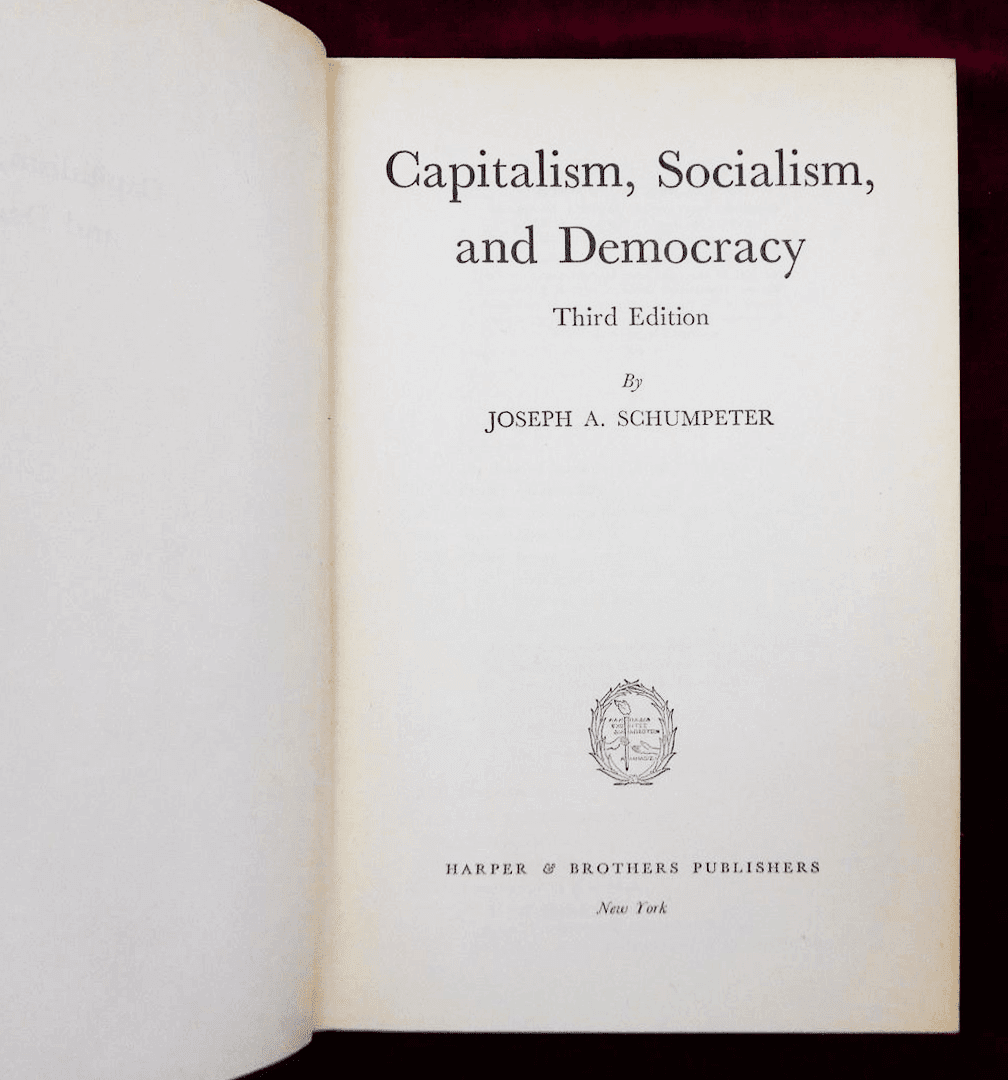
Capitalism, Socialism, and Democracy is a book on economics, sociology, and history by Joseph Schumpeter. It's one of the most famous, controversial, and important books on social theory, social sciences, and economics. Back in the 1920s, economist Joseph Schumpeter asked himself, 'Could socialism be an alternative? Should capitalism last forever? And is that even possible? In the quest for answers he came to a startling conclusion: by its very nature, capitalism is bound to destroy itself. In this book Schrumpeter gives his definition of democracy, his theory of creative destruction and his emphasis on entrepreneurship, much of his ideas have defined the economic theory of the twentieth century.

Joseph Alois Schumpeter (1883-1950) was an Austrian-trained economist, economic historian, and author. He is regarded as one of the 20th century's greatest intellectuals. Schumpeter is best known for his theories on business cycles and the development of capitalist economies, and for introducing the concept of entrepreneurship. For Schumpeter, the entrepreneur was the cornerstone of capitalism—the source of innovation, which is the vital force driving a capitalist economy.


Key Learnings

Capitalism is constantly evolving. It’s driven by a process of creative destruction, and that means that products, production methods, technologies, and markets restructure themselves incessantly. As capitalism progresses, these transformations increasingly threaten its very foundations, such as entrepreneurship and competition. At the same time, these changes can open up society and culture to socialist ideas. Capitalism will ultimately self-destruct and pave the way for socialism. Such socialism, given certain conditions, is in principle entirely operable – although running a democratic socialist society may present a challenge.


Karl Marx’s economic theories were prophetic – but they’re too stationary to account for modern capitalism.

In the social sciences, no figure looms larger than the German economist and philosopher Karl Marx. With his famous argument for an inevitable revolution, spearheaded by the working class, Marx became the great prophet of socialism. Indeed, for its proponents, Marxism is something like a religion. For better or for worse, they view absolutely everything through its lens. Why is that? Well, it’s in part because Marx’s ideas were indeed prophetic, or at least very much ahead of their time. For example, Marx was one of the first thinkers to suggest that what shapes our societies, actions, and attitudes is the economy. He was also among the first to recognise the cyclical nature of economic processes. He recognised that economic crises were inevitable and occurred at regular intervals. 

Schumpeter, recognised the prophetic qualities of Marx’s work – and he agreed that the great German thinker contributed greatly to the field of economics. But he maintained that there were quite a few problems with Marx’s conception of capitalism.

Marx argued that history is essentially all about a struggle between two – and only two – classes. On the one hand, there’s the working class, or proletariat. Its members sell their labor to the capitalists, or the bourgeoisie. These are the people who own the means of production. According to Marx, the capitalist system encourages business owners to make laborers work longer and longer hours, without necessarily paying them for it. Business owners therefore extract “surplus value” from the work of the proletariat. This is the foundation of profit – and over time, the proletariat loses out; the poor become even poorer. Enterprises, meanwhile, tend to become less and less profitable.

Schumpeter pointed to a few problems with Marx’s theory. 
  • First, it leaves no room for a third class of people essential to capitalism: entrepreneurs. Capitalism is driven by smart and energetic people who don’t necessarily belong to the bourgeoisie, but wish to ascend to it. With their ideas and innovations, entrepreneurs are constantly revolutionising the system from within. 
  • For Schumpeter, another issue is that Marxism is too stationary. It cannot explain the constantly evolving phenomenon that is modern capitalism.
  • Finally, Schumpeter sees no evidence that capitalism fuels oppression and poverty, as Marx held. In fact, capitalism has actually improved the lives of most people living under it.


Capitalism is responsible for great social and intellectual progress.

It would be foolish to diminish the progress that societies have made under capitalism. Indeed, in The Communist Manifesto, Marx himself praised capitalism’s many achievements. He argued that capitalism was a necessary historical stage, unavoidable before the triumph of socialism.

The most obvious form of progress that capitalism enables is, of course, economic. One way to measure this is to look at a country’s total production of all goods and services in a year. Let’s take the US, for instance. From the Industrial Revolution through to the 1940s – Schumpeter’s time – this total kept increasing, at an average of about 2 percent per year. With it, people’s average income also increased. And what’s more, contrary to Marx’s predictions, the income gap between the rich and the poor didn’t really widen – at least not until well into the twentieth century.

Capitalism’s economic progress made life better for many in myriad ways. As disposable incomes grew, for example, people began to spend more on personal goods and services that enriched their lives. And it wasn’t just that people started to earn more; their money actually went farther and farther. A car, for example, cost considerably less in proportional terms in the 1940s than it did in the 1900s. On top of this, products just kept getting better. That’s because companies weren’t just competing with each other on price – they also focused on quality and general standards. Think about something as simple as white stockings, for instance. In the nineteenth century, they were largely the preserve of royalty. By the 1940s, they were ubiquitous – even factory girls could afford them. 

Alongside all this progress, something else happened: capitalism, as such, became less costly. For example, practices like child labor and sixteen-hour workdays that defined the Industrial Revolution are generally gone. All in all, then, big business and even monopolistic practices have largely improved our lives. And capitalism didn’t just accelerate material progress. It also encouraged us to develop a certain economic rationality. The basic cost-profit calculation, which lies at the heart of capitalism, is now applied in such diverse fields as space exploration, medicine, beauty, and even justice. This “rationalization” of society gradually replaced the magic and mysticism of the old days. 

Finally, capitalism encourages hard work, innovation, and invention. This means that we have capitalism to thank for our high standard of living, our rational mindset, and our greatest inventions, such as refrigerators, airplanes, and even radio and television. 


Capitalism feeds on a process of creative destruction.

Capitalism itself is constantly progressing. Since it first developed, it has been expanding, accelerating, and transforming. And this is no accident. Indeed, this constant change is in the very nature of the capitalist system. For one, businesses and entrepreneurs are in constant competition with each other – or at least in constant fear of competition. This encourages them to restructure, invent, and innovate at an accelerating pace. You’re never safe at the top for long. Your business strategy may have worked yesterday, but it could easily fail tomorrow. 

And so every year we see the rise of new markets, new consumer goods, new methods of production. None of this innovation comes from nowhere: the novelty always destroys the old structures and grows right through them. Schumpeter popularised a new term, which he used to describe capitalism’s constant transformation from within. He called it the process of “creative destruction” – and, in his view, many economic theories, including Marxism, failed to take it into account.

For example, many economists seem to think that capitalism functions best in a state of “perfect competition.” This view is, of course, idealised, and it simply assumes that all companies in a market produce exactly the same product and compete only on price. Some economists say that big business practices have derailed the structure of perfect competition. But that view presupposes that such a state can exist in the first place. Schumpeter thought that such analyses were facile. He didn’t believe that the state of perfect competition ever existed. To him, competition was not based only on price – it also took into account product quality and advertising. And, above all, he viewed capitalism as a process. To him, the system was subject to constant innovation and destruction. So, then, you can’t really understand capitalism if you don’t take into account the process of creative destruction. And that means that capitalism has never really been static.


There’s nothing to prevent socialism from working.

For most of history, socialism has been considered the only viable alternative to capitalism. In a socialist society, the means of production are controlled by just one central authority, rather than by many private actors. Can this system work in the real world? Many economists have had their doubts.

In a commercial system like capitalism, the economy is controlled through constant competition. Companies, entrepreneurs, and bankers set prices, decide what to buy and sell, and hire and fire people. This means that, in theory at least, a capitalist market regulates itself. A socialist market is different. Instead of self-regulation, it relies on an external force – such as, for example, a political authority. One of its jobs could be to provide people with vouchers, each representing a citizen’s share of all goods produced in a country’s economy. In theory, this value is easy to set: you simply divide the total of all goods by the overall number of claimants.

Some economists, though, think that there’s a flaw in that plan. Here’s their question: Without price competition, how would you gauge the demand for a certain product? In capitalism, after all, prices have a really important role to play: they regulate supply and demand. But Schumpeter saw no problem with implementing a similar system under socialism. For example, the government could set up a pricing authority for each industry whose decisions would be based on customer demand. And as for consumers themselves, they could even receive different “incomes,” depending on how much they worked. Some of that may sound a lot like capitalism. But there’s a key difference here, and that’s the lack of competition. A socialist economy is not shaped by internal market forces. Instead, the way it works is all down to its central authority.

Logically, then, there’s no reason why socialism cannot work. Some economists acknowledge this, but they claim that there’s a difference between theory and reality. In practice, they say, socialism is simply inoperable. For one, a government could never have sufficient information to run a whole economy smoothly. But here’s Schumpeter’s counterargument: government’s decisions are no harder than those that businesses have to make under capitalism. Whatever the system, running it will always involve guesswork. For Schumpeter, the case is clear: of course socialism can work. But the questions is whether it’s compatible with democracy.


We need to update our definition of democracy to account for the realities of elections.

How well do socialism and democracy go together? Before we explore this, we need to ask ourselves what democracy is.

Is it some sort of ultimate good, as many people believe? Can it be an end, in and of itself, rather than a political method? Imagine a society that makes a democratic decision to reinstate witch hunts. Clearly, that would be appalling. So should we really consider democratic processes inherently good or bad? Often, democracy is simply defined as “rule by the people.” But as soon as we probe this formula, it begins to fall apart. First of all, most democracies don't involve all people – children and convicts, for example, are often barred from voting.

As well, in a democracy, people don't "rule" directly. Instead, they delegate their power to leaders who supposedly represent their interests. But here’s what often happens: as soon as these delegates get into office, they begin putting their own ambitions first.

The classical definition of democracy is a bit more complex. It says that democracy is a method of arriving at political decisions for the common good, by letting people elect their own leaders. But that presupposes that a common good is something that people can agree on rationally. And it also suggests that people can work out among themselves how to put decisions into practice. In our complex societies, that is clearly not the case. Even if we agreed that everyone deserves to be healthy, for example, people would still debate the benefits of vaccination.

In reality, we all have interests and values that are varied, irrational, and impulsive. Some of these values aren’t even our own – instead, they’ve been sold to us by advertisers or politicians. So, clearly, we need a new definition of democracy. How about this definition: Democracy is a way of making political decisions by letting individuals compete for people’s votes, in order to gain the power to implement those decisions. This definition may work better than the classical doctrine. For one thing, it makes room for the crucial element of democratic leadership – the fact that it’s politicians who rule countries, not voters themselves. Second, it makes clear that the role of the people isn’t to be the government, but to choose the government. And last, it leaves room for the fact that no democratic government can represent all people – just a majority of them. 


Socialism may be as compatible with democracy as capitalism – under certain conditions.

Throughout history, many socialists have said that theirs is the only path to “true democracy.” But some believe that it’s OK to use undemocratic methods – such as violence and terror – to create a socialist society.

There’s no direct relationship between socialism and democracy. They are neither mutually exclusive nor necessarily entwined. In Russia, for example, socialism was enforced by very undemocratic methods. But in Belgium, the Netherlands, and even England, socialist parties readily embraced democracy.

So what are the conditions under which a democracy can thrive? And is there anything that precludes socialism from creating them – especially after capitalism has laid the economic groundwork?

  • The first condition for the success of democracy is the availability of high-quality leaders. This means that the political sphere of a country should be accessible and appealing enough to attract the right kind of people – individuals who are smart, conscientious, and capable.
  • The second condition is that political decisions made democratically should stay within an appropriate range. The government should decide some things about public life, but not all of them. In fact, there’s no need to make all decisions democratically. For example, most countries appoint supreme courts outside the democratic process.
  • The third thing necessary for democracy is a well-functioning bureaucracy. It needs to be efficient enough to take care of all the mundane but important work that goes into democratic decision-making. 
  • And finally, a democracy only works smoothly if all people accept the way decisions are made, and are able to tolerate differences in opinion.
Schumpeter believed that democracy emerged as a by-product of capitalism’s rationalist ideology. But the four conditions for it can exist in either system – socialist or capitalist.

No system is perfect
, of course. For example, democratic decision-making can be inefficient in large and complex societies. In a socialist country, this may be an even bigger problem. After all, if you can’t make efficient decisions, how can a central body run an efficient economy? So it's possible for Socialism and democracy to coexist.


The key features of capitalism will ultimately lead to its self-destruction.

Let’s turn to the central question: Can capitalism survive?

Schumpeter answers this question with a resounding 'No'. He thinks that the very success of capitalism will be its undoing. It will create conditions for its own destruction and a socialist takeover. 

But how?

As we’ve already seen, capitalism uses the mechanism of creative destruction to push social and technological progress. But progress can only go so far. What happens if one day we find all human needs completely satisfied? What if we lose the motivation to keep pushing?

Under capitalism, progress is becoming increasingly automated and predictable. For example, capitalist progress diminishes the figure of the business owner. Instead, it hands over control to an impersonal structure of managers, executives, and stockholders. In such a world, where running a business becomes an abstraction, why even try? 

As the cost of living increases, and as businesses focus on small niches, not revolutionary innovation, there’s less and less incentive for true entrepreneurial leadership. Instead, there is growing demand simply for administration of already-existing processes. But this is something that socialism does just as well as capitalism.

Capitalist progress also erodes the mechanisms that used to protect the bourgeoisie. For example, it encourages a taste for anti-bourgeois ideas. The rationalist ideology of capitalism creates a critical frame of mind – and, in the end, it inevitably turns against itself. For evidence, just think of the many bourgeois intellectuals who now align themselves with the working class and are growing more and more hostile toward capitalism. 

And there’s another way in which capitalism destroys the very ground that nurtures it. The trend to rationalise everything has contributed to the decline of the traditional family unit. As this trend grows, more and more people will feel inclined to conduct a cost-benefit analysis of having children. As a result, they may well decide to remain child-free. If you don’t have children, you don’t really need long-term investments like property. And that gives you the incentive to earn, and save, less. That's no good for the constant economic growth that capitalism requires.

And so, just as capitalism raises our standard of living, gives us more leisure time, and makes us better educated, it also weakens our motivation. This is self-defeating and can destroy the very structures that underpin the capitalist system. Schumpeter believed that capitalism would, eventually, destroy itself and pave the way for socialism. But maybe that’s nothing to worry about – especially if we can figure out how to consolidate socialism with democratic values.


© Christine Calo 2021. Please do not reproduce without the expressed consent of Christine Calo. Powered by Blogger.