Showing posts with label Entrepreneurship. Show all posts


"The Personal MBA" by Josh Kaufman is a non-fiction book that aims to provide a comprehensive and practical overview of key business concepts and principles without the need for a traditional MBA (Master of Business Administration) degree. It offers a condensed and accessible approach to learning about various aspects of business.

Josh Kaufman is an independent business adviser and the author of two international bestsellers: The Personal MBA and The First 20 Hours: How to Learn Anything, Fast. His website JoshKaufman.net was listed as one of Forbes’ Top 100 Websites For Entrepreneurs.


Summary & Key Learnings

The book is structured into several sections that cover different areas of business, such as marketing, sales, finance, leadership, and more. Kaufman synthesises a wide range of business theories and practices into clear and understandable language, presenting them in a way that anyone can grasp, regardless of their prior business knowledge or educational background.

Throughout the book, Kaufman provides practical insights, actionable advice, and real-world examples to help readers understand and apply the concepts discussed. He emphasises the importance of gaining practical experience and taking action, encouraging readers to apply what they learn to their own ventures or professional endeavors.

"The Personal MBA" challenges the conventional belief that a formal business education is necessary to succeed in the business world. Kaufman argues that by focusing on key principles and developing a strong foundation of business knowledge, individuals can save time, money, and effort compared to pursuing a traditional MBA program.

Overall, the book serves as a comprehensive resource for individuals who want to gain a solid understanding of fundamental business concepts and acquire the skills necessary to excel in the world of business. It offers a practical alternative to a formal business education, providing readers with the tools to navigate the complexities of the business landscape.


Business school: Not only is it extremely expensive – chances are, it won’t pay off.

The book discusses the high cost of business school and questions whether it is worth the investment. It mentions that top MBA programs can charge up to $53,208 per year for tuition, not including additional fees, loan interest, and living expenses. Some business schools even exceed $300,000 in total cost. On average, MBA graduates have a debt of $41,687.

Despite the high cost, an MBA does not necessarily lead to long-term career success. Researchers from Stanford University and the University of Washington found no correlation between possessing an MBA and measures of success such as increased salary or higher-level positions. Kaufman suggests that learning from experience, conducting online research, and reading books can provide valuable knowledge and skills for a business career.


The perfect business idea balances money and passion.

Kaufman advises against starting a business solely for the purpose of making money and emphasises the importance of choosing a field that you enjoy and have knowledge about. The book mentions that even if a business eventually becomes self-sustaining, it requires a significant amount of work and investment to set up.

Starting a business in a field you like increases the likelihood of sticking with it and allows for better decision-making. Understanding the specific market you're entering enables you to make sound decisions, develop attractive products, and effectively compete. Passion for an idea should be balanced with practicality, as some ideas may not have promising business potential. Explore market entry strategies and the possibility of obtaining the necessary funding.


Leveraging your investments can be rewarding, but it’s also risky.

The book discusses the concept of leverage in investment and highlights its potential for amplifying profits or losses. Leverage refers to using borrowed money to increase profit potential. It explains how leveraging can lead to significant gains with minimal personal capital. For example, by borrowing money to make a big investment, such as purchasing properties, even a small initial capital can result in substantial returns if the investment appreciates.

However, there are risks associated with leverage. While borrowing more money may increase potential profits, it can also amplify losses. The example given shows how a decline in the value of the properties could result in significant losses, exceeding the initial capital invested. Leverage can be a powerful tool in investment, but it carries inherent risks. Investors must exercise caution and be mindful of the potential for amplified losses, as demonstrated by the financial crisis of 2008, which was partly caused by excessive leverage.


We’ve all got needs, and a product that satisfies them will sell.

In order for a product to sell, it must fulfill customers' needs, and the quality alone is not enough. It provides examples such as a vampire having no interest in a solarium and a desperate hiker being willing to pay anything for a bottle of water in the desert. Successful businesses meet one or more of their customers' needs.

Harvard professors Nitin Nohria and Paul Lawrence identified four common human needs or drives:
  1. The desire to acquire and collect things, including stamps, shares, and social status. Businesses such as retailers and investment brokerages cater to this need.
  2. The drive to bond with others and feel valued and loved. Dating services and companies that enhance desirability, such as perfumeries and beauty salons, fulfill this need.
  3. The need to learn and satisfy curiosity.
  4. The drive to defend ourselves, loved ones, and property. Security firms and companies selling alarms address this need.
Entrepreneurs are encouraged to consider which of these four drives their business idea can cater to in order to effectively meet customers' needs.


A great product deserves great marketing.

It's important to capture the customers' attention in today's age of social media and information overload. To stand out, businesses need to offer something remarkable and memorable. The medium through which the message is delivered to customers matters. Making the customer feel that the message is personalised and specifically tailored to them increases the likelihood of getting their attention.

Investing in high-quality and personalised ways of informing selected prospective clients, such as hand-addressed FedEx envelopes, can be more effective than spamming mass emails. Additionally, businesses should focus on highlighting the end result or benefit that customers can achieve by using their product. People don't buy products solely for the product itself but for the desired outcome. Testimonials from ordinary individuals who have achieved positive results with the product can be a powerful way to demonstrate the product's value and attract customers.


Even when clients are reluctant, there are ways to make a sale.

It's important to address the customers' fears and objections in the sales process. Understanding and overcoming customers' objections can increase sales.

Customers are often cautious and fear making a bad choice, leading to a major barrier to purchase. To mitigate this, sales experts take on the risk by offering guarantees or return policies, allowing customers to try out products and return them if they are not satisfied. This strategy helps build trust and encourages customers to make a purchase.

Identifying and addressing standard objections, such as concerns about price, product benefits, or timing, is crucial in persuading customers to say "yes" to a purchase. By providing persuasive arguments and countering their objections, salespersons can convince customers that their concerns are unfounded and that the product or service is the right choice for them.

Understanding customers' objections and effectively addressing them through tailored strategies can significantly improve sales outcomes.


To strike a great deal, it helps to prepare.

The book highlights the different stages of a negotiation and emphasises the importance of preparation. The key takeaway is that a successful negotiation involves more than just the final discussion at the conference table.

  1. The first stage of negotiation involves setting the stage and making early decisions that can optimise the outlook for the negotiation. This includes ensuring you are negotiating with the right person who has decision-making authority and creating a conducive environment by choosing the most effective setting for presenting your offer.
  2. Next, it is crucial to carefully consider the terms of your proposal and make them as attractive as possible to the other party. This may involve researching the industry or market to gather data that can inform your decision-making. Anticipating objections and developing an argumentative strategy to address them is also important, along with determining the concessions and compromises you are willing to make.
  3. The final stage of negotiation is the actual discussion, where the preparation done in the earlier stages pays off. By investing time and effort in the initial stages, you will be better prepared and positioned to navigate the negotiation successfully.
Overall, effective negotiation requires thoughtful preparation, consideration of the other party's perspective, and proactive decision-making at each stage of the process.


A good leader is a good communicator.

Effective communication in successfully implementing plans and fostering collaboration within an organisation is extremely important. Providing reasons for requests and sharing intentions can significantly increase compliance and support from others.

Kaufman emphasises that when asking someone to do something, it is essential to provide a reason for the request. A study by Harvard psychologist Ellen Langer showed that people were much more likely to comply when a reason was given. Communicating the why behind a task or goal helps others understand the purpose and align their efforts accordingly.

Furthermore, sharing intentions allows everyone to work in ways that support the plan and adapt when circumstances change. By providing a broader context and larger goal, individuals can make informed decisions and take appropriate actions without constant micromanagement.

Kaufman emphasises the importance of respectful communication. Dismissing or putting others down hinders effective communication and collaboration. It is essential to engage in constructive dialogue, exchanging ideas, and creating an environment where everyone feels valued and comfortable contributing.

In summary, effective communication involves providing reasons for requests, sharing intentions, and promoting respectful and open dialogue. By incorporating these practices, organisations can enhance cooperation, understanding, and the overall success of their plans.


Use your day more effectively by listening to your body.

Setting limits and understanding your natural energy fluctuations to maximize productivity is important. Being too busy and taking on multiple tasks simultaneously can lead to reduced performance and increased stress.

Kaufman compares productivity to juggling, explaining that trying to handle too many tasks at once can result in dropping the metaphorical "balls." Each task brings unexpected demands that require additional time and effort, which can become overwhelming if not accounted for in your schedule.

To optimise productivity, it is crucial to pay attention to your energy levels and work with your natural rhythm. People have different energy fluctuations throughout the day, with mornings generally being a more productive time for many individuals. Additionally, energy tends to cycle in 90-minute intervals, with peaks and troughs within that timeframe.

By being aware of these natural fluctuations, you can capitalize on the periods of high energy and focus on important tasks during those times. Conversely, recognising when your energy is low allows you to take necessary breaks and recharge, preventing burnout and maintaining overall productivity.

In summary, setting limits, understanding your energy fluctuations, and aligning your tasks with your peak productivity periods can help you work more efficiently and maintain a healthy work-life balance.

If you want a thriving business, your product should cater to the core needs of your customers. By communicating confidently and cleverly, you can convince your clients to buy, your employees to cooperate and your business partners to sign your deal.


Actions speak louder than words.

The next time you have to hire a new employee, don’t go for the applicants who performed best in an interview. Instead, do some extra research and find out how an applicant has performed in past months or years. Past performance is the best predictor of future performance.


'How Innovation Works' by Matt Ridley, offers a systematic examination of this incredibly important but poorly understood phenomenon. What is innovation? According to Ridley, it is much more than invention (something often mistaken for innovation). Invention is the act of discovering an idea; it is merely a beginning, an inception point. Innovation is much more, it is when the invention is taken into the world and made practical. Innovation is the creative reconfiguration of multiple inventions and ideas into something new. Innovation is the act of fully exploring the consequences of that new thing and disseminating and integrating it into society and general use. 

Matt Ridley argues that we need to see innovation as an incremental, bottom-up, fortuitous process that happens as a direct result of the human habit of exchange, rather than an orderly, top-down process developing according to a plan. Innovation is crucially different from invention, because it is the turning of inventions into things of practical and affordable use to people. It speeds up in some sectors and slows down in others. It is always a collective, collaborative phenomenon, involving trial and error, not a matter of lonely genius. It still cannot be modelled properly by economists, but it can easily be discouraged by politicians. Far from there being too much innovation, we may be on the brink of an innovation famine.

Matt Ridley, 5th Viscount Ridley, is a British science writer, journalist and businessman. He is best known for his writings on science, the environment, and economics.


Key learnings

Innovation isn’t an instantaneous creative act practiced by lone geniuses. It’s actually a long, messy, and complicated process. Innovation occurs when chance encounters and serendipitous insights are shared, remixed, and built upon by countless individuals. New inventions are slowly and incrementally improved over time as people find practical uses for novel ideas. If we want more innovation in the future, we need to foster the open exchange of knowledge and take big risks as individuals, organizations, and nations.


Innovation is a complex, messy, and collective process

The Industrial Revolution – the giant leap in productivity that kicked off the modern era – began when humans first harnessed the power of steam to automate work. To do this, they used a new machine called the atmospheric steam engine. So, who do we thank for this astounding achievement? A man named Denis Papin. Or, wait, maybe we should thank Thomas Savery. Or, hold on, maybe a fellow called Thomas Newcomen deserves our praise? The truth is, all three men deserve some credit, but none of them can claim all of it. That’s because, around 1700, Papin, Savery, and Newcomen all produced their own working models of the atmospheric engine. To this day, it’s unclear who was truly first or how much each inventor influenced the others.

We often associate a new invention with a single creator. However, that’s an oversimplification of how innovation operates. Even the most creative people don’t work in a vacuum. They’re always influenced by the tools, technologies, ideas, and social structures that surround them. This often means multiple forces contribute to an innovation, even when one person takes the credit. Let’s consider the case of the atmospheric steam engine. This relatively simple device heats and cools water in a metal cylinder. The changing pressure caused by steam creates movement that can be used for work, like pumping water out of mines. Could Papin, Savery, or Newcomen have invented this completely on their own? Not really. The basic ideas behind the device were already hot topics of discussion in scientific circles at the time. Papin and Savery, both educated men, refined their thinking by exchanging letters and papers with other inventors. Moreover, Newcomen, who built the most successful version of the engine, relied on previous advances in blacksmithing technology to complete his machine. Thus, each man’s invention was also a product of their backgrounds and influences.

This principle applies to all innovation. While Thomas Edison gets credit for inventing the light bulb in 1879, the truth is, more than 20 other creators patented similar contraptions in earlier decades. All these thinkers were responding to ideas and technologies circulating at the time. Of course, some of these attempts were better than others, but none of these innovations happened in complete isolation.


Medical innovations offer high risks and even higher rewards

While the atmospheric steam engine kicked off the Industrial Revolution, medicine evolved with its own innovative procedures, like the following: Step one: Find someone recovering from smallpox. Carefully scrape some pus off one of the many open lesions caused by the disease. Step two: Using a knife or needle, cut an open wound into your own skin. Not too deep, but deep enough to draw blood. Step three: Rub the infected pus into your wound.

This technique is called engraftment. In most cases, it’ll make you immune to smallpox. If it seems gross and dangerous now, just imagine how it appeared to a European in the 1700s. They didn’t have a scientific understanding of why it worked, yet it did work. So, as the century progressed, the practice caught on. It saved countless lives and eventually led to the discovery of modern-day vaccines.

An interesting fact about innovation is that the biggest revelations don’t always come from deliberate discovery or sound scientific theory. Instead, they develop piecemeal over time through random chance, as well as trial and error, as people look for practical solutions to their problems. In the medical field, this is a particularly risky process, but it has resulted in many life-saving practices.

Consider Jersey City’s water supply. In 1908, rapid industrial development tainted the city’s water with unsanitary runoff. The result was serious outbreaks of cholera and other diseases. In a rush to fix the problem, Dr. John Leal added chloride of lime, a disinfectant, to the water. At the time, adding chemicals to drinking water was considered repulsive. Local citizens were outraged. But Leal had heard rumors of it working in European cities, so he tried it anyway. Within months, the experiment paid off, and disease rates plummeted. Soon, communities all around the country were following Jersey City’s example.

Are such open-ended experiments occurring today? Of course. Take the example of electronic cigarettes, also known as vaping. For many, picking up a vaping habit is the first step toward quitting smoking. Since tobacco use is a major cause of death, this could save many lives. Yet, we don’t fully know the health effects of vaping, so their use remains controversial. In some countries, like the United Kingdom, government agencies encourage their use. In contrast, other countries, like Australia, have banned it. Which country takes the right stance on this innovation? That remains to be seen.


Travel innovation is all about incremental improvements

The Salamanca, the Puffing Billy, the Sans Pareil. These names sound silly now, but in the early 1800s, each represented a small step toward improving the way we move. You see, at the dawn of the nineteenth century, the horse was the king of transportation. However, inventors believed a machine, the steam-powered locomotive, could take its place. The tricky part was figuring out how to build one. So, engineers tried a great deal of different designs, giving each new prototype a bold new name. Not every device succeeded, but some made subsequent improvements in speed, safety, or reliability. By 1829, the Rocket, a locomotive built by Robert Stephenson, was capable of transporting 13 tons of cargo at 30 miles an hour – and the world was on its way to a railway boom.

Throughout history, humans have always looked for faster, more reliable ways to travel. However, no new mode of transportation ever emerged in a completely perfect form. For example, the sleek, efficient machines that carry us around today are the result of countless individuals making innumerable small design improvements over time.

Look at the evolution of today’s automobiles. Most rely on the internal-combustion engine for power. Isaac de Rivaz, a Franco-Swiss artillery officer, built this machine’s earliest ancestor back in 1807. It ran on hydrogen and oxygen and was loud, clunky, and prone to explosions. In 1860, a Pennsylvanian man named Jean Joseph Lenoir updated the design to run on petroleum. This was a step-up, but the device was still very inefficient.

Next, in 1876, Nikolau Otto, a grocery salesman, refined the machine by adding a four-step cycle of compression and ignition. Dubbed the four-stroke engine, this model allowed for smoother operation. This design was adopted by the German inventor Karl Benz. In 1894, he amped up the engine’s power and used it to drive a three-wheeled machine called the Motorwagen.

While the Motorwagen was a hit with the rich, it remained a novelty. It took another inventor, Henry Ford, to bring the automobile to the masses. In 1909, his assembly-line manufacturing process made the Model T car affordable to more people. Soon, cars were one of the most popular forms of transportation around. It took decades of slow, steady improvement, but the engine had finally conquered the horse.


Some innovations aren’t solid things but simply good ideas

The humble potato is the basis for so many popular snacks and dishes we love today, but this wasn’t always the case. At least, it wasn’t in Europe. That took some innovation. First cultivated more than 8,000 years ago in the Andes Mountains of South America, the potato didn’t arrive in the Old World until the mid-1500s. However, for decades, Europeans regarded potatoes with suspicion. The church in England banned them. People in France believed they caused leprosy. Still, slowly, people learned to love this robust, nutrient-rich crop. The idea of eating potatoes first caught on in Belgium. Then the idea spread throughout the entire continent. By the 1800s, most European countries had made the potato a new staple of their cuisine.

Often, the concept of innovation gets reduced to invention. That is, we think of innovation as the process of making new tangible items like labor-saving machines or electronic gizmos. However, some of the most influential innovations of all time aren’t objects at all. Instead, they’re ideas that open up new ways to approach the world or solve problems.

One intangible innovation you use every day is the Arabic numeric system, more commonly known as numbers.
Yes, even the idea of using 1s, 2s, and 3s was once revolutionary. This counting system was first developed by Indian scholars around 500 AD. It was then adopted by Arab traders in the ninth century, and finally found a foothold in Europe in the 1200s thanks to an Italian author known as Fibonacci. Fibonacci advocated for using Arabic numerals because they were more practical than the Roman numerals popular at the time. Their key advantage was their positional system. While the Roman numeral V always means five, the Arabic five changes value based on its position in a sequence. So, a five followed by a zero means 50, a value ten times greater.

This seems like a small change, but it opens a whole new world for mathematics. With Arabic numbers, it’s possible to do more advanced calculations like multiplication, division, and algebra. It’s also much easier to keep financial records and do accounting. Adopting the idea of Arabic numbers was an innovation essential to launching Europe into a new age of trade, commerce, and scientific discovery.


Our desire to communicate drives rapid innovation

Baltimore, Maryland, 1843. The Whig Party holds a convention and nominates Henry Clay for president. It’s big news, and usually, it would take a train more than an hour to deliver the results to Washington, DC. But, this year, the message arrives in seconds. How? Thanks to the telegraph, a brand-new invention installed by Samuel Morse. It transmits information by sending electrical signals through a suspended wire. It’s the first practical innovation in the emerging field of electrified communication technology. The telephone arrives a few years later, in 1876. The wireless radio soon follows in the 1890s.

By the turn of the century, distant people are more connected than ever before. However, this is just the beginning. Over the following decades, innovations in communication and information technology will revolutionize the world. Before Morse tapped out the first dots and dashes through a telegraph, communication was either conducted face-to-face or through physical objects like letters and books. Ideas spread more slowly, and accessing information depended on which printed materials you could actually get your hands on. However, the advent of electronic communication like the telegraph, telephone, and eventually computers changed everything – and fast.

It’s hard to overstate how quickly new communication technology was adopted. The first telegraph line was completed in 1844. By 1855, there were 42,000 miles of lines in the United States alone. By the end of the 1870s, telegraph cables stretched across the Atlantic and Pacific oceans. Broadcast radio has a similar trajectory. It began with a single station in 1900 and grew to be the dominant form of public communication by the 1930s.

Computers also became an essential part of daily life at an astounding rate. This is partially due to how quickly computer technology improved and miniaturized. A computer’s processing ability is determined by how many transistors it has. Incremental improvements make transistors smaller and easier to produce, steadily allowing for more transistors to be housed in less space. This phenomenon is sometimes called Moore’s Law. So, in 1975, the average computer chip had 65,000 transistors. Today, that number is in the billions, and they’re much cheaper.

With the internet now connecting all the world’s computers, sharing information is easier than ever. This innovation has changed the political landscape by giving a huge amount of power to those who control communication technology. Now, the world’s most influential companies are search engines like Google and social media empires like Facebook.


Innovation relies on chance, collaboration, and recombination

The non-stick pans in your kitchen, the Gore-Tex coats worn in extreme environments, the fluorine gas chambers in the first atomic bombs. What do these all have in common? They’re all innovations based on polytetrafluoroethylene or PTFE. PTFE was first synthesized in 1938 – by accident. A scientist researching refrigerants stored tetrafluoroethylene gas at sub-zero temperatures. The chemical solidified into a hard substance that was unusually stable and heat-resistant. It didn’t work as a refrigerant, but other scientists found that in other contexts, it could be used for so much more. This story of PTFE is useful because it demonstrates the complex way innovation actually works.

Every story of innovation is different, but if you look closely, you’ll see they often follow a similar pattern. Many of the greatest innovations begin with a bit of serendipity. Someone has a lucky break, an unusual insight, or random occurrence. Then, others pick up on the discovery and apply it to new situations. Through trial and error, they apply the new idea or invention in different contexts until they find a practical use.

Consider the modern practice of using DNA as forensic evidence in criminal cases. No one set out specifically to create this innovation. Instead, it began in 1977, when Alec Jeffreys, a scientist at Leicester University, tried to develop a method using DNA to diagnose diseases. While collecting samples, he saw that DNA was a lot like fingerprints – that is, everyone’s genetic code was different. A chance discovery.

Meanwhile, the local police were struggling to solve a grisly murder. They wondered if Jeffery’s discovery could help solve the mystery. So, the scientist and the police worked together. They began collecting and analyzing more than 5,000 genetic samples from local suspects. They then compared them to DNA found at the crime scene. Eventually, they found a match. Case closed.

Because so much innovation follows this same pattern, it’s possible to identify conditions where it’s more likely to happen. Innovation thrives when people can cross paths, mingle, and exchange ideas. That’s why, throughout history, universities, trading hubs, and major cities have consistently produced novel innovations. By bringing different people with different expertise, perspectives, and cultures together in one place, these contexts foster the type of interactions that push innovation forward.


Innovation doesn’t always come from the top down

In 1924, the British government wanted to build a civilian airship capable of traveling across oceans. This raised the question: should the task be handled by the government or by private industry? They decided to try both approaches. Parliament contracted a government lab and a private firm, Vickers, to build two ships. How did this experiment play out? Well, by 1930, Vickers had designed the R100, a light, fast, and efficient aircraft. It traveled to Canada and back with no problems. Meanwhile, the government lab built the R101, a heavier, more costly ship. On its maiden voyage to Karachi, Pakistan, it only made it to France before crashing, killing 48 passengers.

These two very different outcomes illustrate an important point. When it comes to innovation, direct government oversight and control isn't always the answer. There’s a popular notion that innovation requires guidance and funding directly from the state. This argument posits that private industry, in a constant quest for easy profits, will avoid the costly research and development necessary to create truly new ideas. Instead, firms will hoard their patents and simply rehash old products. But is this true? Not exactly. While it’s true that government-directed research makes great discoveries, it often takes the ingenuity of private enterprise to turn them into practical innovations. Consider the internet. The basic components of computer networking were created by the Defense Advanced Research Project Agency, an American government lab. However, the world wide web didn’t take off as a household necessity until private firms like Cisco began to experiment with the technology in the 1980s and 1990s.

This dynamic occurs because big government projects often aren’t sensitive to the needs or desires of everyday people. Additionally, they can be slow to adopt new, outside-the-box ideas. However, big companies can also suffer this tendency. That’s why even giant firms are sometimes usurped by plucky start-ups.

Remember Kodak? This company was once the undisputed master of the photography industry. Film cameras were their flagship product. So, in 1975, when one of their scientists built an early version of a digital camera, his innovation was ignored. The higher-ups just didn’t see the potential in his bulky, electronic gizmo. Yet, smaller companies did. And they developed their own products, which took over the market. Thus, Kodak missed the digital photography revolution and filed for bankruptcy in 2012.


Innovation will always face resistance

Take a stroll through your grocery store’s dairy aisle. Here, you’ll see a wide selection of both butters and margarines sitting side-by-side in perfect harmony. The choice of spread is up to you. This wasn’t always the case. When margarine was first invented in 1869, it caused an uproar. The oily spread was both cheaper and more stable than butter. The dairy industry, fearing the competition, launched a vicious campaign against it. The National Dairy Council even faked studies showing it was dangerous. By the 1940s, two-thirds of American states had banned this innocuous staple.

Of course, the fervor eventually subsided, and margarine became an accepted foodstuff. Yet, this butter battle shows that even harmless new creations can stoke controversy. When a truly novel idea or invention arrives on the scene, it will often be rejected. This is because everyday people often fear change. Also, established industries don’t want to risk losing their supremacy. This is why horse breeders fought against tractors, ice-harvesters tried to stifle refrigeration technology, and some musicians initially wanted to ban radio stations from playing recorded music.

One way interest groups try to slow innovation is by sowing fears about safety and security. Consider the case of genetically modified organisms or GMOs. GMOs, such as vitamin-A-enriched golden rice, have the potential to bring cheaper nutrition to people all over the world. Yet, groups ideologically opposed to genetic modification, like Greenpeace, lobby hard against their production, citing sometimes flimsy evidence that these foods are dangerous.

Another way innovation is held back is through the overly aggressive application of intellectual property laws. When applied correctly, these laws, such as copyrights and patents, incentivize innovation by giving creators exclusive use of their ideas for a short time. This allows the original innovators to profit.

Yet, as we know, innovation requires sharing ideas and building on the work of others. Unfortunately, copyrights have been steadily extended, making this process more difficult. In the United States, a copyright used to last 14 years. In 1976, it was extended to last the life of the author plus 50 years. In 1998, 50 was extended again to 70 years. These laws no longer benefit the original creator post-mortem, but they do keep good ideas locked away from potential new uses.


Innovation is lacking in the West but booming elsewhere

In much of the world, the past few centuries have been filled with astounding leaps in innovation. In mere generations, Western countries have gone from largely agrarian economies to electrified, industrialized powerhouses. Even now, every day seems to bring novel developments in sectors like communications and computer technology.

Yet, alongside these changes, other sectors are strangely stagnant. In the realm of transportation, not much has changed. In 1958, the average commercial aircraft traveled at 600 miles per hour. Today, they move at roughly the same rate. There have been upgrades around the margins to aspects like fuel efficiency, but the fundamentals are untouched.

The business world, too, is less dynamic. In the United States, new businesses made up 12 percent of the economy in 1980. In 2010, they only accounted for 8 percent. Across the Atlantic, things are even staler. Looking at Europe’s 100 most valuable businesses, only two of them are younger than 40 years old. Most industries seem more focused on protecting current profits than bold new ideas.

So, where is innovation occurring? Mostly in rising nations like China. For the past few decades, this country has poured resources and manpower into urbanization and new technologies. Now Chinese firms like Tencent and Alibaba are at the forefront of growth industries like social media and financial services. Moreover, Chinese universities are making huge strides in fields like gene editing and artificial intelligence.

Can the Western world keep up? Maybe. It would require a renewed spirit of innovation. Companies will need to take more risks, workers will need to put in more hours, and governments will need to foster the free and open exchange of ideas that fueled past booms. All that, plus a little luck, will put innovation back on the agenda.


Image - Bright spark: detail of an 1879 illustration depicting Thomas Edison's lightbulb 
CREDIT: Getty Images


This is a practical guide that contains a library of hands-on techniques for rapidly testing new business ideas. 'Testing Business Ideas' explains how to use experimentation to transform your bright idea into a profitable business venture. It will help you to save precious time and money by testing how feasible, desirable, and viable your plans are. It will help you to dramatically reduce the risk and increase the likelihood of success for any new business venture. This book shows leaders how to encourage an experimentation mindset within their organisation and make experimentation a continuous, repeatable process.

This is written by David Bland and Alex Osterwalder. David J. Bland is an author and founder based in Silicon Valley who helps companies find growth using “Lean Startup” methods, design thinking, and business model innovation. Alex Osterwalder is a lead author of the international bestsellers Business Model Generation and Value Proposition Design; #7 on the “Thinkers 50” list; passionate entrepreneur; and in-demand speaker.


Key Learnings

In the world of business, a good idea isn't enough. Instead, you'll need lots of good ideas. Then, you can carefully select the most promising concept to take forward. Once you've decided on a direction, it's time to test your chosen ideas and concepts by using reliable, cost-effective experiments. This is the best way of finding out whether your idea works in practice as well as in theory. It's important to know your hypotheses. When you formulate a hypothesis, it's useful to know what kind of questions you're asking. There are three different types of hypotheses that broadly address three questions. Feasibility hypotheses concern questions surrounding whether it is possible for you to get a venture up and running with the resources and constraints you have. Viability hypotheses will answer questions about the profitability of your idea. Finally, desirability hypotheses will address questions around whether your target audience actually wants your product or service.


Table of Contents

Design
  • Design the team (p. 3)
  • Shape the idea (p. 15)
Test
  • Hypothesize (p. 27)
  • Experiment (p. 41)
  • Learn (p. 49)
  • Decide (p. 59)
  • Manage (p. 65)
Experiments
  • Select an Experiment (p. 91)
  • Discovery (p. 101)
  • Validation (p. 231)
Mindset
  • Avoid Experiment Pitfalls (p. 313)
  • Lead Through Experimentation (p. 317)
  • Organize for Experiments (p.323)


Design

Design the team - The best teams are diverse, open-minded, and entrepreneurial

If you're going to test your business ideas, you'll need a great team in place. Creating a great team starts with great design, and the best entrepreneurs proactively design their teams. They think carefully about bringing together people who have cross-functional skill set that encompasses all or most of the competencies that a fledgling business needs.

Cross-Functional Skillset
A cross-functional team has all core abilities needed to ship the product and learn from customers. A common basic example of a cross-functional team consists of design, product and engineering.

Commonly Required Skills to Test Business Ideas
  • Design
  • Product
  • Tech
  • Legal
  • Data
  • Sales
  • Marketing
  • Research
  • Finance

Entrepreneurial Experience
It's not a coincidence that successful businesses benefit from those who already have entrepreneurial experience.

Diversity
The best teams tend to be diverse. They are filled with people from a range of backgrounds - of different genders, ethnicities, ages, and careers. Diversity is so important because a successful business has an impact on people's lives and on society as a whole - and society is made up of people from all walks of life. If the business team doesn't reflect this reality, then their decision-making and their testing will contain inherent biases.


Team Behaviour

Team behavior can be unpacked into six categories that are leading indicators of team success.

Successful Teams Exhibit Six Behaviours
  1. Data Influenced - You don't have to be data driven, but you need to be data influenced. Teams no longer have the luxury of burning down a product backlog of features. The insights generated from data shape the backlog and strategy.
  2. Experiment Driven - Teams are willing to be wrong and experiment. 
  3. Customer Centric - To create new businesses today, teams have to know "the why" behind the work. This begins with being constantly connected to the customer. 
  4. Entrepreneurial - Move fast and validate things. Teams have a sense of urgency and create momentum toward a viable outcome. This includes creative problem-solving at speed.
  5. Iterative Approach - Teams aim for a desired result by means of a repeated cycle of operations. The iterative approach assumes you may not know the solution, so you iterate through different tactics to achieve the outcome.
  6. Question Assumptions - Teams have to be willing to challenge the status quo and business as usual. They aren't afraid to test out a disruptive business model that will lead to big results, as compared to always playing it safe. 


Team Environment

Teams needs a supportive environment to explore new business opportunities. They cannot be held to a standard where failure is not an option. Failure will occur and the goal is to learn faster than the competition and put that learning into action. Leaders need to intentionally design an environment where this can occur. 

The Team Needs to be:
  • Dedicated - teams need an environment in which they can be dedicated to work. Multi-tasking across several projects will silently kill any progress and preferably a small team.
  • Funded - It's unrealistic to expect these teams to function without a budget or funding. Experiments cost money. Incrementally fund the teams using a venture-capital style approach, based on the learnings they share during stakeholder reviews.
  • Autonomous - Teams need to be given space to own the work. Do not micromanage them to the extent where it slows down their progress. Instead, give them space to give on accounting of how they are making progress towards the goal. 

The Company Needs to Provide:
Support
  • Leadership - Teams need an environment that has the right type of leadership. support. A facilitative leadership style is ideal here because you do not know the solution. Lead with questions, not answers, and be mindful that the bottleneck is always at the top of the bottle.
  • Coaching - Teams need coaching, especially if this is their first journey together. Coaches, either internal or external, can help guide the teams when they are stuck trying to find the next experiment to run. Teams that have only used interviews and surveys can benefit from coaches who've seen a wide range of experiments.

Access
  • Customers - Teams need access to customers. The trend over the years has been to isolate teams from the customer, but in order to solve customer problems, this can no longer be the case. If teams keep getting pushback on customer access, they'll eventually just guess and build it anyway.
  • Resources - Teams need access to resources in order to be successful. Constraints are good, but starving a team will not yield results. They need enough resources to make progress and generate evidence. Resources can be physical or digital in nature, depending on the new business idea.

Direction
  • Strategy - Teams need a direction and strategy, or it'll be very difficult to make informed pivot, persevere, or kill decisions on the new business idea. Without a clear coherent strategy, you'll mistake being busy with making progress,
  • Guidance - Teams need constraints to focus their experimentation. Whether it's an adjacent market or creating a new one, to unlock new revenue teams need direction on where they will play. 
  • KPIs - Teams need key performance indicators (KPIs) to help everyone understand whether they are making progress toward a goal. Without signposts along the way, it may be challenging to know if you should invest in the new business.


Team Alignment

Teams often lack a shared goal, context, and language when being formed. This can be devastating later on, if not resolved during the team formation and kickoff. The 'Team Alignment Map', created by Stefano Mastrogiacomo, is a visual tool that allows participants to prepare for action: hold more productive meetings and structure the content of their conversations. It can help teams have more productive kickoffs, with better engagement and increased business success. 


Shape the Idea


Business Design

In the design loop you shape and reshape your business idea to turn it into the best possible value proposition and business model. Your first iterations are based on your intuition and starting point (product idea, technology, market opportunity, etc.). Subsequent iterations are based on evidence and insights from the testing loop. 

The design loop has 3 steps:
  1. Ideate - You try to come up with as many alternative ways as possible to use your initial intuition or insights from testing your idea into a strong business. Don't fall in love with your first ideas.
  2. Business Prototype - Narrow down the alternatives from ideation with business prototypes. When you start out, use rough prototypes. Subsequently, use the Value Proposition Canvas and Business Model Canvas to make your ideas clear and tangible. 
  3. Assess - In the last step of the design loop you assess the design of your business prototypes. Ask questions like "Is this the best way to address our customer's jobs, pains, and gains?" or "Is this the best way to monetise our idea?" or Does this best take into account what we have learned from testing?" Once you are satisfied with the design of your business prototypes you start testing in the field or go back to testing, if you are working on subsequent iterations. 
 

The Business Model Canvas

Use the Business Model Canvas to shape ideas into a business model so you can define, test, and manage risk. I helps define the Desirability, Feasibility, and Viability of an idea. 


Customer Segments
Describe the different groups of people of organisations you aim to reach and serve.

Value Propositions
Describe the bundle of products and services that create value for a specific customer segment.

Channels
Describe how a company communicates with and reaches its customer segments to deliver a value proposition.

Customer Relationships
Describe the types of relationships a company establishes with specific customer segments.

Revenue Streams
Describe the cash a company generates from each customer segment.

Key Resources
Describe the most important assets required to make a business model work.

Key Activities
Describe the most important things a company must do to make its business model work. 

Key Partners
Describe the network of suppliers and partners that make the business model work. 

Cost Structure
Describe all costs incurred to operate a business model.


The Value Proposition Canvas

Much like the Business Model Canvas, the same goes for the Value Proposition Canvas. This is another tool to help understand the customer and how your products and services create value. 


Value Map (Left side of the map)
Describes the features of a specific value proposition in your business model in a structured and detailed way.
  • Products and Services - List the products and services your value proposition is built around.
  • Gain Creators - Describe how your products and services create customer gains.
  • Pain Relievers - Describe how your products and services alleviate customer pains.

Customer Profile (Right side of the map)
Describes a specific customer segment in your business in a structured and detailed way.
  • Customer Jobs - Describe what customers are trying to get done in their work and in their lives.
  • Gains - Describe the outcomes customers want to achieve or the concrete benefits they are seeking.
  • Pains - Describe the bad outcomes, risk, and obstacles related to customer jobs.


Test

Hypothesise 

  1. Identify the Hypotheses Underlying Your Idea - To test a business idea you first have to make explicit all the risks that your idea won't work. You need to turn the assumptions underlying your idea into clear hypotheses that you can test. 
  2. Prioritise Most Important Hypotheses - To identify the most important hypotheses to test first, you need to ask 2 questions. First, "What is the most important hypothesis that needs to be true for my idea to work?" Second, "For which hypotheses do I lack concrete evidence from the field?"

Business hypothesis is defined as:
  • An assumption that your value proposition, business model, or strategy builds on.
  • What you need to learn about to understand if your business idea might work.

Creating a good hypothesis
When creating hypotheses you believe to be true for your business idea, begin by writing the phrase "We believe that..."

e.g. "We believe that millennial parents will subscribe to monthly educational science projects for their kids."

Be mindful that if you create all of your hypotheses in the "We believe that..." format, you can fall into a confirmation bias trap. You'll be constantly trying to prove what you believe, instead of trying to refute it. In order to prevent this from occurring create a few hypotheses that try to disprove your assumptions.  

e.g. "We believe that millennial parents won't subscribe to monthly educational science projects for their kids."

You can even test these competing hypotheses at the same time. This is especially helpful when team members cannot agree on which hypothesis to test. 

Characteristics of a good hypothesis
A well-formed business hypothesis describes a testable, precise, and discrete thing you want to investigate.
  • Testable - when it can be shown true (validated) or false (invalidated), based on evidence (and guided by experience).
  • Precise - when you know what success looks like. Ideally, it describes the precise what, who, and when of your assumptions.
  • Discrete - when it describes only one distinct, testable, and precise thing you want to investigate.


Types of Hypotheses
  • Desirable - "Do they want this?" The risk is that the market a business is targeting is too small; that too few customers want the value proposition, or that the company can't reach, acquire, and retain targeted customers.
  • Feasible - "Can we do this?" The risk is that a business can't manage, scale, or get access to key resources (technology, IP, brand, etc.), key activities or key partners.
  • Viable - "Should we do this?" The risk that a business revenue cannot generate more revenue than costs (revenue stream and cost structure).
Both the Value Proposition Canvas and the Business Model Canvas help identify the desirable, feasible and viable hypotheses.


To be continued...


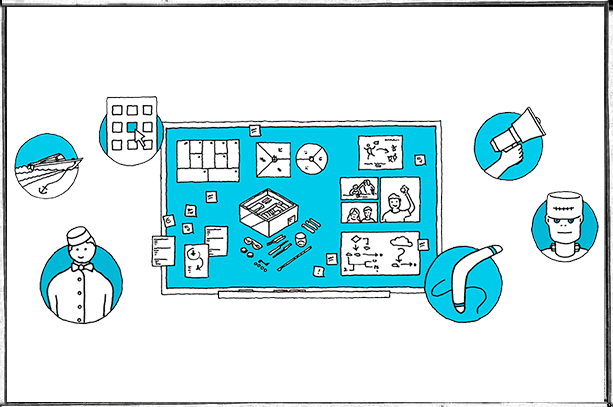
Image source: Strategyzer Testing Business Ideas 


In 'The Serendipity Mindset - The Art and Science of Creating Good Luck', Christian Busch explains that serendipity isn’t about luck in the sense of simple randomness. It’s about seeing links that others don’t, combining these observations in unexpected and strategic ways, and learning how to detect the moments when apparently random or unconnected ideas merge to form new opportunities. Busch explores serendipity from a rational and scientific perspective and argues that there are identifiable approaches we can use to foster the conditions to let serendipity grow.

Drawing from biology, chemistry, management, and information systems, and using examples of people from all walks of life, Busch illustrates how serendipity works and explains how we can train our own serendipity muscle and use it to turn the unexpected into opportunity. Once we understand serendipity, Busch says, we become curators of it, and luck becomes something that no longer just happens to us—it becomes a force that we can grasp, shape, and hone. Full of exciting ideas and strategies, The Serendipity Mindset offers a clear blueprint for how we can cultivate serendipity to increase innovation, influence, and opportunity in every aspect of our lives.

Dr Christian Busch, is an internationally known expert in the areas of innovation and entrepreneurship. He is the Director of the Global Economy Program at New York University’s Center for Global Affairs, and also teaches at the London School of Economics. A cofounder of Leaders on Purpose and the Sandbox Network – and former co-director of the LSE’s Innovation Lab – he has worked with senior executives around the world.


Key Learnings

Optimism. Open-mindedness. Curiosity. Perseverance. Adaptability. These are some of the core qualities of the serendipity mindset. With this mindset, you can seek out and embrace the unexpected and use these unusual moments to make new and exciting connections. When you begin to see the world with this frame of mind, you’ll begin to see that each and every day is filled with the unexpected, and chances to spark new serendipitous ideas and innovations. This holds true for businesses as well. With a few changes to culture and environment, you can begin to set the stage for more innovation and fortuitous events to transpire.


There are several kinds of serendipity, but they're all different than "blind" luck of the draw - they're about creating "smart luck"

What is serendipity? The word itself dates back to 1754 when British writer Horace Walpole used it to describe a kind of discovery that was made unexpectedly, by accident, or through a certain foresighted wisdom known as 'sagacity'. This definition has more or less stood the test of time. However, think of serendipity as a positive occurrence, one made when your actions collide with chance. This means serendipity is different from pure chance, or luck on its own.

Generally speaking, there are three types of serendipity:

1. The first is Archimedes Serendipity. 
This is when you’re looking for a solution to a specific problem and the solution arrives in an unexpected way.
The name comes from the story of how Archimedes solved the problem of King Hiero’s crown. King Hiero had hired a goldsmith to make a crown – and he’d given him a precise amount of gold to make it from. The goldsmith forged the crown, and it weighed exactly as much as the gold he’d been given, but King Hiero grew suspicious. What if it was a forgery? So Hiero called upon the brilliant Archimedes to test its authenticity. Archimedes thought it over. And during his brainstorming, he went to the public baths. Here, serendipity struck. Archimedes noticed how the water levels rose as people lowered themselves into the baths – and, in a flash, he knew how to test the crown. Gold is denser than silver. This means that, if a pure-silver crown and a pure-gold crown weighed the same amount, the pure-silver crown would be larger. And a larger crown would displace more water than a smaller crown. Thus, Archimedes correctly reasoned, if Hiero’s crown had been diluted with silver, it would displace more water than if it were pure gold.

2. The second type of serendipity is Post-It Note Serendipity. 
This is when a solution is unexpectedly found for a problem that wasn’t even being considered at the time.
The name comes from the Post-It note. They were invented when Dr. Spencer Silver, a researcher for 3M, was trying to develop a new type of strong glue. One attempt fell short. It wasn’t very sticky at all. But Silver was curious to discover the potential for this weak glue. It eventually became the perfect ingredient for the Post-It Note.

3. The third type is the Thunderbolt Serendipity. 
As the name suggests, this is when you’re struck by a solution out of nowhere. You weren’t examining any specific problem or researching any particular solution. You were just going about your day when out of the blue an idea and exciting new opportunity presented itself.

Sometimes, serendipity might be a combination or variation of these types. But no matter what, these aren’t cases of blind luck. Hitting upon serendipity is something you can facilitate, as long as you have the right mindset.


Serendipity is usually about connecting dots that have previously remained elusive

How we interpret or look back upon serendipity is important. In fact, it can make a big difference in the likelihood of serendipity occurring in the future. For example, we shouldn’t think of serendipity as a singular event, even if it is one of those thunderbolt experiences. Instead, we should think of it as a process. Often serendipity is the result of seeds that were planted weeks, months, or years in advance. And it always requires something of you – whether it’s noticing a value that hasn’t been seen before, or drawing a conclusion that hasn’t been reached before.

One of history’s famous accounts of serendipity was the discovery of penicillin. One day, Dr. Alexander Flemming returned to the lab to find that some of the petri dishes had accidentally been left uncovered, sitting on a windowsill. He’d been working with an infectious bacteria and was surprised to find that the dishes had become moldy, and around that mold, the bacteria had vanished. Now, some doctors would have just focused on the mistake of leaving the dishes uncovered and gotten back to what they were doing in the first place. In fact, other scientists had already noticed that mold could kill bacteria, but they didn’t connect the dots and explore this any further.

But Flemming was curious. He saw the opportunity here. He was open to the possibilities and shared his ideas with trusted colleagues. This curiosity and openness was key to the serendipitous results. So, this is one of the first things to be aware of when it comes to cultivating the right mindset: being perceptive, curious, open-minded, and eager to see opportunities where others might see only negativity. This also requires an observant and perceptive attitude – the kind that not only notices something unusual, but can connect that bit of information with something else.


Being attuned and alert to serendipity means letting go of ingrained biases

Do you ever find yourself being a glass-half-empty type of person? It can happen to the best of us. In fact, having biases and preconceptions goes hand-in-hand with human nature, but that doesn’t mean it’s helpful in life. As far as serendipity goes, having strict, unbending preconceptions can be a big hindrance.

There are four biases that can stand in the way of serendipity:

1. The first is underestimating the unexpected. 
This is the kind of attitude where someone believes life is full of the predictable, the boring, and the expected. This attitude has been especially prevalent in the business world. Traditional strategy has generally centered around stability, and repeating what has worked in the past. But given the amount of data we now have access to, and how fast things are changing, it’s become clear that no matter how much you try to plan and prepare, the unexpected always happens.

2. The second bias is conforming to the majority. 
Again, this is a very natural bias to have. It’s safe and comfortable to stick to the majority opinions and ways of doing things. But this can easily lead to a self-censoring herd mentality that isn’t conducive to taking advantage of unexpected developments. Christian Busch works as a consultant for businesses, and one of his practices is to find a high-traffic spot somewhere in an office where he can sit at his laptop and eavesdrop on what people are saying. It might be next to a break room or the water cooler. It gives him a chance to get a sense of what the culture is like at the company. Is it one that promotes free-thinking or stifles it? If people are getting together and talking about how foolish it was for someone to speak up at a meeting and propose a new idea, then he knows this is a bad culture for serendipity and innovation.

3. The third bias is post-rationalism. 
A big reason for being skeptical about serendipity is that we tend to look back at an unusual occurrence and spin it into something predictable. This is related to “hindsight bias,” and it’s a very human thing to do. It’s more comfortable to think of everything that happens as being a sensible part of an ongoing narrative, not as a bunch of random, chaotic events.

4. The fourth bias is functional fixedness. 
This is when you develop skills or a certain expertise and that becomes the only way you want to do things. In other words, you want every problem to have one solution.


To stay alert and motivated, remain focused on a meaningful north star.

What motivates you on a day-to-day basis, money or something more meaningful? Maslow’s Hierarchy of Needs was developed by the philosopher Abraham Maslow over 50 years ago, but it’s left a lasting impression and continues to influence many of today’s social theories.

In short, Maslow’s hierarchy suggests that people are first motivated by basic things like food and shelter. Once that is covered, people are then motivated by sex and relationships, and only later on, when all the lower needs are met, are they concerned with loftier things like existential fulfillment. It sounds logical, but this is an idea that is currently being challenged.

There’s a good reason for people wanting to be purpose-driven rather than money-driven: it feels a lot better and is more rewarding in the long run. Putting your true values to the side in order to show up for your day job can be exhausting. It takes energy to hide your true self from nine-to-five every day. The better path is to be authentic, stay true to yourself, and find a way to mix purpose with a paycheck. This is important for serendipity as well, because an exhausted mind isn’t going to be eager to spot the unexpected and make valuable connections. Instead, it’s the focused mind – one that is fixed on a north star, or a guiding principle that cultivated serendipity.

Ideally, your north star is an ongoing purpose, interest, or curiosity that can continue to inspire you indefinitely. It could be as simple as helping those who are marginalised or disenfranchised.
With your north star in place, your serendipity will always have a purpose – you’ll always have a direction on how to act. So when the unexpected does arise, you’ll be well prepared on how to take advantage of it.


You can increase the chances of serendipity in simple ways.

Essentially, you want to create possibilities, and you can do this in a number of ways, no matter what your current circumstances are. There are many people who’ve sent out a mass email to everyone in their contact list, or to people they’ve never met, in the hopes of having a serendipitous result. You may be surprised to know how often this works. Other times, it may be a chance meeting in an elevator or in a Zoom conference, but such encounters require an optimistic willingness to take chances, be sociable, and introduce yourself. Patience is also required. Sometimes, it may take years before the business card you handed someone turns into a case of life-changing serendipity. 


There are easy steps for planting the seeds for serendipity to occur.

Having a strong and healthy network of diverse people helps plant the seeds for serendipity. This kind of network doesn't need to be massive, by it does need to be regularly maintained. While conferences and online platforms can be good for establishing casual connections, meaningful ones need to be kept in good condition through periodic emails, conversations, or some kind of communication to make sure they don't wither away.


Serendipity can take time to develop, so patience is often required.

Another characteristic of the serendipity mindset is grit, or perseverance. The road to serendipity is often paved with rejection, failed experiments, and near misses. Many entrepreneurs will tell you that they were turned away countless times before they finally found the idea that clicked with investors. You need tenacity. Not only because it can take time for the right opportunities to present themselves, but because it often takes time for your brain to connect those important dots. While having a good supply of diverse people around you can be a vital part of setting the stage for serendipity, it also takes patience and perseverance.


Fostering serendipity involves creating a safe space for the mixing of new ideas from diverse minds.

Increasingly, a lot of businesses are wanting to facilitate as much serendipity as possible. They know that things are changing fast these days and relying on stability and consistency just doesn’t make sense anymore. So, what kind of culture and structures do make sense? Basically, you don’t want the kind of company where people are ridiculed for coming up with new or ambitious ideas. You want to create a safe space, where people not only feel free to speak their minds, but where they can also feel free to experiment and fail without fear of being reprimanded or losing their jobs.

This kind of environment often needs to be inspired from the top down. So it’s up to the leaders to tell everyone that the company needs their voices and ideas in order to succeed. If serendipity is to occur, it’s going to require the free sharing of ideas.

Many companies are also forgoing the usual hierarchical structure to empower employees and get them to feel comfortable with making their own decisions. This is also a good move for fostering serendipity, as sometimes the window of opportunity for taking advantage of serendipitous moments is fleeting and requires quick action. 

Businesses are also taking down the walls that used to exist between different departments, and perhaps no company offers a better example of this than the animation studio Pixar. Understanding that mixing diverse ideas is key to innovation, the studio was purposefully designed to maximize cross-pollination between the three main departments – animators, executives, and computer scientists. Built around a central atrium, it forces these three departments to mix and mingle every day.

Ensuring your employees can interact and share feedback is vital. But it’s also important to listen to the customer. Don’t ignore feedback, even if it’s negative. With the serendipity mindset, problems, complaints, failures can be triggers for the most wonderful and creative outcomes.


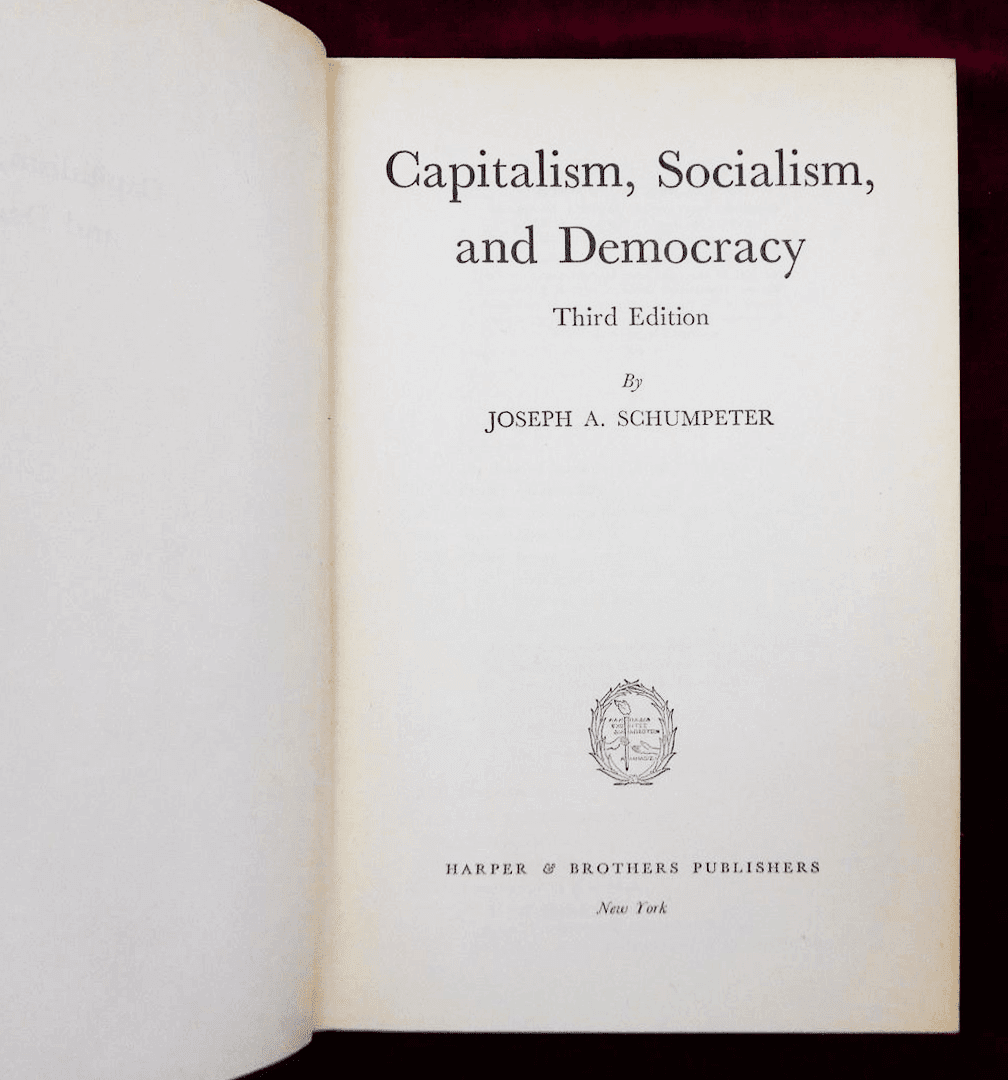
Capitalism, Socialism, and Democracy is a book on economics, sociology, and history by Joseph Schumpeter. It's one of the most famous, controversial, and important books on social theory, social sciences, and economics. Back in the 1920s, economist Joseph Schumpeter asked himself, 'Could socialism be an alternative? Should capitalism last forever? And is that even possible? In the quest for answers he came to a startling conclusion: by its very nature, capitalism is bound to destroy itself. In this book Schrumpeter gives his definition of democracy, his theory of creative destruction and his emphasis on entrepreneurship, much of his ideas have defined the economic theory of the twentieth century.

Joseph Alois Schumpeter (1883-1950) was an Austrian-trained economist, economic historian, and author. He is regarded as one of the 20th century's greatest intellectuals. Schumpeter is best known for his theories on business cycles and the development of capitalist economies, and for introducing the concept of entrepreneurship. For Schumpeter, the entrepreneur was the cornerstone of capitalism—the source of innovation, which is the vital force driving a capitalist economy.


Key Learnings

Capitalism is constantly evolving. It’s driven by a process of creative destruction, and that means that products, production methods, technologies, and markets restructure themselves incessantly. As capitalism progresses, these transformations increasingly threaten its very foundations, such as entrepreneurship and competition. At the same time, these changes can open up society and culture to socialist ideas. Capitalism will ultimately self-destruct and pave the way for socialism. Such socialism, given certain conditions, is in principle entirely operable – although running a democratic socialist society may present a challenge.


Karl Marx’s economic theories were prophetic – but they’re too stationary to account for modern capitalism.

In the social sciences, no figure looms larger than the German economist and philosopher Karl Marx. With his famous argument for an inevitable revolution, spearheaded by the working class, Marx became the great prophet of socialism. Indeed, for its proponents, Marxism is something like a religion. For better or for worse, they view absolutely everything through its lens. Why is that? Well, it’s in part because Marx’s ideas were indeed prophetic, or at least very much ahead of their time. For example, Marx was one of the first thinkers to suggest that what shapes our societies, actions, and attitudes is the economy. He was also among the first to recognise the cyclical nature of economic processes. He recognised that economic crises were inevitable and occurred at regular intervals. 

Schumpeter, recognised the prophetic qualities of Marx’s work – and he agreed that the great German thinker contributed greatly to the field of economics. But he maintained that there were quite a few problems with Marx’s conception of capitalism.

Marx argued that history is essentially all about a struggle between two – and only two – classes. On the one hand, there’s the working class, or proletariat. Its members sell their labor to the capitalists, or the bourgeoisie. These are the people who own the means of production. According to Marx, the capitalist system encourages business owners to make laborers work longer and longer hours, without necessarily paying them for it. Business owners therefore extract “surplus value” from the work of the proletariat. This is the foundation of profit – and over time, the proletariat loses out; the poor become even poorer. Enterprises, meanwhile, tend to become less and less profitable.

Schumpeter pointed to a few problems with Marx’s theory. 
  • First, it leaves no room for a third class of people essential to capitalism: entrepreneurs. Capitalism is driven by smart and energetic people who don’t necessarily belong to the bourgeoisie, but wish to ascend to it. With their ideas and innovations, entrepreneurs are constantly revolutionising the system from within. 
  • For Schumpeter, another issue is that Marxism is too stationary. It cannot explain the constantly evolving phenomenon that is modern capitalism.
  • Finally, Schumpeter sees no evidence that capitalism fuels oppression and poverty, as Marx held. In fact, capitalism has actually improved the lives of most people living under it.


Capitalism is responsible for great social and intellectual progress.

It would be foolish to diminish the progress that societies have made under capitalism. Indeed, in The Communist Manifesto, Marx himself praised capitalism’s many achievements. He argued that capitalism was a necessary historical stage, unavoidable before the triumph of socialism.

The most obvious form of progress that capitalism enables is, of course, economic. One way to measure this is to look at a country’s total production of all goods and services in a year. Let’s take the US, for instance. From the Industrial Revolution through to the 1940s – Schumpeter’s time – this total kept increasing, at an average of about 2 percent per year. With it, people’s average income also increased. And what’s more, contrary to Marx’s predictions, the income gap between the rich and the poor didn’t really widen – at least not until well into the twentieth century.

Capitalism’s economic progress made life better for many in myriad ways. As disposable incomes grew, for example, people began to spend more on personal goods and services that enriched their lives. And it wasn’t just that people started to earn more; their money actually went farther and farther. A car, for example, cost considerably less in proportional terms in the 1940s than it did in the 1900s. On top of this, products just kept getting better. That’s because companies weren’t just competing with each other on price – they also focused on quality and general standards. Think about something as simple as white stockings, for instance. In the nineteenth century, they were largely the preserve of royalty. By the 1940s, they were ubiquitous – even factory girls could afford them. 

Alongside all this progress, something else happened: capitalism, as such, became less costly. For example, practices like child labor and sixteen-hour workdays that defined the Industrial Revolution are generally gone. All in all, then, big business and even monopolistic practices have largely improved our lives. And capitalism didn’t just accelerate material progress. It also encouraged us to develop a certain economic rationality. The basic cost-profit calculation, which lies at the heart of capitalism, is now applied in such diverse fields as space exploration, medicine, beauty, and even justice. This “rationalization” of society gradually replaced the magic and mysticism of the old days. 

Finally, capitalism encourages hard work, innovation, and invention. This means that we have capitalism to thank for our high standard of living, our rational mindset, and our greatest inventions, such as refrigerators, airplanes, and even radio and television. 


Capitalism feeds on a process of creative destruction.

Capitalism itself is constantly progressing. Since it first developed, it has been expanding, accelerating, and transforming. And this is no accident. Indeed, this constant change is in the very nature of the capitalist system. For one, businesses and entrepreneurs are in constant competition with each other – or at least in constant fear of competition. This encourages them to restructure, invent, and innovate at an accelerating pace. You’re never safe at the top for long. Your business strategy may have worked yesterday, but it could easily fail tomorrow. 

And so every year we see the rise of new markets, new consumer goods, new methods of production. None of this innovation comes from nowhere: the novelty always destroys the old structures and grows right through them. Schumpeter popularised a new term, which he used to describe capitalism’s constant transformation from within. He called it the process of “creative destruction” – and, in his view, many economic theories, including Marxism, failed to take it into account.

For example, many economists seem to think that capitalism functions best in a state of “perfect competition.” This view is, of course, idealised, and it simply assumes that all companies in a market produce exactly the same product and compete only on price. Some economists say that big business practices have derailed the structure of perfect competition. But that view presupposes that such a state can exist in the first place. Schumpeter thought that such analyses were facile. He didn’t believe that the state of perfect competition ever existed. To him, competition was not based only on price – it also took into account product quality and advertising. And, above all, he viewed capitalism as a process. To him, the system was subject to constant innovation and destruction. So, then, you can’t really understand capitalism if you don’t take into account the process of creative destruction. And that means that capitalism has never really been static.


There’s nothing to prevent socialism from working.

For most of history, socialism has been considered the only viable alternative to capitalism. In a socialist society, the means of production are controlled by just one central authority, rather than by many private actors. Can this system work in the real world? Many economists have had their doubts.

In a commercial system like capitalism, the economy is controlled through constant competition. Companies, entrepreneurs, and bankers set prices, decide what to buy and sell, and hire and fire people. This means that, in theory at least, a capitalist market regulates itself. A socialist market is different. Instead of self-regulation, it relies on an external force – such as, for example, a political authority. One of its jobs could be to provide people with vouchers, each representing a citizen’s share of all goods produced in a country’s economy. In theory, this value is easy to set: you simply divide the total of all goods by the overall number of claimants.

Some economists, though, think that there’s a flaw in that plan. Here’s their question: Without price competition, how would you gauge the demand for a certain product? In capitalism, after all, prices have a really important role to play: they regulate supply and demand. But Schumpeter saw no problem with implementing a similar system under socialism. For example, the government could set up a pricing authority for each industry whose decisions would be based on customer demand. And as for consumers themselves, they could even receive different “incomes,” depending on how much they worked. Some of that may sound a lot like capitalism. But there’s a key difference here, and that’s the lack of competition. A socialist economy is not shaped by internal market forces. Instead, the way it works is all down to its central authority.

Logically, then, there’s no reason why socialism cannot work. Some economists acknowledge this, but they claim that there’s a difference between theory and reality. In practice, they say, socialism is simply inoperable. For one, a government could never have sufficient information to run a whole economy smoothly. But here’s Schumpeter’s counterargument: government’s decisions are no harder than those that businesses have to make under capitalism. Whatever the system, running it will always involve guesswork. For Schumpeter, the case is clear: of course socialism can work. But the questions is whether it’s compatible with democracy.


We need to update our definition of democracy to account for the realities of elections.

How well do socialism and democracy go together? Before we explore this, we need to ask ourselves what democracy is.

Is it some sort of ultimate good, as many people believe? Can it be an end, in and of itself, rather than a political method? Imagine a society that makes a democratic decision to reinstate witch hunts. Clearly, that would be appalling. So should we really consider democratic processes inherently good or bad? Often, democracy is simply defined as “rule by the people.” But as soon as we probe this formula, it begins to fall apart. First of all, most democracies don't involve all people – children and convicts, for example, are often barred from voting.

As well, in a democracy, people don't "rule" directly. Instead, they delegate their power to leaders who supposedly represent their interests. But here’s what often happens: as soon as these delegates get into office, they begin putting their own ambitions first.

The classical definition of democracy is a bit more complex. It says that democracy is a method of arriving at political decisions for the common good, by letting people elect their own leaders. But that presupposes that a common good is something that people can agree on rationally. And it also suggests that people can work out among themselves how to put decisions into practice. In our complex societies, that is clearly not the case. Even if we agreed that everyone deserves to be healthy, for example, people would still debate the benefits of vaccination.

In reality, we all have interests and values that are varied, irrational, and impulsive. Some of these values aren’t even our own – instead, they’ve been sold to us by advertisers or politicians. So, clearly, we need a new definition of democracy. How about this definition: Democracy is a way of making political decisions by letting individuals compete for people’s votes, in order to gain the power to implement those decisions. This definition may work better than the classical doctrine. For one thing, it makes room for the crucial element of democratic leadership – the fact that it’s politicians who rule countries, not voters themselves. Second, it makes clear that the role of the people isn’t to be the government, but to choose the government. And last, it leaves room for the fact that no democratic government can represent all people – just a majority of them. 


Socialism may be as compatible with democracy as capitalism – under certain conditions.

Throughout history, many socialists have said that theirs is the only path to “true democracy.” But some believe that it’s OK to use undemocratic methods – such as violence and terror – to create a socialist society.

There’s no direct relationship between socialism and democracy. They are neither mutually exclusive nor necessarily entwined. In Russia, for example, socialism was enforced by very undemocratic methods. But in Belgium, the Netherlands, and even England, socialist parties readily embraced democracy.

So what are the conditions under which a democracy can thrive? And is there anything that precludes socialism from creating them – especially after capitalism has laid the economic groundwork?

  • The first condition for the success of democracy is the availability of high-quality leaders. This means that the political sphere of a country should be accessible and appealing enough to attract the right kind of people – individuals who are smart, conscientious, and capable.
  • The second condition is that political decisions made democratically should stay within an appropriate range. The government should decide some things about public life, but not all of them. In fact, there’s no need to make all decisions democratically. For example, most countries appoint supreme courts outside the democratic process.
  • The third thing necessary for democracy is a well-functioning bureaucracy. It needs to be efficient enough to take care of all the mundane but important work that goes into democratic decision-making. 
  • And finally, a democracy only works smoothly if all people accept the way decisions are made, and are able to tolerate differences in opinion.
Schumpeter believed that democracy emerged as a by-product of capitalism’s rationalist ideology. But the four conditions for it can exist in either system – socialist or capitalist.

No system is perfect
, of course. For example, democratic decision-making can be inefficient in large and complex societies. In a socialist country, this may be an even bigger problem. After all, if you can’t make efficient decisions, how can a central body run an efficient economy? So it's possible for Socialism and democracy to coexist.


The key features of capitalism will ultimately lead to its self-destruction.

Let’s turn to the central question: Can capitalism survive?

Schumpeter answers this question with a resounding 'No'. He thinks that the very success of capitalism will be its undoing. It will create conditions for its own destruction and a socialist takeover. 

But how?

As we’ve already seen, capitalism uses the mechanism of creative destruction to push social and technological progress. But progress can only go so far. What happens if one day we find all human needs completely satisfied? What if we lose the motivation to keep pushing?

Under capitalism, progress is becoming increasingly automated and predictable. For example, capitalist progress diminishes the figure of the business owner. Instead, it hands over control to an impersonal structure of managers, executives, and stockholders. In such a world, where running a business becomes an abstraction, why even try? 

As the cost of living increases, and as businesses focus on small niches, not revolutionary innovation, there’s less and less incentive for true entrepreneurial leadership. Instead, there is growing demand simply for administration of already-existing processes. But this is something that socialism does just as well as capitalism.

Capitalist progress also erodes the mechanisms that used to protect the bourgeoisie. For example, it encourages a taste for anti-bourgeois ideas. The rationalist ideology of capitalism creates a critical frame of mind – and, in the end, it inevitably turns against itself. For evidence, just think of the many bourgeois intellectuals who now align themselves with the working class and are growing more and more hostile toward capitalism. 

And there’s another way in which capitalism destroys the very ground that nurtures it. The trend to rationalise everything has contributed to the decline of the traditional family unit. As this trend grows, more and more people will feel inclined to conduct a cost-benefit analysis of having children. As a result, they may well decide to remain child-free. If you don’t have children, you don’t really need long-term investments like property. And that gives you the incentive to earn, and save, less. That's no good for the constant economic growth that capitalism requires.

And so, just as capitalism raises our standard of living, gives us more leisure time, and makes us better educated, it also weakens our motivation. This is self-defeating and can destroy the very structures that underpin the capitalist system. Schumpeter believed that capitalism would, eventually, destroy itself and pave the way for socialism. But maybe that’s nothing to worry about – especially if we can figure out how to consolidate socialism with democratic values.


© Christine Calo 2021. Please do not reproduce without the expressed consent of Christine Calo. Powered by Blogger.