"Org Design for Design Orgs" is a book that focuses on the organisational design of design teams within companies. It explores the unique challenges and considerations involved in structuring and scaling design organisations effectively.

The authors of "Org Design for Design Orgs" are Peter Merholz and Kristin Skinner. Peter Merholz is a designer and entrepreneur with extensive experience in design leadership and organisational design. He co-founded Adaptive Path, a renowned design consultancy, and has worked with numerous organisations to help shape and evolve their design capabilities. Peter is recognised as a thought leader in the design community.

Kristin Skinner is a design leader and executive coach who has worked with various companies to develop and transform their design organisations. She has served as the Head of Design Management at Capital One and has also held design leadership roles at Microsoft and Adaptive Path. Kristin is known for her expertise in design operations and design management.


Summary & Key Learnings

Chapter 1: Why Design? Why Now?
Chapter 2: Realizing the Potential of Design
Chapter 3: 12 Qualities of Effective Design Organizations
Chapter 4: The Centralized Partnership
Chapter 5: Roles and Team Composition
Chapter 6: Recruiting and Hiring
Chapter 7: Developing the Team: Professional Growth and Managing People
Chapter 8: Creating a Design Culture
Chapter 9: Successful Interactions with Other Disciplines
Chapter 10: Parting Thoughts

The book addresses topics such as aligning design with business objectives, establishing design principles, building a strong design culture, fostering collaboration between design teams and other functions, and managing the growth and scalability of design organisations.

By providing insights, strategies, and practical advice, the authors aim to help design leaders and practitioners navigate the complexities of organisational design within the context of design teams. They draw from their own experiences and industry case studies to offer guidance on creating successful design organizations that can drive innovation and deliver impactful outcomes.

In summary, "Org Design for Design Orgs" is a resource that seeks to empower design leaders and practitioners with the knowledge and tools to structure, scale, and optimise design teams within organisations, ultimately contributing to the overall success of the design function and its ability to create value.


Chapter 1: Why Design? Why Now?

Design plays a crucial role in modern organisations for several reasons. Here are some key points:
  1. Competitive Advantage: Good design can differentiate a company's products or services from those of its competitors. It can enhance the user experience, create emotional connections with customers, and contribute to overall customer satisfaction.
  2. User-Centric Approach: Design places a strong emphasis on understanding user needs and preferences. By incorporating user insights into the design process, organisations can create products and services that better meet customer expectations and address their pain points.
  3. Innovation and Problem-Solving: Design thinking encourages creativity and promotes innovative problem-solving approaches. Designers are trained to think outside the box, challenge assumptions, and explore alternative solutions. This mindset can drive innovation within an organisation.
  4. Collaboration and Interdisciplinary Work: Design often involves collaboration between various disciplines, such as design, engineering, marketing, and business. Integrating design into an organisation encourages cross-functional collaboration, leading to more holistic and well-rounded solutions.
  5. Branding and Image: Design is a powerful tool for shaping a company's brand identity and image. Visual design, branding, and communication materials help convey a consistent and compelling message to customers, partners, and employees.
Overall, incorporating design into organisational structures and decision-making processes can lead to improved products, enhanced customer experiences, and a competitive advantage in the marketplace.

Design can be so much more than "Problem Solving"
Business in the industrial and information ages of the 19th and 20th centuries was dominated by the analytical approaches typical in scientific management and engineering. Such reductive approaches are insufficient for tackling the complex challenges companies now face. This has led to greater investment in design for the following reasons:
  • Squeezing greater efficiency has run its course, and design's generative qualities are seen as a means to realise new business value.
  • Given software's abstract nature, design is required to tether the experience to something people can understand; with networked software, this challenge is exponentialised.
  • The shift from products to services, with umpteen touchpoints by which someone chooses to interact, places greater reliance on design for coordination so as not to overwhelm the customer.
These challenges explain corporations' willingness to spend on design, but if we focus only on known problems, we limit the potential impact that design can have on a company. While design is often associated with problem solving, the irony is that this view represents the same reductionist mindset that created the challenges that design is being brought in to address.

Problem solving is only the tip of the iceberg for design. Beneath the surface, design is a powerful tool for problem framing, ensuring that what is being addressed is worth tackling. Go deeper still, and you discover that the core opportunity for design is to inject humanism into work. The best designed products and services don't simply solve problems - they connect deeply with people. When design combined with social sciences like anthropology and sociology, and other creative disciplines such as writing, there exists the possibility of creating a powerful expression of the human experience. As Steve Jobs said, "Design is the fundamental soul of a man-made creation that ends up expressing itself in successive outer layers of the product or service."


Chapter 2: Realizing the Potential of Design

Companies invest in design in order to manage the software-driven complexity of their businesses. There’s a sense that design makes things “better,” by making them more attractive, more desirable, and easier to use. However, many, and probably most, of the people responsible for bringing design into their organizations have only a rudimentary understanding of what it can deliver. They perceive design primarily as aesthetics, styling, and appearances.

Here is a quote from Steve Jobs quote about design, "Most people make the mistake of thinking design is what it looks like. People think it’s this veneer—that the designers are handed this box and told, “Make it look good!” That’s not what we think design is. It’s not just what it looks like and feels like. Design is how it works.

Jobs’ definition is inspiring, but hard to make actionable. The authors prefer the definition from noted user experience expert Jared Spool, who wrote, “Design is the rendering of intent.” He continues, “The designer imagines an outcome and puts forth activities to make that outcome real.” This might seem vague or abstract, but that’s purposeful—it points out that “design” is happening all the time, in a variety of contexts, whether or not we think of it as that. For a company to better deliver on its own intentions, it benefits from incorporating mindful design throughout its activities. 

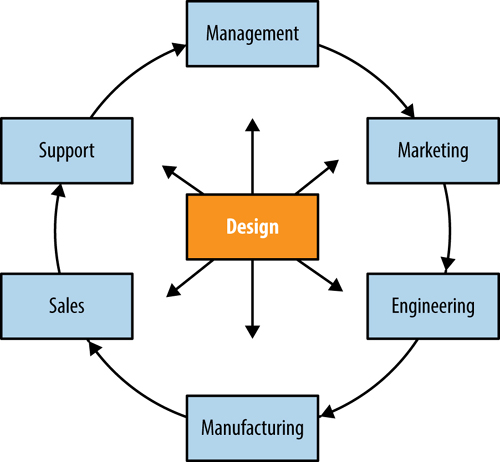
Rob Brunner, founder of product design consultancy Ammunition (best known for their work on Beats by Dre), gave a presentation at the 2016 O’Reilly Design Conference titled “Design Is a Process, Not an Event,” where he shared what he saw in the evolution of design. He points out that until recently, design was seen as a step in a chain (Figure 1-1).

Figure 1-1. How product development and delivery has been typically handled


He contends that what is now becoming clear is that design is not a standalone event, but a process that works best when infused throughout a product development lifecycle (Figure 1-2). 


Figure 1-2. Design plays a role throughout product development and delivery


All Design Is Service Design
As every company becomes a services firm, it follows that the opportunity for design is to make every part of that service experience more intentional. An emerging discipline called “service design” reframes how organizations utilize design. Historically, design has been focused on the creation of things, whether in service of marketing (advertising, branding, packaging) or product (industrial design, software design). Service design applies many of the same practices, but pulls back from this emphasis on artifacts, instead assuming a broader view in an effort to understand the relationships between people (customers, frontline employees, management, partners) and the activities they take part in. Artifacts are no longer considered on their own, but as tools in a larger service ecosystem.

At the heart of service design is the customer journey. Mapping these journeys begins before the customer even knows about a company, traces the customer’s interactions with the company across different touchpoints, and ends when that customer moves on from the relationship. This mapping provides an alternative perspective on service delivery from how organizations are typically structured. It reveals that a customer interacts with marketing, sales, product, and support in a manner that’s typically impeded by departmental silos. It also highlights how certain touchpoints get overloaded with poorly aligned interactions. For example, a company might use email:
  • To deliver marketing and promotions
  • To extend certain product experiences (daily updates, results of saved searches, etc.)
  • For technical or customer support communications
If these messages are not coordinated well, the customer is overrun by email, and may choose to simply ignore that channel altogether, thus inadvertently inhibiting the company’s ability to communicate.

This has implications for organizational structure. For example, many companies have separate marketing and product design teams. However, to a customer, marketing and product are simply points along the same journey, often delivered in the same media—web browser, mobile app, and email—and would benefit from coherence in the team that designs them. The logical conclusion of the journey mindset is that design practices that are currently kept separate—marketing, communication, environments, and digital products—all contribute to a single journey, and ought to be coordinated. Additionally, this mindset shows how design can support things that it typically is not involved with, such as sales and customer support.

This book is not a how-to on service design. For that, we recommend Marc Stickdorn, Markus Edgar Hormess, Adam Lawrence, and Jakob Schneider’s This Is Service Design Doing (O’Reilly, 2016) and Andy Polaine, Ben Reason, and Lavrans Løvlie’s Service Design: From Insight to Implementation (Rosenfeld Media, 2013). Our point is to recognize that contributions from design shouldn’t be limited to marketing and product efforts, but instead infused throughout the entire service. Wherever the customer and your organization interact, that touchpoint will be improved by design’s intentionality, and this has implications on the shape of the design team.

The Double Diamond
To frame design’s ability to contribute broadly, we use the Double Diamond (Figure 1-3), a diagrammatic model of product definition and delivery.

It’s a bit of a simplification, and shouldn’t be construed as a strict process. Still, it serves to depict how designers best approach and solve problems. The first diamond, Definition, addresses the steps needed to articulate a strategy and develop a plan for your offering. The second diamond, Execution, is about implementing that plan.

Figure 1-3. The Double Diamond model of product definition and delivery

Too often, project teams settle for linear thinking, where the team leader (typically a product or marketing manager) puts forth an idea that is then taken as the solution, and teams just march toward its implementation. The genius of the diamond shape is that it shows, for both definition and execution, that the team first engages in divergent thinking that broadens the possibility space, before turning a corner and practicing the convergent thinking that narrows in on a specific solution.

Design Defines
In most organizations, designers are not engaged until the second diamond, when strategic and planning decisions have already been made, and their role is to execute on a set of requirements or a creative brief. While service design encourages a broader role throughout the entire customer experience, it may still remain quite superficial and execution oriented. If organizations are going to embrace all that design has to offer, this must involve influencing product and even corporate strategy.

Since at least the advent of scientific management, the predominant mode of business strategy has been analytical. Reduce processes and practices to their elemental components, and squeeze the most out of them. Even product marketing, which should be rooted in creativity and user experience, instead relies on practices such as market segmentation and sizing, surveys to assess consumer sentiment and satisfaction, and product requirements that focus on Cost of Goods Sold (COGS) and the Four Ps (Product, Price, Promotion, and Place).

This stereotypically “left-brained” approach has served business well for quite a while, but has run aground of the connected services economy. Services are predicated on relationships with and between people, a human messiness that these analytical means insufficiently address. What’s called for are more “right-brained” approaches that are holistic instead of analytical, and that are generative instead of reductive. And key to successful human relationships is empathy, a quality distinctly lacking in traditional business practice. Good design practice is an expression of deep empathy, and businesses are realizing that bringing design into the definition conversation (the first diamond) provides better balance in their thinking. At Airbnb, extensive user research was done to build deep personas for Hosts and Guests, which included their respective customer journeys. Airbnb then brought on an artist from Pixar to illustrate key moments in the journey, and these visual storyboards help orient design, engineering, and business around common goals.

Design Makes Strategy Concrete
When strategy focuses on optimization, directives can be written as a set of metrics, such as improving conversion rates or increasing engagement. When it’s about delivering products to market segments, directives are a list of features and the audiences they serve. But when it’s about creating new offerings in an uncertain market context, these reductive approaches fall short. If you remain in the abstraction of spreadsheet formulas or bullet-pointed requirements on PowerPoint decks, four issues arise:
  • There are trade-offs or conflicts within the requirements that are not apparent (say, improving ease of use or task completion, while also empowering users with more functionality), and so a chosen strategy might actually be unworkable.
  • Each stakeholder has their own, unstated understanding of what that strategy means, and their misalignment is not evident until the building process, which proves too late for resolving the conflict.
  • What’s being developed doesn’t accord with the vision stakeholders had in their heads.
  • Internal teams are not motivated by abstractions, and may deliver tepid work that satisfies the requirements, but goes no further.
An architect would never propose a building design without presenting stakeholders a scale model; filmmakers write scripts and draw storyboards before rounding up a crew and committing to a foot of film. Likewise, bringing the design activities of user research, sketching, ideation, and rapid prototyping into strategy work ensures these issues won’t arise. Low-fidelity sketches quickly make apparent shortcomings in an incoherent or incomplete strategy. Even if the strategy is solid, by making it concrete, you ensure that all stakeholders have a shared understanding of the implications of that strategy. If there are issues with the strategy, they get addressed in this early stage, when iteration is cheap, and not during development, when making changes can be quite costly. And by embodying the strategy in a clear vision, project teams have a compelling, motivating goal to attain, a “north star” that encourages them to deliver better than they’ve ever delivered before.

But design shouldn’t be limited to just embodying a strategy established by the business. Design practices should actively contribute to and shape the strategy. Because sketching and ideation are relatively inexpensive, design employs divergent thinking to explore a range of options, feeling them out, or even putting them in front of customers to gauge acceptance. In this way, design brings forth solutions that had not yet even been considered, and does so in a way that can garner meaningful external feedback.

Even with all these obvious benefits, many organizations resist making strategy concrete. By remaining in abstraction as long as possible, hard decisions do not have to be made. Trade-offs do not have to be realized, and everyone can believe that their pet idea will see it through. When design contributes to strategy, it challenges this mindset, and forces stakeholders to commit.

Customer-Centered Planning
In between the two diamonds exists the project plan. The plan typically contains two parts: (a) a vision for where the product is ultimately headed (informed by the strategy work), and (b) a series of steps to realize that vision, sometimes called a roadmap or backlog.

It might seem like a small thing, but how that plan is shaped can be crucial for the offering’s overall success. These plans are typically organized by importance to the business and estimated effort. Features are scored across these two criteria, and then ranked. And then the teams plow through the list.

The shortcoming of this approach is illustrated in the diagram in Figure 1-4, drawn by agile coach Henrik Kniberg:
Figure 1-4. Henrik Kniberg’s drawing of a preferred product development approach

When releasing products or services in an iterative and accretive fashion, it’s important to keep in mind the customer’s experience every step of the way. So, even though the first row gets to the ultimate release faster, taking four steps, it does so by sacrificing user happiness at each earlier release. This means, in practicality, users won’t stick around for that ultimate release. They will have moved on to other options.

While it takes five steps to get to the ultimate release in the second row, at every stage there’s a holistic experience. The initial experience might not be what the customer wants, but as the organization learns through successive releases, they deliver more happiness sooner. Also, through that learning, the organization can correct course, and realize a different ultimate delivery (“the convertible”) that serves their customers even better than their original vision (“the sedan”). Design’s role in this process is to bring an empathetic perspective that understands what customers will find desirable, and influence the roadmap to reflect that.

The Bulk of Design Is Execution
We’ve dwelled on strategic and planning matters because these are not widely appreciated, and are essential for design to deliver to its fullest extent. That said, the bulk of an organization’s design effort (80%–90%) will be within that second diamond of execution. A shortcoming of the Double Diamond diagram is that it suggests that for every act of definition, there is an act of execution. In fact, after the creation of a plan, execution occurs iteratively, knocking down elements of the roadmap with each pass (Figure 1-5).
Figure 1-5. Definition occurs once in a while, and execution occurs iteratively against the established plan

The specific design practices shift when going from definition to execution. When informing strategy, design is more generalized, drawing on user research, sketching, and prototyping. A sketch might represent a software interface, a piece of marketing collateral, or a physical object. Execution brings with it a focus on specific design disciplines. Designing for software, designing for marketing and communications, and designing for physical products are quite distinct practices, and require specialists well-versed in those media.

Bringing Design In-House
The history of business and design is typically one of clients and design firms. Bell Laboratories and Henry Dreyfuss, IBM with Eliot Noyes, Paul Rand and the Eames Studio, Apple and Frogdesign. Design was an outsourced specialty, needed in a tightly defined fashion, usually for logos and products.

At the rise of the Web, most companies handled the need for design through external vendors. They didn’t have capabilities in-house, and weren’t sure it was worth the investment. Twenty years in, it’s clear that we are in a new normal. The shift to networked software and multi-touchpoint services has created a fundamentally chaotic and unpredictable environment that requires continuous delivery.

Design can no longer be a specification that is handed off, built, and never seen again. It needs to be embedded within the strategy and development processes, and its practitioners must be deeply familiar with the company’s mission, vision, and practices. To make this work with an outsourced partner is possible, but very expensive, and raises concerns about an external firm’s alignment with the company’s values and ideals. It’s simply more straightforward to build in-house design competencies that are organizationally and operationally conjoined with functions such as marketing, engineering, and support.

The Three-Legged Stool
This continuous delivery requires changes within product teams. Historically, the ultimate authority in product development lived with someone representing “the business,” such as product marketing, general managers, or product managers, who took in an understanding of market needs, articulated a set of requirements, and gave that to teams to build. For software products, the technology became too complex to locate all decisions in a single product manager—delivering quality work required that people with technical depth also be given authority. This led to teams with joint product and engineering leadership. As we enter a world of connected software and services, the primacy of relationships and need for quality user experience cannot be addressed only through technical and business expertise. Designers should no longer be handed briefs and requirements, but instead be part of the conversation earlier to make sure that their empathetic perspective is represented. The reality of contemporary product and service delivery is a messy one, and requires the productive tension between business, technology, and design. Think of them as the three legs that the offering rests upon (Figure 1-6). If any leg is deficient, what is delivered will be wobbly.

Figure 1-6. The three-legged stool of product and service development and delivery


The Expanded Role of Design
Pulling all this together, we arrive at an expanded role for design. For decades, the typical operating mode for design was to receive a brief or requirements from “the business,” limited to the look and feel of the product or the brand impact of a marketing campaign, and execute on that.

The rise of software led to more complex products, and a subsequent realization that many requirements didn’t make sense when users tried to actually operate the system—a lack of empathy led to confusing experiences. Designers created the discipline of user experience to compensate for this shortcoming, developing a set of methods (user research, usability testing, personas, workflows, wireframes) and fostering a user-centered mindset that helped manage this complexity and make it understandable to people.

It then became clear that these practices are useful not just in the execution of a product. As companies improved instrumentation of their experiences, they realized that such approaches drive real business value. They can be used to meaningfully contribute to a service’s definition, and designers found themselves part of the strategic conversations about what should be built. Design had earned its long-sought-after “seat at the table.”

Design and “User Experience”
It is common, when discussing design as we have, to also refer to “user experience.” In fact, many would call the kind of software design we’re discussing “user experience design.” We have two reasons we’re avoiding this specific association between design and user experience.

The first reason is that when you try to find or articulate a definition of “user experience design,” things get muddier, not clearer. Most of the time, people interpret “user experience design” to mean “interaction design with some information architecture,” and focus on the creation of workflows and wireframes. Some of the time, though, UX design is expected to include user research and strategy, and other times it’s associated with visual interface design. Throughout this book, we avoid “user experience design” in favor of referring to specific disciplines.

The second reason is that automatically lumping design with user experience gives short shrift to all the other disciplines that contribute to the user experience. A user’s experience is the emergent outcome of numerous contributions, including design, but also engineering (technical performance has a huge impact on user experience), marketing (how expectations are managed affects the user experience), and customer care (a bad experience can become a good one if handled well). If a single team is labeled as the primary keeper of the user experience, that absolves other departments from concerning themselves with it. User experience must be everyone’s responsibility.And from that vantage point, it has become clear that the frontier for design is to play a role not only in every stage of development from idea to final offering, but to be woven into every aspect of the service experience from marketing to product to support. The challenge is that most organizations are structured and run in a way that inhibits this potential. In subsequent chapters, we’ll show how to establish, organize, and evolve a design team that can realize this expanded mandate.


Chapter 3: 12 Qualities of Effective Design Organizations

There are two lessons for any team. The first is that skill and talent matter. But talent isn’t sufficient. The second lesson is that to get the most out of a team requires sensitive management, visionary leadership, and well-run operations. Design teams often suffer in this second area because, compared with other corporate functions like engineering and marketing, design is newer and its appreciation is less sophisticated. This nascency means that (a) most people in an organization have never worked with a truly effective design team, and (b) most designers haven’t been part of fully actualized teams, and so they don’t know what they need in order to realize their own potential.

Many design teams have the raw talent to realize the expanded role , but don’t yet have the maturity to embrace it. A design team’s output is the result not only of their skill, but the sophistication and sensitivity of how they operate. In this chapter, a set of qualities of effective design organizations are presented. Assessing a team’s performance against each of these qualities clarifies opportunities for improvement.

The qualities are broken up into three groups: Foundation, Output, and Management (Table 1-1). The Foundation outlines the core concepts that drive the team’s behavior, and explain its very reason for being. With a strong Foundation established, energies then shift toward Output and Management. These qualities are indicative of the broader creative/operational split that is required to sustainably deliver good design, and is a theme throughout this book. Output and Management need to be tackled in tandem, as they reinforce each other. Output addresses what most people think of when considering design—is the team able to produce quality work across the necessary set of capabilities? Management addresses the unsung and often overlooked aspects of actually running a team. To realize team longevity and continued broadening impact, it’s imperative to treat operations as seriously as the work product.

Table 1-1. Table 1-1. The 12 qualities of effective design organizations

Foundation
Often, in the rush to just get a design team in place and producing work, laying foundational components such as values, principles, and mindset is neglected. That leads to an unengaged team working without clear objectives, and efforts can feel frenetic and unfocused. Being intentional about the foundation leads to stronger work and more committed team members.

1. Shared Sense of Purpose
Meaning and purpose are important for organizations at every level of scale. Companies have mission statements that orient and inspire their staff. Individuals have passions that motivate their behavior and decisions. Successful teams need a shared sense of purpose that establishes their identity and the impact they hope to have.

Making this purpose explicit supports design teams by serving as:
  • A beacon that attracts talent excited by the purpose
  • A rallying cry for team members as they do their work
  • A signal to the rest of the organization of what to expect from the team
One way to articulate this shared sense of purpose is through a team charter. Charters can come in all shapes and sizes, from brief mission statements to lengthier documents that detail how a team operates. Start brief and expand as needed. Every design team is different, so no one charter will apply universally. We propose the following as a way to get started.

We’re not here just to make it pretty or easy to use. Through empathy, we ensure meaning and utility. With craft, we elicit understanding and desire. We wrangle the complexity of our offering to deliver a clear, coherent, and satisfying experience from start to finish.

2. Focused, Empowered Leadership
Strong and formal leadership within successful teams, particularly design teams is important. Effective leaders possess a deep understanding of how the team should function, make decisions that benefit the team, and earn the respect of team members. They also have the crucial task of translating the team's internal dynamics and goals to the wider organization, ensuring that the team is positioned for success within the larger context.

Design leadership often doesn't receive adequate attention, especially in small design teams. It is not uncommon for junior-to-senior designers to report to individuals who are not designers themselves but hold positions in product management, engineering, or marketing. While this arrangement may be acceptable for small teams in early stages, it becomes more frustrating when larger organizations continue this practice despite knowing better. The author cites an example of a Silicon Valley company where design directors reported to the VP of Product Management rather than having a dedicated head of design. Consequently, the VP, lacking an understanding of design's potential, made decisions that affected the design team.

A design team should have control over its own destiny, which necessitates focused leadership with autonomy and executive access. In other words, design teams require leaders who can champion their needs, provide them with decision-making power, and enable them to have a direct influence on the organization's direction.

Focused leadership
Here the concept of "focused leadership" within design organizations is discussed. It emphasizes that effective design leaders should come from within the design organization itself and should not be overseeing other functions simultaneously.

One common mistake made by companies is appointing a design visionary or a creative director with a strong attention to detail as the design leader. While these individuals may excel in their creative roles, managing and leading a design organization requires different skills such as care, nurturing, diplomacy, and leadership. The primary responsibilities of a design leader should be organizational in nature, working with other executives to create a conducive environment for design and serving as a manager, mentor, team builder, and operator for the design team. The design leader needs to create a space where design can thrive.

In most organizations, having a single design leader is sufficient. This quality was initially referred to as "singular, empowered leadership" because it is important to have a clear line of authority within the design organization, rather than having multiple supposed leaders reporting to a non-design role. However, as the design team grows, it may become necessary to split the leadership into two roles: one focused on creative matters and the other on operational aspects. This model of partnership can be seen in various fields, such as technology organizations having a CTO and a VP of Engineering, publications having Editors-in-Chief and Managing Editors, and filmmaking having Directors and Producers. Similarly, some design teams now have a lead Creative Director and a VP of Design. This allows the creative leader to focus on the overall journey and key initiatives, while the operational leader can handle portfolio planning, capacity and hiring, budgeting, and the operating plan.

Autonomy
With focused leadership established, they must have autonomy over how the design organization works. Leadership’s overarching responsibility is to make their organization as effective and efficient as possible, and given the expanded role of design, this will likely mean it doesn’t conform to how other departments are structured or operate. This requires freedom to establish methods of practice, both internal to the design team and cross-functionally. And, finally, because design teams are always asked to do more than they have the capacity for, leadership must be able to prioritize their own efforts. For design to be seen as a truly essential contributor, it must be able to focus efforts on what matters, and say “No” to that which is not crucial.

Executive access
For design to realize its full potential, leadership must be only one or two rungs away from the CEO, and so must either be an executive or have executive access. If too far away from the “C-suite,” then the politics needed to navigate the organizational reality of end-to-end experiences becomes extremely difficult. Such distance makes it easy for others to dismiss design’s contribution. Executive engagement (whether in the form of sponsorship, organizational cover, or simple reporting structures) demonstrates the importance that design has within the organization. Such executive support will prove necessary as the expanded role of design inevitably upsets corporate “business as usual.”


3. Authentic User Empathy
Having an authentic understanding of user contexts and behaviors in design is important. Traditional market research and user testing are valuable, but deeper engagement with users' lives is crucial. Going into their homes or offices and observing their daily activities provides rich insights that cannot be obtained through quantitative methods alone.

Such user research reveals the customer's journey and exposes experiential breakdowns that occur when users encounter challenges due to organizational silos. The primary benefit of this research is that designers develop empathy for users, enabling them to create impactful systems and avoid solutions that will be rejected. Another important benefit is when executives and non-design authorities witness the results of user research, including raw data or analyses that highlight problematic patterns. This presents an opportunity for design, particularly service design, to propose solutions that integrate silos and address the identified breakdowns.


4. Understand, Articulate, and Create Value
After the dot-com bust in 2001, companies viewed design as a cost to be minimized. To address this perception, research conducted by Adaptive Path in 2003 explored the relationship between return on investment (ROI) and user experience design. While no simple equation was found, the research revealed that using ROI and other valuation methods helped to establish design as a visible and credible business lever, similar to marketing or research and development. Applying ROI-measuring techniques to design decisions positively impacted how design teams were structured and perceived within organizations.

Despite the progress made in recognizing the value of design since then, it remains important for design organizations to speak the language of value. Designers must understand how their work contributes to business success and avoid practicing design-for-design's-sake. Savvy design leaders embrace the concept of business value and connect their design efforts to the company's goals. This can be achieved through metrics such as conversion rates and engagement times, as well as ensuring alignment with the company's brand. When business objectives are combined with authentic user empathy, new opportunities for value creation emerge, enhancing the credibility and impact of design organizations.

Output
We are finally at the place where most people begin when thinking about design—making stuff! The following four qualities address the design organization’s capability to produce sufficient, robust, and relevant work.

5. Support the Entire Journey
To support the entire customer journey, the design team must have access to and be involved in all aspects of the journey, even areas traditionally not considered relevant to design, such as sales and customer service. This challenges the conventional practice of having separate product/UX and marketing design teams.

In a services-oriented world, the lines between marketing and product experiences blur, and the digital realm becomes the primary platform for both. Companies that cling to outdated distinctions between marketing and product miss out on new opportunities, like integrating user acquisition into product development.

With a unified design organization covering the entire customer journey, a diverse range of design skills is necessary. Although even large teams may not possess all these skills, the design organization must be accountable for delivering these practices, whether through full-time employees or external contractors. The cohesive effort of these practices is essential for designing the end-to-end customer journey. Given a single design organization invited to work end to end throughout the customer’s journey, a third implication arises: the need for a vast array of design skills to address the totality of that journey (Table 1-2).

Table 1-2. Table 1-2. The design skills needed for an end-to-end service experience

Don’t be discouraged by the breadth of this list—even most large teams aren’t so broadly skilled. Still, the design organization must be accountable and responsible for the delivery of these design practices, whether they are done by people employed full-time, or external contractors and agencies brought in on a project basis. The design of the end-to-end journey is the sum of these practices, and having a single design organization ensures that these efforts cohere.

Facilitation: the non-craft design skill
A final implication arises in recognition of how overwhelming such a broad mandate can be. In a connected-software-and-services world, to render an entire journey is a matter of managing overwhelming complexity. There are too many moving parts, too much specialized knowledge necessary to fully appreciate a situation. Designers can no longer rely solely on the hard skills of their practice and craft to succeed. They need to facilitate the creative output of others throughout the organization, tapping into a resource often left dormant. If working in a hospital setting, get nurses, technicians, and doctors to ideate around their specific problems. In a call center, have the customer service representatives pitch how they think things should be. The point isn’t to be bound to the input from other functions—the design organization still has the crucial responsibility of refining, honing, and executing these ideas. But realize that the problems we’re solving are too big for any one team to have a complete handle on.

6. Deliver at All Levels of Scale
For the team to deliver to its potential, it must operate across a range not only of skills, but of conceptual scale, from the “big picture” down to the pixel and pica. Imagine a conceptual scale that spans a product and services view from 10,000 feet to 1 foot, and place design work along that scale (Figure 1-1).

Figure 1-1. Figure 1-1. Design work is more than just what people see—design effort and artifacts inform product and service experiences at all levels of scale

The relative effort percentages are not a strict staff breakdown—while individuals will gravitate toward a particular level, most will not operate only at that level. What the percentages show is that while the effort placed in the lower, execution-focused levels will far outweigh that which is spent in the higher levels, in order for design to fulfill its potential, it must deliver across all levels.

A design organization ought to be able to operate across these levels of scale regardless of its size. If the organization is just establishing an internal design function, the implication is that hiring a single designer is insufficient, because there’s no way you’ll find someone who can span all these levels competently. Instead, bring on two designers as quickly as you can, one who can take the bulk of the lower level work (spending 80% of their time in Surface and 20% in Structure), and another who can do some of that, but also engage strategically and across the organization (spending 60% of their time in Structure, 30% of their time in Strategy, and 10% addressing The Big Picture).

Newly hired design leaders brought in to run an existing organization can use this model to plan their next set of hires. When Peter was hired to run design at one company, he inherited an organization whose efforts mostly consisted of turning product managers’ requirements into comps, and where user research made an impact only at the interface level. This immaturity was not imposed by the rest of the organization—product managers and engineers were eager for greater design contributions. Assessing the team’s capability, he found that it was strong in delivering at the Surface level, mediocre when it came to Structure, and pretty much non-existent with matters of Strategy. Thus, design was getting in its own way when trying to have more of an impact. This drove Peter’s decision to recruit designers who could deliver quality work at the Structure and Strategy levels. As they came onboard, design’s influence grew organically.

7. Establish and Uphold Standards of Quality
The quality of a design organization's output is subjective and lacks a universal definition. While engineering can be measured with quantifiable metrics, design quality relies on personal preference. To address this, design organizations must define their own quality standards and make them known to others. They should shift design critique from subjective preferences to agreed-upon principles and guidelines supported by examples. However, external pressures often discourage quality, as people outside the design team may not understand the effort required. Designers' tendency to please others and get involved in everything can lead to subpar work. Design leaders should learn to say "No" and prioritize quality over quantity. Relying on process as a proxy for quality is misleading, as critical thinking and adaptability are essential. Following a rigid methodology can harm quality, and design teams should be familiar with various approaches and methods to solve different problems effectively.


8. Value Delivery Over Perfection
In a world that emphasizes speed, balancing delivery with upholding quality is important. The notion of "delivery over perfection" acknowledges the need to get work out into the world to have an impact. Designers, influenced by traditional media and perfectionism, may struggle with frequent delivery. However, in the realm of connected software and services, regular delivery should be a habit to diminish the paralyzing effect of a single launch event.

Continuous delivery should not justify shipping low-quality work with the intention of fixing it later. Leadership plays a crucial role in finding the right balance between quality and delivery. Recognizing when something is "ready" is important, as software is never truly finished. Designers should avoid endlessly perfecting their work and label it as "ready" based on real-world usage, even if it may upset some team members who believe it's not good enough yet. Ultimately, quality is best evaluated through real people's experiences.


Management

Effective management is crucial for a healthy design team. Design leaders, often lacking management training, need to focus on managing their team to maintain quality and prevent high turnover.

9. Teams Are Made of People, Not Resources

Design leadership should prioritize treating team members as individuals, respecting their unique skills and strengths, and creating an environment that values their individuality. It is important to avoid reducing employees to labels and levels, as this diminishes their engagement and creativity. Additionally, promoting reasonable working hours helps prevent burnout and maintain work quality. Encouraging team members' growth and providing opportunities for professional development is crucial. Managers should understand their team members' aspirations and support them through mentorship and access to resources for skill-building.

10. Diversity of Perspective and Background
Design managers often make the mistake of building teams composed of individuals who resemble themselves, leading to limited perspectives and groupthink. Divergent thinking is crucial for a successful design process, and it requires a diverse team with varied backgrounds and perspectives. As the field of software design becomes more professionalized, there is a risk of narrow thinking and adherence to dogma. To counter this, it is important to cast a wide net when hiring and avoid solely recruiting from a limited set of schools. Gender and racial diversity are also significant challenges in the design industry, and efforts should be made to foster inclusivity and check assumptions through diverse representation. Change will take time, but working with educational institutions, supporting organizations focused on increasing opportunities for underrepresented students, and implementing rigorous assessment practices can help drive progress.


11. Foster a Collaborative Environment

Creating a supportive and collaborative environment is essential for harnessing the benefits of diverse perspectives in design teams. Respect among team members is crucial, while dismissiveness and negative behavior should not be tolerated. Constructive feedback and open discussions are necessary for upholding quality standards and fostering creativity. Hierarchical structures can hinder idea flow, so design leaders should encourage everyone to contribute and be willing to accept critique. Physical spaces that promote collaboration and visibility of work are valuable, but if not feasible, virtual tools can be utilized for online collaboration.

12. Manage Operations Effectively
The most underappreciated aspect of running a design organization is the importance of smooth operations. Just because design is “creative,” it shouldn’t get a pass in terms of running effectively. Much of what causes designers to stress in their work is the result of flawed operations. Symptoms include:
  • Trouble coordinating internally, particularly around process, communications, and file management
  • Difficulty collaborating with other parts of the organization
  • Inappropriate staffing on projects and programs
  • Lack of visibility into related workstreams or duplicate efforts
  • Non-existent measurement
Such symptoms make people feel like they are spinning their wheels, expending a lot of effort with little to show for it. Ironically, though, designers often resist practices and policies meant to streamline their work, concerned with how it may inhibit creativity. In other cases, too much process will mask deficiencies in other areas, such as lack of a clear strategy, vision, or roadmap, and doing the work feels too prescriptive and constrained. Accelerated hiring and inadequate—or non-existent—onboarding further exacerbate problems. If done well, team members will learn to appreciate the ability to remain focused on the work, instead of being sucked into the work-about-the-work that insidiously steals a surprising amount of time.

Our Humanistic Agenda
Twentieth-century management practices focused on maximizing productivity and treating employees as interchangeable parts. However, in the 21st century, where relationships are crucial in the software and services industry, this approach is inadequate. For design teams, who rely on their human qualities for empathy and perspective, a humanistic orientation is even more essential. To assess a design organization, use 12 qualities as guidelines and involve the entire team in scoring and identifying areas for improvement. This inclusive approach strengthens team bonds and ensures shared responsibility for growth.


Chapter 4: The Centralized Partnership

Corporate organizational structures are often adopted without much thought or intentionality. People tend to rely on hierarchical bureaucracy and functional departments that have worked in the past. However, these structures are rooted in outdated 19th- and 20th-century industrial thinking and may hinder the potential of design in the 21st century. To unlock the full potential of design, leaders need to be deliberate and purposeful in structuring and shaping the design organization.

Organizational Models for Design Teams
When the design team is small, it operates simply as a cohesive unit. However, as the team grows, a more deliberate structure is needed to avoid chaos. Traditionally, design organizations have operated either as centralized internal services or decentralized and embedded teams. A third approach is introduced in the book, called the Centralized Partnership, which offers a new perspective on structuring functional teams to address contemporary challenges.

Centralized Internal Services
Initially, companies often adopt a centralized internal services model for their in-house design teams, resembling an in-house agency. This model consists of a director overseeing functional teams like interaction design, visual design, and project management. Requests for design work come from business units, and the director assigns available designers to the project. Some companies even treat their internal design team as an external firm, with chargebacks and the option to work with external design agencies.

Benefits of centralization
This form of centralization is so out of favor, it can be hard to remember why anyone would operate this way. That said, it’s worth recognizing that it offers some very real benefits:
  • Supports an internal design community and culture
  • Provides clear lines of authority and control
  • Allows designers to work on a range of projects
  • Encourages a consistent user experience
  • Create efficiencies in doing the work
Centralization of the design team brings several benefits. It fosters a strong design community, facilitates clear lines of authority and control, enables a wide range of project opportunities, ensures consistency in designed experiences for customers, improves efficiency through established design guidelines, and reduces redundant roles and costs for the finance department. Chargebacks emphasize the value of design and encourage a serious approach to requesting design services within the organization.

Drawbacks of centralization
While centralization makes a lot of abstract business sense, when it comes to day-to-day practice, it proves problematic for the following reasons:
  • Disempowerment and lack of ownership
  • “Us versus them” attitude
  • Lack of clarity around priority and timing
Designers often feel disempowered in organizations because important decisions are made before their involvement, and their concerns are easily dismissed. They may be limited to aesthetics and not given the opportunity to conduct usability studies. This disempowerment leads to frustration and a divide between designers and the business units. The business units, in turn, feel a lack of control over the design function and desire more autonomy.

Decentralized and Embedded
To address issues in centralized organizations, companies often reorganize into independent teams with all the necessary capabilities. Design teams follow suit and embed within these decentralized teams, working closely with product managers and engineers. This allows for greater autonomy and collaboration within the team structure.

Figure 4-1. Designers (D) are embedded in each product/feature team (“Search/Browse,” “Product Page,” etc.), alongside product managers (P) and engineers (E). A director-level leadership team (DD-Design Director, DP- Director of Product Management, DE-Director of Engineering) overlooks all the efforts.

There might still be a design head, who remains part of the “corporate” or “headquarters” team, but that person’s role has become more consultative and strategic. This design head helps the different teams understand how they can best embrace design, and helps executives understand the role design can play in the organization, but because of the autonomy given to the decentralized teams, no longer has direct authority over hiring and creative direction.

Benefits of decentralized design teams
The benefits of decentralization are realized immediately, and directly overcome the challenges of centralization. The benefits include:
  • Development is speedier and iterative
  • Designers are empowered and engaged as full team members
  • Teams have greater ownership for what is delivered
  • Output is higher quality
Decentralized teams experience newfound freedom and speed, no longer needing to wait for approvals or rely on others. Designers become full team members, participating in all stages of the product lifecycle and contributing to strategy. This fosters a sense of ownership, pride, and deeper understanding of trade-offs, resulting in improved product quality and the ability to refine designs post-launch. Collaboration across functions leads to better outcomes.

Drawbacks of decentralized organization

This sounds like nirvana! What’s not to love? While decentralized models work better in the near term and at smaller scales, over time the following kinds of issues arise:
  • Teams are focused on one problem for a long time
  • Designers become lonely and disconnected
  • There is little cohesive design culture and community
  • The user experience is fractured
  • There are inefficiencies as efforts are duplicated
  • User research is marginalized
Designers experience a decline in excitement as they iterate on the same problem within a decentralized team structure. They feel isolated and struggle to enhance their skills and find career growth opportunities. The fragmented decision-making process leads to inconsistencies in the overall customer experience, particularly in service industries. Decentralization also results in inefficiencies and wasted effort, with each team creating their own versions of common features. Limited justification and resources for user research further hinder the team's ability to make informed design decisions.

Centralized Partnership: The Best of Both Worlds
Centralization is slow and disempowering, while decentralization lacks cohesion. The Centralized Partnership is a third way that combines the benefits of both models. It involves a centralized design organization that ensures coherence and ongoing communication, addressing the issue of fractured user experiences caused by isolated decision-making. Designers prefer this hybrid approach as it supports their career growth and development, allowing collaboration with peers and guidance from mentors. In the Centralized Partnership, designers are organized into skills-complete teams dedicated to specific aspects of the business, rather than being part of a general resource pool assigned on a project basis.

Figure 4-2. In the Centralized Partnership, there is a distinct design team that has committed connections to the different product/feature/business teams. The team includes a team lead (TL), senior designers (S), other designers (D), and a content strategist (CS). The team lead and senior designers have direct relationships with product managers (P). Experiences are treated more holistically, as the entire team understands the breadth of what is being delivered.

The Makeup of a Design Team
Unlike the decentralized model, which orients on staffing design at the individual level (as many decentralized teams have only a single designer), the Centralized Partnership takes a team mindset from the outset. Just like flocks of geese are safer (thanks to their many eyes) and expend less energy (thanks to the reduced drag) than geese flying individually,[15] a gestalt occurs where a strong design team can accomplish much more than the same number of designers working on their own. A Centralized Partnership design organization is composed of these subteams, and the bigger the organization, the more teams there are.

What’s described here won’t be news to people who have worked in design agencies. Though many in-house teams are often dismissive of how agencies operate, there’s much to be learned from companies whose sole purpose was to deliver the best design work. The philosophy discussed here was honed over many years of practice at Adaptive Path (where both authors worked), and has been successfully applied when brought in-house.

Teams range in size from 2 to 7 members. Seven people can take on a large program—consider a generous designer-to-developer ratio of 1 to 5, we’re talking about a program that requires 35 engineers! If it seems the team should be bigger than 7, it’s likely its mandate has gotten too big. Split the team into two, each with a sharper focus.

Each team needs a range of skills and the ability to operate across scales (Figure 4-3). While each team does not need to go as broad as the whole design organization, they should still perform well across the core software and communication design practices—research, strategy, ideation, planning, interaction design, information architecture, visual design, and prototyping. From the perspective of scale, the team will not likely be active in addressing the Big Picture, but should be able to operate across Strategy, Structure, and Surface.

Figure 4-3. How a team’s members array across the conceptual scale introduced in Chapter 3 (in the section “6. Deliver at All Levels of Scale”). Leadership maintains the broadest view, senior designers fill in the mid-tiers, and younger designers focus on the specifics.

Team leads for centralized partnerships
Regardless of size, each design team benefits from a single point of authority and leadership, an individual with vision and high standards who can get the most out of their team. This is the most important role on the team, and the hardest job to do well. Team leads must be able to:

Manage down
Leads are responsible for overall team performance. They need to create a space (whether physical or conceptual) where great design work can happen. They must coach, guide, mentor, and prod. They address collaboration challenges, personality conflicts, unclear mandates, and people’s emotions.

Manage across
Design leads coordinate with product leads, business leads, technology leads, and people in other functions in order to make sure their teams’ work is appropriately integrated with the larger whole. They must also be able to credibly push back on unreasonable requirements, and goad when others claim that the design team’s work is too difficult to be delivered.

Manage up
It’s crucial that these leads are comfortable talking to executives, whether it’s to explain the rationale behind design decisions or to make the case for spending money, whether on people or facilities. Design leads must present clear arguments, delivered without frustration, that demonstrate how their work ties into the larger goals and objectives of the business.

The ideal team leads possess coaching, diplomacy, and sales skills. They have the ability to oversee the entire user experience, ensuring alignment with user needs, business goals, and design quality. They integrate efforts across various design disciplines and articulate a shared design vision. It's worth noting that being a team lead doesn't necessarily involve people management responsibilities, as reporting structures can be organized by function rather than team structure.

Organizing Your Teams
In the Centralized Partnership, it is crucial to define each design team's mandate and partnerships. It is advised not to simply mirror the structure of the product organization or business units. Instead, organizing teams based on customer types can lead to a deeper understanding of users and stronger designs that align with their needs and contexts. Designers should prioritize the overall user experience rather than being solely focused on specific products or services.

How this could work
In a two-sided marketplace like eBay or Airbnb, the product management organization consists of teams such as Growth, Seller Tools, Search/Browse, Product Page, Shopping Cart and Checkout, and Reviews. These teams operate autonomously but communicate when necessary to meet specific requirements. Designers can be embedded within each product team, but a more appropriate approach is to have an independent design structure that supports distinct buyer and seller experiences.

These product teams report up through a VP of Product Management, but otherwise don’t have much structure overlaid. An embedded model would place designers within each product team. While the Centralized Partnership could mimic that, with design teams organized by product, what’s more appropriate is an independent structure overlaid on this product organization, supporting distinct buyer and seller experiences (Figure 4-4).

Figure 4-4. Design teams map onto product teams in such a way that they can support the end-to-end user experience

In this example, certain product teams, such as Search/Browse or Seller Tools, only collaborate with one design team, because their efforts are focused on one user type. Growth and Reviews, however, interact with both Buyers and Sellers, and so those product teams need to collaborate with both design teams. The senior designer focusing on Reviews is also familiar with the tools that precede Reviews on the seller’s journey, and makes sure that the interface for Reviews flows from those tools in an elegant fashion.

In certain companies, organizing design teams around the customer experience rather than specific products may be seen as radical. Financial institutions, for example, often have teams organized around individual products or business lines, resulting in a lack of coherence for the customer. Creating a "retail consumer" design team that works across these products can improve the customer experience, but it requires executive sponsorship to prioritize a cohesive customer experience over individual product success.

Organize by the customer’s journey
If your company is successful, you’ll need to grow those teams. Keeping in mind what we stated earlier that no design team should have more than seven people, consider splitting them up along a customer’s journey. Using the Buyer Design Team from our simple marketplace, establish subteams such as Discovery, Purchase, and Post-Purchase (Figure 4-5).

Figure 4-5. Three smaller design teams (Discovery, Purchase, and Post-Purchase) make up the larger Buyer Design Team

This approach to design team organization focuses on organizing teams based on the customer journey rather than how product or business teams are structured. Each team's focus shifts from individual features to the overall experience, ensuring that their design work aligns with the broader context. These teams are part of a larger "Buyer Design Team" led by a director, and while they operate independently, regular communication is essential.

Commitment is key
The success of the Centralized Partnership relies on commitment from both designers and the business/product team. Designers need to be seen as integral members of the team and develop strong relationships across functions. This commitment allows designers to engage throughout the product lifecycle and provide valuable input, pushing back on decisions that may impact the customer experience. While team leads should remain committed, rotating designers after a certain period can bring fresh perspectives and skills to the organization. This approach benefits designers by keeping their thinking fresh and expanding their expertise, while also weaving a cohesive customer experience by leveraging their diverse experiences within the organization.

Design operations must be made explicit
The Centralized Partnership in design organizations brings challenges to traditional organizational structures and communication. In a centralized model, communication flows up and down the chain, while decentralized teams have clear visibility and autonomy. The Centralized Partnership complicates this communication dynamic as the design organization may not directly align with the rest of the company. Design teams find themselves accountable to both their business counterparts and design leadership, creating challenges for longer-term planning. Business teams, accustomed to having control over their own designers, may feel anxious in this setup. Addressing these concerns requires discussions about planning, staffing, and collaboration, which can burden design directors and team leads focused on creative leadership and professional development.

To address this, the design organization needs an operations team, what we call Design Management (or Design Program Management). It is not a big team—you can get by with one Design Program Manager for every 10–15 designers. The charter of this team is to make things go and to ensure that the rest of the design organization as effective as possible. Their work is made up of two big areas:

Planning and resourcing
Work first with the business or product team leadership to understand roadmaps, backlogs, and other forecasting of activity, and then with the design team lead to figure out capacity. If there’s a disconnect between what the business team wants to do and what the design team can handle, this then gets addressed through adding headcount or bringing on contractors. If it’s not possible to get more people, then Design Program Management spearheads portfolio prioritization exercises in order to make sure the most important work is supported.

Process and tools
The Design Program Management team is the prime coordinator of how the work gets done, both within the design teams and across functions. They talk with design leads to plan the best process for tackling a design problem. As best practices emerge, they codify them for all the teams to draw from. They drive conversations for standardizing tool use—Photoshop or Sketch? Dropbox or Box? Hipchat or Slack?

This is explicitly not project management although many of the responsibilities are built off a strong project management foundation. Project management should be cross-functional, coordinating across the different disciplines needed to deliver. Though Design Program Managers are often in conversation with the delivery people (whether they’re called agile coaches, project managers, or delivery managers), they themselves are not responsible for delivery. Within a design team, that responsibility falls squarely on the design lead. This means design leads must do some of their own lightweight project management.

Where Does the Design Organization Report?
The question of where design belongs in the organizational structure has long been debated. In the past, web design teams were often placed under IT or marketing, limiting their influence on product direction. While some advocate for design to report directly to the C-suite, the current reality is that design lacks the critical mass and senior executive leaders to warrant such placement. As design's prominence grows, many design organizations now report up through product management, which has proven successful even when design teams have responsibilities beyond product design, such as marketing.

Some organizations don’t have a single head of product management for the design team to report to, and in those instances, may report up through marketing, or even operations. It turns out that more important than reporting lines is that the design team:
  • Is a single operating entity
  • Has a mandate to infuse their work through the entire customer experience
  • Has leadership empowered to shape the team and its activities to deliver on that mandate
New Problems Warrant New Organizational Models
The traditional hierarchical organizational model is not well-suited for the connected software and services economy. Some companies are embracing decentralization, but struggle to maintain coherent user experiences. The Centralized Partnership model, with a strong central foundation and empowered teams, creates a productive tension that drives the organization forward. This model may be foundational for all functions in connected companies.


Chapter 5: Roles and Team Composition

Design roles and job titles can be confusing and varied. The traditional use of job titles and the focus on specialization can limit the potential of design professionals. Instead, a progressive organization should adopt a taxonomy of roles and responsibilities that embrace design's potential. Job titles should be used as a practical tool for organization and recruitment, but they should not define the entirety of a person's work or restrict their growth. Generalist titles allow for flexibility and encourage a human-centric approach in the 21st-century services-based economy.


Individual Contributors
The bulk of the team are practitioners, individuals rolling up their sleeves and getting the work done. The first four roles are core to pretty much any design team:
  • Product Designer
  • Communication Designer
  • User Experience Researcher
  • Design Program Manager
Whether a design team includes the next three roles is a matter of size, industry, and the problems being solved:
  • Service Designer
  • Content Strategist
  • Creative Technologist
Each of these roles contains a range of experience. For now, we’re not distinguishing between junior and senior practitioners. Their basic responsibilities do not change in type, only as a matter of degree.

Product Designer
In the past, software design was split between Interaction Designers and Visual Designers, but the rise of software design natives has blurred these roles. Many designers now feel constrained by job titles and seek broader responsibilities. The emerging consensus job title in Silicon Valley is Product Designer, encompassing both interaction and visual design. This allows for team members' growth, discourages narrow expectations, and promotes a more versatile approach. However, it's important to note that "product designer" can also refer to someone designing physical products in certain contexts.

Communication Designer
Product designers focus on translating software complexity into user-friendly experiences, while communication designers create visual communications that convey a company's personality. Product designers need a baseline understanding of technical issues, while communication designers should be comfortable with both digital and analog design. Communication designers can specialize in information design for clarity or visual and brand design for emotional resonance. They can work on structure (brand standards, system design) or surface (typography, imagery, storytelling) aspects. The title "Communication Designer" acknowledges their focus on communication across various contexts, including marketing, product, and service communications, and emphasizes collaboration with product designers for a coherent user experience.

User Experience (UX) Researcher
Service design requires a deep understanding of users, which is why organizations often hire a dedicated User Experience (UX) Researcher once they have a certain scale. The role involves generative research to uncover insights for innovative solutions and evaluative research to test the efficacy of designed solutions. UX Researcher focuses on the totality of the user's experience and collaborates with marketing, sales, product, and customer care teams. The role requires organizational skills, attention to detail, and operational management of research activities. While a dedicated UX research function is important, others should also engage with users directly, with the UX research team providing support.

Design Program Manager
A Design Program Manager is a role within a design organization that focuses on two main areas: planning and resourcing, and process and tools. They work closely with business or product team leadership to understand roadmaps and backlogs, and collaborate with design team leads to determine capacity and address any disconnects. They also coordinate how work gets done within design teams and across functions, establishing processes, codifying best practices, and facilitating tool standardization. The Design Program Manager plays a crucial role in ensuring the effectiveness and efficiency of the design organization.

Design Program Management skillset
Design Program Management is a strategic role that emphasizes the value of design in business and customer satisfaction. Design Managers oversee smooth design processes, coordinate collaboration between different functions, handle communication and planning, and ensure project quality. They possess strong communication, design, managerial, and influencing skills. Various titles can be used for this role, but Design Program Manager is preferred for its specificity and portfolio-level perspective.

Content Strategist
Marketing has excelled in integrating content and design, while product and service design often separate writing and design. However, progressive design organizations recognize the importance of content strategists who work alongside designers. Content strategists contribute to brand strategy, develop content models, navigation design, and write the words for user interfaces and task-related copy. Using the general label "Content Strategist" instead of specific roles like Copywriter or UI Writer encourages a holistic approach to content and emphasizes its significance in end-to-end service experiences. Crafting a deliberate content experience is as crucial as designing features and functionality.

Service Designer
A service design mindset is advocated throughout the book. While most organizations can practice service design with existing roles like product designers and communication designers, some service-heavy industries can benefit from dedicated service designers. Service designers integrate efforts across product teams, focusing on Structure and Strategy to design a system for delivering great service experiences. Their role involves coordination, connecting with frontline staff, facilitating co-creation, and supporting implementation and training for service execution. Craft is important, but the emphasis is on collaboration and ensuring a coherent service delivery.

Creative Technologist
Engineering is often seen as purely an implementation function, but design teams benefit from engaging with technology to explore design solutions. Prototyping allows designers to understand the experiential impact of their decisions. While many product designers have prototyping skills, as the design organization grows, it becomes beneficial to have dedicated creative technologists who focus on this practice. Creative technologists bridge the gap between design and engineering, allowing designers to focus on their strengths while exploring possibilities. This role differs from frontend developers, who are oriented towards delivery, while creative technologists prioritize uncovering opportunities for a clear and satisfying user experience.


Design Leadership
While the individual contributors do the work of design, the organization’s leadership expends effort making a space, both literal and figurative, where great design can happen. Also, they must evangelize the organization outside the design team, helping their peers understand what it takes to be design-driven, and repeatedly deliver great experiences.
  • Head of Design
  • Design Manager/Design Director
  • Creative Director
  • Director of Design Program Management

Head of Design
Head of Design has emerged as a title for this role, which works regardless of whether they are considered a manager, director, or VP. Whatever the level, the Head of Design is the “CEO” of the design organization, ultimately accountable for the team’s results. Their impact is the outcome of how they handle three types of leadership:
  • Creative
  • Managerial
  • Operational
The Head of Design provides a creative vision for the company and sets the bar for quality. They establish processes, contribute to brand development, and lead the design team. Their managerial style influences the work environment, growth opportunities, and hiring decisions. Operational leadership involves optimizing the effectiveness of the design organization through communication, tools, scheduling, and interactions with core operations teams. It's important to prioritize managerial and operational excellence when hiring a Head of Design, as creative vision alone may not ensure effective organization. As the team grows, Design Managers, Creative Directors, and Directors of Design Program Management can support the Head of Design, who then focuses on key responsibilities. A Head of Design focuses on:

Recruiting and hiring
There may be nothing more important in the organization than identifying talent and getting them to join the team.

Living the culture
The culture of a design team is essential to its long-term success. A Head of Design not only establishes the team’s cultural values, but demonstrates them every day through his or her actions.

Process and practices
Working with Design Managers and Creative Directors, establish a methodological toolkit, and make sure it is shared, understood, and used throughout the team.

Vision
Developing a “north star” for the company is not a one-time act, but an ongoing process of refinement and evolution.

Represent design for the organization
The Head is the primary voice of design inside and outside the company, sharing its work, evangelizing its success, and articulating its vision. Sometimes this representation means fighting for design in the face of policies, procedures, and bureaucracy that limits the team’s potential.

Design Manager/Design Director
Design Managers and Design Directors play a crucial role in successful design organizations. They balance creative leadership with people management, nurturing their team members' growth and providing constructive feedback. These managers understand that their own success is tied to the team's success and are comfortable putting the team's needs ahead of personal recognition. They also demonstrate their design skills to earn credibility and trust from their team. The distinction between a Design Manager and Design Director is often based on scale or seniority, but their work is fundamentally similar.

Creative Director
Unlike Design Directors, whose primary responsibilities are managerial and team-oriented, Creative Directors are leaders whose primary responsibilities are creative, and even with “Director” in the title, might have no managerial responsibility. This role emerges in recognition of a couple conditions:
  • As teams scale, it can be difficult for the Head of Design, and even the Design Directors, to provide exceptional creative leadership alongside their managerial and operational duties.
  • There are brilliantly creative people who warrant leadership roles with authority, but who are ill-suited to managing direct reports.
A Creative Director works as a peer of design directors, and is responsible for articulating a creative vision and setting creative standards for the design team. Brand identity standards, style guides, experience principles, and other aspects that touch on the entirety of the end-to-end experience fall under this purview. In sufficiently large organizations, there may be multiple Creative Directors responsible for different parts of the service experience. For a marketplace, there may be a Creative Director each for the seller experience and buyer experience.

Director of Design Program Management
As the design organization expands, the Head of Design may need to shift their focus towards operational matters, which can impact their creative and managerial responsibilities. To address this, a Director of Design Program Management should be appointed. This director is primarily responsible for the effectiveness and productivity of the design team, handling logistical and procedural obstacles. They work closely with the Head of Design, functioning as the executive officer to ensure smooth operations and remove barriers.

Five Stages of Design Organization Evolution
The roles just defined are the players in the game. Now the question is “When do they come out onto the field?” The rest of the chapter depicts the evolution of a design organization, from the first hires to when it has dozens of members, and shows when those roles are needed:
  • Stage 1: The Initial Pair
  • Stage 2: A Full Team
  • Stage 3: From Design Team to Design Organization
  • Stage 4: Coordination to Manage Complexity
  • Stage 5: Distributed Leadership

Stage 1: The Initial Pair
Companies that start by hiring a single designer force themselves to work through a series of trade-offs. Should they hire for experience and management savvy, someone who can build out a team, but who might be overqualified or disconnected on matters of delivery, and be expensive to boot? Or hire someone strong but junior, who can execute rapidly and with quality, but places design in a role subservient to others? Should emphasis be placed on pixel-level polish, or more on the structural level of workflows and wireframes?

Core to the philosophy of the Centralized Partnership is to orient around teams, not individuals. When that is done, the answer to these questions becomes clear: “Yes.” From the outset, establish a design team with at least two designers who complement each other (Figure 5-1).

Figure 5-1. The design team starts with a Head of Design (HD) and a Product Designer (PD)

If the organization is serious about design as a competency, starting with two should not be too much to ask. Two designers allows for leadership experience and output velocity, structural competence, and surface savvy. The senior-most designer is the Head of Design, a role worth establishing as early as possible. This person is peers with lead product managers and engineers, contributing to product strategy and definition, as well as getting their hands dirty with the work. The other is a Product Designer, focused on execution. Together they set a strong foundation for design within the organization.

Stage 2: A Full Team
As the design team demonstrates its value, it grows to meet demand. The next stage of development is having a full, skills-complete team (Figure 5-2), ready to tackle pretty much anything thrown at it.

Figure 5-2. A skills-complete design team, with a Head of Design, four Product Designers, a Communication Designer (CD), and a Content Strategist (CS)


Along with the Head of Design and the initial Product Designer, three more Product Designers have joined. The specific makeup of each designer can vary. What matters is that there are strong capabilities in user research, strategy, interaction design, visual design, and prototyping, and competence across conceptual levels from the Big Picture to the Surface. The team also features a Communication Designer to address the growing need for non-digital design, such as marketing, packaging, or environments. Rounding out the team is a Content Strategist, working across marketing and product needs.

Everyone reports directly to the Head of Design. In day-to-day practice, this team tackles projects in units of two, so it can handle three distinct efforts at once.

Stage 3: From Design Team to Design Organization
A single team of more than seven members proves unwieldy and hard to manage. Now is the time for organizational mitosis, splitting the team into two. This crucial step is where design goes from being a straightforward team to being a more complex organization (Figure 5-3).

Figure 5-3. The design organization is composed of two teams; new roles include the Team Lead (TL) and a User Experience Researcher (UXR)

As design teams grow, two new roles emerge: Team Leads and UX Researchers. The Team Lead is the creative authority for their specific team and is usually an existing team member who assumes the role. The Head of Design also serves as a Team Lead to stay involved in the work. Hiring a dedicated UX Researcher is important for products or services with a familiar user base. The Head of Design's role becomes more operational and managerial at this stage, which can be challenging for some leaders. In such cases, it may be necessary to bring in a new Head of Design who is comfortable with broader organizational responsibilities.

Stage 4: Coordination to Manage Complexity
Adding another handful of designers means creating yet another team (Figure 5-4), which signals a new level of complexity. Coordinating across three teams is an order of magnitude more difficult, requiring new roles ensuring end-to-end coherence, and keeping operations smooth.

Figure 5-4. Complexity takes hold, requiring the coordinating efforts of a Service Designer (SD), a Design Program Manager (PM), and Design Managers (DM) doubling as Team Leads

As design teams grow and become more complex, it is important to bring on additional roles to ensure a cohesive customer experience. This includes hiring a dedicated Service Designer to provide a systemic framework for the design organization's efforts and connect with frontline roles. A Design Program Manager is needed to handle coordination and operations across the teams. With the team's size, two Design Managers should be appointed to distribute people management responsibilities, while also serving as Team Leads.

Stage 5: Distributed Leadership
When the team gets to five or six distinct teams, simple management is no longer sufficient, and a true leadership layer is needed to keep the organization humming (Figure 5-5).

At this stage, the organization structure expands, introducing a leadership team. Design Directors take on the roles of both creative and managerial leaders for their respective teams, partnering with a Service Designer and Design Program Manager for coherence and coordination. Each Director and their team focus on a specific part of the customer experience. A new role, the Creative Director, enhances creative leadership and sets quality standards for the entire design organization. UX Researchers now form their own team, with researchers dedicated to each Design Director and their teams. A Head of Research oversees the researchers' professional growth and maintains a global understanding of research insights across the company's offerings.

Figure 5-5. An organization of this size requires a leadership team. Introduced are two Design Directors (DD—each overseeing three teams), a Creative Director (CrD), and a Head of UX Research (HR). Also, Creative Technologists (CT) make their entrance.

At this stage, Creative Technologists join the organization to provide design-oriented engineering expertise. They report to either a Design Manager or Design Director. The further evolution of the design organization involves scaling by adding more teams and augmenting them with additional roles as needed. For each new design team, a UX Researcher is added. For every three teams, a Service Designer, Design Program Manager, and Design Director are added. The only significant role introduced afterwards is the Director of Design Program Management, who joins when the organization reaches around 60 people and works alongside the Design Directors.

Where to Go from Here
The depicted evolution is a simplified and generic framework that can be adapted to specific contexts. Factors like business nature, customer base, and internal power dynamics can influence the composition of design teams. Companies with a marketing focus may have more Communication Designers, while hardware companies may include Industrial Designers. The key concept is organizing a single design organization across the customer journey, which departs from traditional departmental and functional design structures. This approach, with skills-complete teams, is designed to work effectively regardless of the organization's size.

Chapter 6: Recruiting and Hiring

In this chapter, the book discusses the challenges and strategies involved in recruiting and hiring designers. Here are the key takeaways:
  • Design organizations face a shortage of designers, and the demand for designers is increasing.
  • Establishing headcount requires collaboration between the Head of Design, product, engineering, marketing, finance, and HR teams.
  • Using a "design to developer ratio" can help maintain balance in product development, but it should be a secondary factor.
  • Annual program planning should drive headcount decisions, considering the output, goals, and objectives for the year.
  • Discussions with funding sources should focus on output rather than specific headcount to maintain authority over resource management.
  • Recruiting designers requires a humanistic approach, avoiding bureaucratic processes and providing a personal touch.
  • While compensation is important, money alone is not a strong motivator for designers.
  • Emphasize the nature of the work and its compelling aspects to attract designers.
  • Explain the work environment, team dynamics, mentorship opportunities, and respect for design within the organization.
  • Be honest and frank with candidates, avoiding telling them what they want to hear.
  • Don't sugarcoat troubles or mislead candidates about future opportunities.
  • Be direct about the working conditions and steps being taken to address any issues.
  • The design community is small and word gets around, so honesty and authenticity are crucial in building a positive reputation.
These guidelines can help design leaders in recruiting and hiring designers effectively and fostering a positive relationship with candidates.

Recruiting Is the Whole Team’s Responsibility
Recruiting and hiring are essential for a design team's success. It's a shared responsibility, even if designers are already overworked. Spreading the recruiting effort across the team lessens the burden and increases the chances of success. Design leaders must prioritize sourcing, contacting, and interviewing designers. Schools, training programs, career fairs, and internships are potential sources of talent. Building relationships with top schools, leveraging alumni networks, and engaging with local schools are effective strategies. Internships provide valuable opportunities to evaluate and nurture future talent.

Crafting the Job Posting

Crafting effective job postings is crucial for attracting the right design talent. While many job postings tend to be repetitive and generic, it's important to invest time in creating compelling and specific postings. Striking the right balance between being too general or too specific is key. Clearly communicate the team, project work, and why the opportunity is interesting. When listing responsibilities, focus on the type of work expected rather than process documentation. Emphasize accomplishments and meaningful skills in the qualifications section, avoiding numeric requirements. Provide context about the company, mission, and values. Use an iterative approach, regularly revisiting and refining the posting based on response.

To expand the candidate pool, leverage online services like LinkedIn to connect with passive candidates. Build a substantial network on LinkedIn and filter profiles based on job titles and location. Explore online platforms like Coroflot and Behance, as well as design-focused communities like Dribbble. When reaching out to prospects, be concise, authentic, and highlight specific aspects that resonate with their work. Personalize the communication and avoid sounding like a generic recruiter.

If personal connections and online sourcing aren't sufficient, consider working with external recruiters. Choose recruiters who specialize in design and understand the unique requirements of the field. Networking is crucial, so actively participate in local meetups, both attending and hosting events, to establish connections and advertise hiring interest.

Reviewing portfolios is a critical step in the hiring process. Look for portfolios that not only showcase work but also provide insight into the designer's personality, problem-solving approach, and impact of their projects. Be mindful of the portfolio's interface design as it reflects the designer's principles. With practice, develop the ability to quickly screen portfolios, focusing on the most promising candidates while exploring those with potential.

By following these strategies, design managers can improve their recruiting efforts and attract the right talent for their teams.

The Candidate Review Process
In the hiring process for designers, it is important to follow a structured approach to ensure the right candidate is selected while minimizing the time investment of the design team. The process typically includes initial screens, a day of interviews, coordinating feedback, and reference checks.

During the initial screens, conduct introductory conversations to understand the candidate's background, career trajectory, and assess their meta-qualities such as articulation, pleasantness, and passion. If there is potential compatibility, have the candidate walk through one or two projects to evaluate their involvement.

After the initial screen, assess whether the candidate feels like a potential fit based on their career, experience, and personality. If they meet the criteria, proceed to the second screen where the focus is on their work, skills, and execution. Engage with a critical eye and involve a design team member who is known for being discerning.

If the candidate passes the screening process, bring them onsite for a day of interviews. Start with a portfolio presentation where the candidate showcases their work to the entire team. This allows interviewers to assess presentation skills and provides a teaching opportunity when differing opinions arise within the team.

Schedule a series of conversations with different team members and key stakeholders, limited to no more than six. Each conversation should cover specific topics related to the candidate's skills, process, collaboration style, behavioral traits, and cultural fit. Peers, managers, product managers, engineers, and design program managers should be included in the interviews, tailored to the role.

Avoid using design tests or challenges during the interview process. Instead, thoroughly probe the candidate about their portfolio to gain insights into their abilities and approach. Design tests create an unhealthy power dynamic and may not accurately reflect real-world performance.

Ensure interviewers submit feedback in a timely manner, preferably within 24 hours, and clearly express their impressions and hiring recommendations. Consider conducting debriefs where the interview panel discusses their assessments, especially if some interviewers are not experienced in interviewing designers.

If there is a split decision on a candidate, it is generally better to err on the side of caution and not hire them. However, if a design leader strongly believes in a candidate's potential and can address objections raised by others, they can make a case for extending an offer.

Be cautious of rejecting candidates based on unfamiliar backgrounds or approaches, awkward communication skills, or unconventional behavior. Unorthodox perspectives can bring diversity and innovative thinking to the team, and communication skills can be improved.

Lastly, utilize reference checks to gain insights into a candidate's working style, leadership abilities, collaboration skills, and overall fit. Specific questions related to the candidate's strengths, weaknesses, and interactions with colleagues can provide valuable information.

By following these steps, a structured and thorough hiring process can be implemented to select the most suitable candidate for a design role.

Making the Hire Decision
The hiring decision is crucial, and it's best to avoid hiring in about 80-90% of uncertain cases. Managers should trust their instincts and seek counsel but have the authority to build their teams. In some cases, offering a contract-to-hire option can be a good alternative. When extending an offer, make sure it's fair and competitive, but avoid being overly generous. Salary is important, but other factors like the work and team environment also matter to designers. Equity may not be as influential as cash compensation for designers. It's important for the hiring manager to communicate the offer directly to the candidate to maintain a connection. Negotiations may occur, primarily regarding salary and job title. Stick to the defined role and be upfront about limitations to ensure a good fit. Recruitment is an ongoing process, and even after hiring, leaders must be prepared for future openings and stay engaged in networking and talent identification.


Chapter 7: Developing the Team: Professional Growth and Managing People

One of the qualities of successful design organizations is that they “treat team members as people, not resources.” This quality is most evident in how people are managed, and how their professional growth is supported. Companies may question why they should do so much for their staff—isn’t a good job with a steady paycheck enough? Considering the difficulty of finding, hiring, and retaining talent in this heated design job market, investing time in thoughtful management and professional development pays dividends in three ways every business will appreciate:

Reputation
Quality improves as team members are more deeply engaged, bolstering the company’s reputation as a place to do good design work.

Retention
Churn is reduced, lowering recruiting costs and the overhead of onboarding.

Recruiting
Team members become advocates for joining the team, saving additional recruiting expenses.

Levels Framework for Designers
Any design organization has a responsibility to grow their people. Given that design is a craft of practice, the primary means for such growth are widening and deepening design skills. In addition, as the designer becomes more senior, growth must also take into account soft skills and leadership skills, those that help them not just work with others but get the most out of them.

Levels and Career Paths
Many companies use a framework of levels to chart the seniority of employees. Typically, human resources (HR) teams use levels to calibrate employees across different functions, to make things easier in matters such as compensation. The risk of working with levels is adopting a bureaucratic stance, seeing team members not as people, but as resources within a certain band of experience. Do not let levels define the team. Instead, use levels from the perspective of the team members, who are eager to understand how they can grow and evolve in their careers. Done right, levels are the scaffolding that helps team members elevate.

Levels and career paths should be made explicit during the recruiting and hiring process. A consideration for many candidates is how they will be able to grow as professionals. A clear, designer-driven leveling structure with charted paths gives the candidate confidence that the company will be supportive in their development.

We propose five basic levels of growth for members of a design organization, whether those members remain individual contributors or become managers. These levels should not be taken as universal—they will need interpretation and modification to fit within a company’s existing scheme.

Our leveling framework has a series of criteria to assess a team member’s progress:

Theme
This is the overarching professional theme for the team member at this level, the orientation and focus for their development.

Title
A list of suggested titles for people working at this level.

Achievements
Concrete accomplishments in the member’s career that have gotten them to this level. Typically companies use “x years’ experience,” but that should be of secondary concern to what they’ve actually done.

Scope
The scope and scale of the work this person is expected to do.

Process
Their relationship to a broader design and development process.

People
What is this person’s relationship with people on their team, and with people on other teams?

Cross-functional meetings
Though this may seem a minor detail, what role this person plays in cross-functional meetings (i.e., with the product development team, or shareouts to executives) is a strong indicator of their influence and visiblity.

Core skills
How they deepen and add core design skills (outlined in the next section).

Soft skills
Working as a designer is just as much about working as designing. There are interpersonal skills that enable becoming a reliable and productive member of a team.

Leadership skills
As designers advance, it is important that they not only develop their design craft, but embrace leadership skills that will help their ideas and positions be realized.

The levels framework holds regardless of whether the team member has direct reports. We are avoiding the unfortunate practice of many companies to bind the idea of “career growth” with “becoming management,” where the only way for someone to advance in their career is by managing other people. Engineering organizations have long known that leadership and management are not the same, and someone can drive the efforts of a team, even a bunch of teams, without being responsible for their team’s day-to-day management. Design organizations should follow suit. Going through our five levels, a team member may be an individual or contributor. After presenting those levels, we dig into the Manager Path, and the qualities of a successful design manager.

Core Design Skills
A vast range of skills—more than any one person could be expected to master—are necessary to deliver great product and service design. Each skill is grounded in a deep discipline with its own processes and tools:

User research
Conducting user research sessions (in-home, in-office, user testing, diary studies), and deriving meaningful insights through analysis.

Information architecture
Structuring content, developing taxonomies, crafting navigation, and formulating other activities that make information accessible, usable, and understandable.

Interaction design
The structural design of a software interface, supporting a user’s flow through a system and ability to successfully interact.

Visual design
Color, composition, typography, visual hierarchy, and brand expression that present the product or service in a way that not only is clear and approachable, but appropriately exhibits personality.

Writing
Clear written communication that, like good design, guides the user through an experience. Much of the time, written content is the experience, and far more valuable than the design dress around it.

Service design
Systems-level understanding of all the parts (technical systems, frontline employees, touchpoints, etc.) that go into delivering a service, coordinated to support customer journeys.

Prototyping
Quickly simulating proposed designs in order to better judge their user experience. Could be technical (writing code) or a patchwork use of tools like After Effects, Keynote, Axure, and Invision.

Frontend development
Delivery of production-ready frontend code. Valuable in ensuring that designs are implemented as proposed.

Given this variety, how a team member grows their skills is variable, depending on the designer’s desires, mindset, and inclination. What matters is that, in order to progress, designers must deepen existing skills and add new ones.

The Myth of the Design Unicorn
In Silicon Valley, there’s fetishization of the “full-stack” or “unicorn” designer, typically someone delivering interaction design, visual design, and frontend development. This is unfortunate, as no designer can be truly great across these skills, and this emphasis on technical execution serves to minimize design’s potential. The less technical skills are more strategic, and set design up for greater impact.

Level 1: Becoming a Design Professional

Theme

Develop their craft and professionalism

Title

Junior Product Designer

Junior Communications Designer

Junior Content Strategist

Junior UX Researcher

Achievements

Right out of school, roughly 0–2 years’ experience; quality portfolio

Scope

Solve specific function-level problems (e.g., add item to shopping cart)

Process

Work within process established by team lead

People

Part of a team that they’ve been assigned to

Cross-functional meetings

Attending the meeting

Core skills

Strong in one, capable in two others

Soft skills

Professionalism

Leadership skills

Not applicable


We begin with people right out of school, or who have made a career switch into design. This is an entry-level role, and no professional experience is expected. That said, even at this early stage, people must have some portfolio of work, either from school, or personal projects taken on in order to demonstrate their capability and promise.

At this level, the point is to simply become a design professional, focusing on deepening and widening their skillset.

Core skills
Ideally, even at Level 1, the team member is strong at one of the core design skills, and capable in a couple others. One typical template is the graduate of a graphic or communication design program who is strong in visual design, and has shown capability in interaction design and prototyping. Another template is someone shifting from a writing background into digital product design, who is strong in writing, and capable in user research and information architecture.

Soft skills
The discussion of soft skills throughout these levels is meant to be additive—new ones are developed over time, and none are left behind. The first soft skill to acquire is professionalism. Show up on time. Listen. Contribute. Respect peers. For people who have worked for a while, this might seem overly basic, but it’s worth recognizing these are skills that need to be learned, particularly by those just coming out of school, but sometimes even by those who should know better.

Responsibilities
As we discuss responsibilities level by level, we will use the example of working in a company delivering ecommerce. At this level, the focus of work is on the details of execution, typically for function-level challenges, such as “add item to shopping cart.”

People are on teams created by someone else, work within a process established by someone else, and look to their team lead for direction. In cross-functional meetings, they are a mostly silent presence, contributing when asked about their particular area.

Level 2: The Solid Contributor

Theme

Deepen their craft, talk about their work

Title

Designer

Content Strategist

UX Researcher

Achievements

Roughly 2–5 years’ experience; contributed to a couple of shipped projects

Scope

Given specific product capabilities that need to be solved (e.g., shopping cart)

Process

Work within a process established by team lead

People

Part of a team they’ve been assigned to

Cross-functional meetings

Contributing to the meeting

Core skills

Strong in two, capable in two others

Soft skills

Communication and presentation

Leadership skills

Not applicable


This designer’s portfolio now shows their contributions to a couple of shipped projects, featuring less school work.

As with the prior level, they are still primarily focused on deepening and widening their core skills. As they are now being given some influence and even authority, it becomes essential that they learn how to talk about their work, particularly explaining their design decisions, in a convincing manner.

Core skills
They can strongly execute in two design skills, and are capable in two others. The specific path is less important than is the demonstration of deepening and widening of skills. Table 7-1 shows how that progress might happen from Levels 1 to 3.

Table 7-1. Two possible skills paths for two different roles (items in bold are acquired or improved at that level)


Soft skills
While continuing to deepen their professionalism from Level 1, the new soft skill most in need at Level 2 is communication and presentation. Designers often wish for the work to speak for itself, that the rightness of a solution is self-evident. The reality is that if designers want their work to be realized, they need to know how to talk about it, present it, and articulate a clear rationale for the decisions that led to it.

Responsibilities
Execution details are still the primary focus, though the scope has shifted from function-level specifics to broader feature-level responsibilities, so from “add item to shopping cart” to “shopping cart.” They are still a member of a team created by someone else, work within a process established by someone else, and look to their team lead for direction. Given their broader purview, in cross-functional meetings, they are expected to provide greater contribution.

The designer also becomes a more integral member of the design organization, supporting recruiting and hiring practices, and contributing to the ongoing development of the team’s culture.

Level 3: Stepping Up—from Doer to Leader

Theme

Transition from doer to leader, understanding the business context of their work

Title

Senior Designer

Senior Content Strategist

Senior UX Researcher

Design Manager

Achievements

Roughly 5–10 years’ experience; contributed to multiple shipped products

Scope

Lead the solution of a product area (e.g., “the conversion funnel”)

Process

Develop the process/approach for tackling a problem

People

Leading a team that’s been given to you; collaborating with cross-functional peers

Cross-functional meetings

Driving the meeting

Core skills

Expert in one, strong in two, capable in two others

Soft skills

Facilitation, listening

Leadership skills

Strategy, empathy, and compassion


To achieve Level 3, team members have a portfolio featuring multiple shipped products; it should no longer contain schoolwork. Arriving at this level, they have demonstrated their understanding of the broader context in which their designs live, the intersection of business, technical, and customer factors that allow their work to be successful. They might not know how to navigate these interests, but they recognize their importance.

This level requires the first big professional shift for the team member. To succeed means knowing when to set aside design and focus on the interpersonal aspects of work. No longer is it simply about practicing their craft. They acquire new leadership skills and develop a serious shift in mindset. They must appreciate how all the core design skills, not just those they directly practice, work together to produce a great experience. Understanding the business context in which they’re operating becomes important in driving better design decisions. This shift may prove challenging for designers whose success up to this point has been all about how they practiced their craft.

Managers need to play an active role in helping team members navigate this shift. Engage in hands-on coaching, spending more one-on-one time in order to provide guidance through specific challenges. Suggest leadership and communication skills training that will give team members tools to better facilitate, present, and persuade.

It takes about five years for someone to get to Level 3. It then takes around five years to get through it. Team members must grow in their design practice, their people skills, and their leadership ability before moving on.

Core skills
People at Level 3 continue to deepen their skills, though perhaps not at the rapid pace of the prior two levels. Shown in Table 7-1, as they move through this level, they should develop expertise in at least one skill, strength in two others, and competency in two more.

Soft skills
As the team member tackles bigger, hairier challenges, their scope becomes too complex for any one person to solve completely on their own. Grappling with this complexity requires designers getting ideas out of others, and so designers must develop the soft skill of facilitation.

To develop empathy and to facilitate successfully requires the team member to not just hear what others have to say, but to develop their skill of listening. Learn to devote undivided attention and appreciate interpersonal nuances. Be open to opinions and perspectives that challenge existing beliefs, and be willing to evolve their stance based on new information.

Leadership skills
To succeed at Level 3, it is imperative to acquire leadership skills. The first is the ability to engage in strategy, no longer just executing the “how,” but articulating the “what” and “why” for a product and service. To conduct strategy is to make clear the trade-offs and positioning within business, technical, and customer contexts.

Along with strategy, this is the time to develop empathy and compassion. People who are caught up in their own thoughts, and their own perspectives, will have trouble leading. Developing a sense of empathy helps people better understand their colleagues, and engage them from their perspectives. Demonstrations of compassion make clear that other’s interests are being taken to heart.

Responsibilities
With growth, the scope of responsibilities further widens, from specific features to more holistic product areas. Continuing our ecommerce example, the shift would be from “shopping cart” to “the conversion funnel,” the sequence that takes a shopper from a product description through to payment. Team members at this level continue to work on the execution of design, but importantly, begin to spend more time on product definition activities, collaborating with cross-functional peers on figuring out just what to make, and then coordinate the efforts of other design team members to deliver quality work. They are now responsible for developing the process and approach for solving the problem, and leading others toward that solution. In cross-functional meetings, they are not just contributing, but setting the agenda and driving the conversation.

Team members deepen their responsibilities to the team in such matters as recruiting, hiring, and developing culture. This includes handling phone screens, conducting Career Day visits at colleges, and being part of on-site interview panels.

Level 4: Taking Charge

Theme

Establish the business context, develop strategy

Title

Lead Designer

Lead Content Strategist

Lead UX Researcher

Achievements

Roughly 10–15 years’ experience; delivered successful work at the scope of “product areas”

Scope

Leading the solution of undefined problem spaces (e.g., “How do people complete a transaction?”)

Process

Develop the process/approach for tackling a problem

People

Creating the team you need; defining the problem with cross-functional leads

Cross-functional meetings

Driving the meeting

Core skills

Expert in one, strong in two, capable in two others

Soft skills

Confidence and swagger

Leadership skills

Planning, mentorship


This team member has led design through development and launch of several successful products and services. They have a proven track record of strategic thinking that shows they arrive at intelligent design decisions.

Level 4 requires confidence in coordinating with peers in business and technology to not just understand and implement against someone else’s strategy, but to craft that strategy. These leaders oversee a set of concurrent workstreams, requiring not only broad creative leadership, but a comfort in establishing process and conducting planning.

Core skills
Unlike previous levels, mastery of core design skills is not the primary marker of professional growth. Yes, team members should continue their mastery, but the reality is that in order for them to excel, it’s less about how well they practice their skills, and more about how they lead others through the delivery of great design work.

Soft skills
A shrinking violet will struggle leading multiple teams and coordinating with accomplished peers across functions. To succeed at this level requires developing the soft skill of projecting confidence and even exhibiting swagger. This isn’t about cockiness or arrogance—that kind of overbearing display turns people away. But by demonstrating an abiding faith in the rightness of idea, offering a vision that compels people to follow, leaders encourage others to join them in making that idea a reality.

Leadership skills
Going from Level 3 to Level 4 is to move from “little L” to “big L” leadership. The organizational expectation is that they are rallying teams to deliver great work. Team members at this level may have multiple smaller teams they are overseeing, requiring coordination to ensure effectiveness. This requires skills around planning, figuring out how a team will realize a strategy. This also requires a rich understanding of a range of design tools and methods, the time and effort it takes to practice them, and how to coordinate and deploy them to achieve desired results.

Getting the most out of a team means expending effort developing the members of that team. If this hasn’t happened organically already, it is at this level where mentorship becomes a necessary skill. Leaders gain leverage through coaching less experienced designers, improving their practices. They also garner respect from their team, both through the demonstration of their mastery, and in their willingness to spend time helping others.

Responsibilities

The scope again shifts beyond already-known point solutions and features, and toward shaping products and services at a more holistic level. Team members are no longer given known problems to solve (“the conversion funnel,” common to all ecommerce), but instead have to start by framing a problem before tackling it (“How do people transact with our service?”). This reframing means this leader is no longer following “best practices,” but is setting themselves up to invent new ways of thinking about a problem, which enables innovation.

To deliver on this promise, team members are actively leading product definition, including planning, strategy, and the prioritization of work. They develop and drive initiatives such as style guides, pattern libraries, tackling new platforms, or generating wholly new product and service experiences. This broader mandate may require overseeing multiple workstreams within a program.

Outside of their design work, team members are responsible for elevating the organization. They recognize the headcount needs to deliver on their programs, and address it through recruiting and hiring. They support the professional development of their team members, whether through formal training and dedicated mentorship, or less formal coaching and advice.

Level 5: The Complete Design Leader

Theme

Articulate a compelling vision; help run the company

Title

Principal Designer

Design Director

Creative Director

VP of Design

Achievements

Roughly 15–20 years’ experience; has led teams in framing and solving hard problems, and has driven innovative efforts that uncovered new value with new kinds of experiences

Scope

Entire user experiences (e.g., “What is the end-to-end shopper experience?”)

Process

Establish a philosophy/mindset for how the team approaches its work (e.g., the Double Diamond)

People

Establishing the organizational structure, defining roles, opening headcount

Cross-functional meetings

Stakeholder for whom the meeting exists

Core skills

Expert in one, strong in two, capable in two others

Soft skills

No new ones, but continued refinement of existing ones

Leadership skills

Vision


And here we have our fully realized design leader. They lead multiple teams, and have become a peer to the company’s executives, working with them to set direction. There is little time for hands-on design work beyond whiteboard sketches, and instead their efforts focus on activities with leverage—establishing processes, recruiting and hiring and composing teams, articulating visions that rally not just the design organization, but the company as a whole. Ultimately, team members at this level are accountable for the subject matter addressed throughout this book.

While the job titles have simplified and seem to focus on design—Principal Designer, Design Director, Creative Director, VP of Design—it’s important to note that team members from any background, whether it’s content strategy, prototyping, UX research, design program management, or design, can achieve this level.

Core skills
By this point, core design skills may begin to wane, in favor of leadership and soft skills—and that’s OK. Skills such as planning, vision, and mentorship provide the leverage needed to direct the organization.

Leadership skills
One more leadership skill is necessary to adopt at this level: vision. This is the ability to create a narrative and representation that makes strategy concrete, and provides a “north star” and inspiration for the teams building toward it. Driving this allows design leadership to stand out, from leadership of other functions. The leader’s success in this skill is not just in the development of a vision—the corporate world is littered with concept videos, detailed mockups, and other scenarios of possible futures. Their success is instead shown in how the vision catalyzes action, inspiring the people within a company to charge forward because they want to live in a world where that vision is made a reality.

Responsibilities
Level 3 was about understanding strategy, Level 4 was about creating strategy and the planning to realize it, and Level 5 is about crafting and selling a vision that compels an organization to embrace that strategy. At this level, the team member’s impact goes beyond their team and direct peers. Their purview is to frame the end-to-end user experience for their company’s customers, and to establish the processes and mindsets to achieve it. Their efforts influence the work of large swaths of the organization, and prove crucial for setting the agenda for the company.

A fundamental shift occurs in their relationship to cross-functional meetings. Where before they planned and drove the meeting, now they are a stakeholder for whom the meeting exists. They contribute through feedback and review.

Team members at this level are the architects of the design organization, and the standard bearers of its culture. They run internal meetings, and get funding and make plans for events such as team offsites. It’s important to develop relationships with operations people in order to support the design organization—working with people in facilities to make sure the design space supports collaborative and visual work or partnering with HR to rework standard professional development practices to better support the needs of designers. They join other executives in annual planning initiatives, forecasting headcount and budget needs to keep the team effective and engaged.


The Manager Path
Intentionally, the prior discussion of levels is meant to be agnostic of whether the team member has people directly reporting to them or not. We took care not to address matters of people management, only creative leadership.

That said, as a design organization grows, it needs managers. These are folks who are eager to take part in the professional development of their team members. They exhibit empathy and compassion, and are able to navigate the messiness of people, and the variety of emotions that come into play.

The Manager Path appears at Level 3. At this level, someone interested in people management may take on a direct report, most likely someone at Level 1 who is new to the team. As managers grow, they take on more people. By Level 5, they become a Design Director or VP of Design, and may have other managers they are now managing.

Managers continue to keep their hand in creative work, appropriate to their level on the team, though they cannot be expected to devote as much time to it, given their management responsibilities.

Their skills and professional development evolve pretty much the same as those of individual contributors, with one key difference—they dig much deeper into the soft skill of empathy and compassion. Managers are the engine that drives everything discussed in this chapter, and as such they will benefit from receiving training and coaching specific to people management.

Rules of Thumb for Managing Designers
Managing designers is different than managing design. Design is a process that is best managed within team contexts, driven by creative leadership. What we’re addressing here is managing designers, the people, where the focus should be on helping them as professionals.

As an employee class, designers were millennials before there were millennials, and much of what is being written in the business press about new management practices has long applied to them. The following rules of thumb might not feel revolutionary, but are necessary to keep in mind when working with designers.

Set clear expectations
Like other professionals, designers can be quite goal oriented, and are eager to succeed. Unlike other professionals, success can be challenging to define. Whereas a salesperson can have a clear goal of a certain dollar amount of sales in a quarter, designers’ goals are harder to articulate, because their work is collaborative by nature, and so any one person’s impact is less direct. Some companies have tried measuring designers’ work in terms of the amount of output, but that makes as much sense as rewarding engineers for the number of lines of code—quantity is not quality. Work with team members to make clear what is expected from them. For more junior members, whose work is farthest from direct impact, set expectations around improving their craft and learning processes, and developing the people skills necessary in a professional context. As designers become more senior, shift expectations to delivery, impact, and organizational influence. Consider factors such as the scope of projects, how many workstreams they are driving, timeliness and quality of their work, and their ability to productively engage senior executives. Because each team member is on their own journey, it’s important to manage expectations person by person, and resist the temptation to set middle-of-the-road standards everyone can meet. Tailoring growth plans to individuals encourages them to be the best they can be.

Support, don’t manage
After setting expectations, the next step is to help team members achieve them. Avoid telling people how to do their work—this is the kind of behavior that gave the word “management” a negative association. While that may have been appropriate in companies geared toward mass work such as manufacturing or industry (and it’s debatable whether it was there), it’s never been the best way to engage people in creative or knowledge work. Instead, encourage the team member’s autonomy, and help them develop their own plan to achieve those expectations. When given ownership of not just their work product but also how they arrive there, the team member is even more driven to deliver.

Help remove obstacles
Team members often find themselves blocked, unable to make progress, but unclear as to exactly why they can’t move forward. Sometimes it’s a hangup in the creative process, where the proposed design solutions just aren’t feeling right, and the team is spinning its wheels. Leaders identify when the team is slowed, and figure out ways to regain traction. A story: Not long after iPad launched, Peter led a team creating a cross-device ecommerce experience. The solutions for web and mobile were great, but the work for tablet was uninspired. Peter basically called “time out” and encouraged the team to stop designing, and to instead go back a few steps and think hard about what it means to deliver an experience on this new device. After a 45-minute ideation session based on this new thinking, the team became unstuck and began again to produce great work.

Often, the solution isn’t a matter of creative thinking, but interpersonal relationships. Team members may become frustrated working with others, particularly across functions, who don’t understand their contribution, or a team lead might have trouble getting executives to appreciate a proposed solution. A common tactic designers take at these times is to try to design their way out of the problem, doubling down on the work. This proves ineffective, because the problem isn’t the design, but how people communicate. The manager needs to help the team members engage in better conversations, reminding them to be sympathetic to others’ perspectives, and coaching them on how to frame a more productive discussion.

Whatever the issue, it’s important that the team member be encouraged to resolve the situation themselves; managers should only directly handle obstacles in matters requiring escalation.

Go to the mat when necessary
Management isn’t just about support and enablement. Sometimes team members find themselves unfairly or inappropriately challenged, particularly by those more senior to them. In such situations, it can be easy for a manager to shrug and stay out of it, but that will confirm to team members that their best interests aren’t at heart. Sometimes, managers need to risk their social capital with the broader organization in favor of standing up and fighting for their team.

Frequent feedback
Too often, managers wait until a formal performance review cycle to provide needed critical feedback. Successful managers are those who offer small feedback frequently, whether positive or negative. It’s important that managers provide not only creative feedback. More important is feedback about being a professional and a member of the team, and what’s working and what’s not from this perspective. Creative feedback should handle itself through critique and review processes within the team. Professional feedback is the specific purview of the manager.

It’s not about design
Designers and their managers can find themselves in a world where everything is about design. It’s important that managers remind their teams that design is one function of many, and to illuminate the role design plays within the broader organization. The goal is not for the company to deliver great design, but to deliver a great product and service experience in a profitable manner.

Get to know them as people
Designers work best when they can bring their whole selves to their work, and not just behave as an employee. When managing designers, seek to understand who they are outside of work. Encourage presentations between team members about their passions, hobbies, and pastimes. Host lunches where people share food traditional to their cultural backgrounds. Take them out for after-work drinks. These activities deepen the bond between team members, and the trust and respect engendered will lead to better work.

The Personal Professional Mission
There are many ways for people to grow, and a good design manager is sensitive to the particulars of each individual on their team. To better understand those particulars, we use a tool called the Personal Professional Mission. Ask each team member just what it is that motivates them. Why, in a universe of opportunities, did they make the choices that landed them in the role they have? It’s a big idea that most people have never been asked about, and haven’t considered deeply. It may require some time, and repeated conversations, to develop an answer. The Personal Professional Mission is key to understanding how the person will want to grow, and form the foundation of the relationship between a manager and an employee. This foundation will shape what is expected of that team member, and drive the charting of that employee’s career path.

As an example of a Personal Professional Mission, Peter’s is to make the world safe for great user experiences. This has pretty much been his animating principle since he first started blogging in 1998, and was perhaps most fully realized in the creation and development of Adaptive Path, a design consulting firm dedicated to advance the field of user experience. It also spurred his departure from Adaptive Path, because Peter felt that he could best tackle this mission from inside the enterprise. User experience no longer needed a laboratory for development, but instead required operationalizing in-house in order to deliver on the promise. It’s also led to his writing this book that you are reading—enlightened organizational design provides remarkable leverage for supporting the delivery of better user experiences.


Design Community Participation and Leadership
Because design organizations are relatively small, team members may feel stymied in their growth within a company—there are only so many senior positions to go around. This requires cleverness in identifying other ways to support professional growth. One area many designers wish to pursue involves active participation in the broader design community, sharing ideas and case studies, and potentially being seen as a leader in the industry.

It used to be that only design agencies felt it worthwhile to support their team members’ desires to speak and write about design, serving as a marketing vehicle that could drum up new business (as it worked for us at Adaptive Path). Designers working in-house typically found that the company discouraged such participation. There was no direct benefit, and it was seen as a distraction from doing the work. Also, companies feared that sensitive intellectual property may be shared. Now, however, given the Global War for Talent, public speaking and writing are seen as means to help recruiting, signaling to other designers that interesting work is taking place.

To support team members means more than just offering consent. To grow as an industry leader requires real commitment from the company. It means time taken away from hands-on design duties. It may require offering training for speaking and writing. If nothing else, a more senior member of the design organization will need to mentor the junior members on how to communicate effectively for public presentation. The team member will need help finding suitable speaking and writing opportunities, and will also probably need organizational cover to make sure their presentation or essay is approved by corporate communications. (We advocate a don’t-ask-for-permission-but-beg-for-forgiveness approach, as corporate communications often loves the word “no”.)


Investing in Professional Development
What are the means by which team members can develop? The most obvious are those that exist within the organization—guidance and mentorship. Given the nature of design craft, a team that encourages a guild-like atmosphere, with masters and apprentices, will go a long way to supporting development. Much of this mentorship will take place on the job and in the work, but time should also be set aside for more formal internal training in contexts such as lunch-and-learns and team offsites.

While great, this type of mentorship traffics in ideas the team is already familiar with. Budget should be set aside to promote exposure to new ideas. Bring in external speakers and teachers that can introduce new ways of working. Offer an education credit to each staff member, around US$2,000–3,000 per year, for conferences, books, evening classes, online courses. Try to not place too many restrictions on how the money is spent—make clear it’s for growth, and demonstrate trust in the team members by letting them figure out how they can best use the funds.

Growth Through the Organization
The very nature of the organization itself supports a form of growth. For junior members of the team (Levels 1 and 2), find a cadence for circulating them from team to team within the design organization. This way they get exposed to a wider range of problems, ways of working, and types of leadership. They also are less susceptible to burning out. Don’t overdo it—the value of the Centralized Partnership is the committed relationship that allows designers to really dig into a problem and understand it deeply. Rotating staff too frequently will bring an unwelcome disruption to flow and team character.

More senior designers necessarily settle into working with a particular part of the business, and should be discouraged from circulation. Their relationship with cross-functional leaders such as product managers and engineers is crucial for maintaining the perceived value of design. That said, shifts can happen on the order of years if a design lead feels like they’ve given a particular area all they have to offer.

An opportunity for growth that design leadership might have trouble accepting is for people to leave the design organization for other functions in the company, such as product management or marketing. While a Head of Design may hate losing a valued team member, it’s never worth restraining someone. In fact, such cross-functional movement can prove a boon to the design organization, providing advocates and accomplices throughout the company.

Climbing the Corporate Trellis
Professional development is often described as “climbing the corporate ladder.” It implies the employee has a careerist bent, and a narrow, steady focus to reach the next rung. Often, such a linear orientation is not of interest to designers. Many don’t seek to climb so much as to grow. Their motivations are more internal, pursuing mastery, seeking autonomy, following threads of personal interest, and tackling challenges that align with passions. This bushy, meandering growth is more like climbing the corporate trellis.

The leaders of the organization serve as gardeners, nurturing this growth, encouraging this progress, recognizing that the acquisition of skills means team members move laterally before they continue heading up.

These leaders need to hold firm on their criteria for levels. Team members may chafe at their placement and seek accelerated growth. Remind them that these levels are not restraints to hold them down, but simply benchmarks of their progress. If someone is sped through, they will not develop sufficient depth of craft or skill, and will be given responsibilities where they cannot meet expectations. It is crucial to set team members up for success as they grow.

It is not all on the team’s leadership. Designers are responsible for charting that path, and accepting the reality of what will allow them to succeed. If they want positions of organizational power and authority, they will need to use non-design skills, letting go of their craft in favor of more leveraged activities. This might mean sitting in more meetings, reading and sending more email, staring at more spreadsheets, and preparing more presentations, but it’s through these activities that they will have greater impact. For people who went to design school and have their identity wrapped up in their practice, this shift may prove challenging, leading to a crisis of confidence. Their managers must help them through this transformation, making explicit the connections between non-design leadership activities and their goals.


Chapter 8: Creating a Design Culture

Corporate culture is gaining increasing attention in management circles, especially due to the influence of millennials in the workforce. Companies are recognizing the need for a meaningful and fulfilling work environment beyond superficial perks. Design leaders should focus on cultivating a strong team culture before attempting broader organizational changes. Culture can be broken down into values, environment, and activities. Values are the core principles of an organization and should be explicitly defined. There is no one-size-fits-all design culture, and each team should articulate a culture that aligns with its values and purpose. Collaboration, respect for maker time, constructive critique, inclusivity, quality, and focusing on the work rather than individual egos are common values among strong design teams. It is important to articulate values and purpose, and have them written down as a charter that can guide decision-making and be communicated within the team. The process of drafting a charter helps the team solidify their values and create a tangible reference for their culture.

Environment
The environments in which work takes place have a significant impact on the quality and nature of the work produced. This applies to both physical and virtual workspaces. Design organizations recognize the importance of creating spaces that reflect their values and support the type of work they do.

In the physical environment, open and collaborative studio spaces have become popular in design firms. These spaces allow for easy sharing of work, feedback, and collaboration. They also promote creativity and innovation. Design organizations invest in creating dedicated spaces for collaboration, project rooms, and areas to showcase work in progress. The physical environment should reflect the purpose and values of the organization.

Design firms also value the importance of curating physical spaces, such as libraries, shelves, and walls. Libraries can contain informative books on design methods and case studies, as well as sources of inspiration. Shelves and walls can display art and design that inspire the team. Additionally, key project artifacts should be archived and showcased to demonstrate quality standards.

Determining seating arrangements in the physical workspace can be a challenge as teams grow. Ideally, designers should have opportunities to work both with their cross-functional teams and with other designers. This balance promotes collaboration and allows for reflection and review. If space is limited, the decision on seating arrangements should depend on the maturity and culture of the design team.

In virtual environments, it is crucial to use collaboration tools effectively. Email is not considered a suitable collaborative work tool. Design teams should use chat tools, project coordination tools, shared file servers, and cloud-based collaborative productivity tools to facilitate effective communication and collaboration. Enforcing standards and practices is essential to ensure the proper use of these tools.

To maximize team time and productivity in virtual environments, considerations include using chat for quick conversations, video conferencing for discussions, utilizing tools like Google Docs for collaboration and decision-making, and installing cameras to show collaboration in each location. It's important to decide as a team how files will be distributed and versioned using platforms like Dropbox, Basecamp, or Box for regulatory compliance.

Overall, creating environments that support collaboration, communication, and creativity is crucial for design organizations to produce high-quality work. Both physical and virtual spaces should align with the organization's values and purpose.

Activities
The design team may not have complete control over their environment, but they can control their day-to-day activities and behaviors. Onboarding new team members should be thoughtful and include providing necessary information and resources. Meetings should have clear agendas and include updates from the company and the design team, as well as time to share work and discuss design topics. The team's ability to deliver is crucial, and obstacles such as excessive meetings should be addressed. Establishing a predictable work cadence and design guidelines can help teams scale. Critiques should be respectful and focused on objectives and results, not personal preferences. Designers should provide multiple solutions and leaders should comment last. Exposing designers to customers and promoting cross-team collaboration can strengthen the design culture. Engaging with the design community and spreading the culture throughout the organization are also important. Creating a welcoming and collaborative environment can facilitate connections with other disciplines.


Chapter 9: Successful Interactions with Other Disciplines

In Chapter 2, the importance of design throughout the development process was emphasized, highlighting the need for it to be integrated into every aspect of a service, from marketing to customer support. However, many organizations treat design as a separate phase in the production chain and often hire designers too late in the product or service lifecycle. Funding models also don't consider the need for designers who aren't aligned with specific products or services, further isolating them. To be effective, design must collaborate with other disciplines while maintaining its own identity and practice.

Cross-functional teams are essential for accelerating speed to market, but a significant percentage of them are dysfunctional, failing to meet budget, schedule, specifications, customer expectations, and alignment with corporate goals. The main reason for this failure is the perpetuation of silos within organizations. Projects with strong governance support, such as a higher-level cross-functional team or executive champion, have a higher success rate.

For design to succeed cross-functionally, it needs clear leadership and to be considered a peer among other disciplines. This requires collaboration between directors of design, product management, and engineering. However, the field of design is relatively new within enterprises, making it challenging for designers to engage with other disciplines as equals. In fast-paced environments focused on speed and efficiency, it can be difficult for designers to advocate for important details that impact the user experience.

To achieve achievable, sustainable, and impactful collaboration with other disciplines, the design organization must be solidified and elevated. Establishing clear goals, resources, deadlines, and review cycles are crucial. Principles and practices that support strong cross-functional work include prioritizing the customer experience, recognizing design's role and demonstrating humility and equality, adapting a suitable design process, and openly addressing the challenges of organizational structure.

Phase 1: Achievable
  • Design leaders should collaborate with business and technology leaders to manage organizational complexity and ensure the work is achievable.
  • Clear decision-making processes and stakeholder mapping are important for defining responsibilities and approvals.
  • The design team should focus on what is achievable based on their skills, time, and budget.
  • Maintaining quality requires a shared understanding of what quality means for the experience.
  • Roles and expectations should be defined to ensure effective collaboration.

Phase 2: Sustainable
  • The design team needs clear direction and guidelines to coordinate and facilitate work across multiple initiatives.
  • Protecting maker time is crucial to allow designers to focus on their work.
  • Operating agreements can outline how the team will interact, communicate, and escalate issues.
  • Effective communication and knowledge sharing are essential for collaboration.

Phase 3: Impactful
  • Continuous monitoring and adjustment of the plan is necessary.
  • Assessing overall project health, team satisfaction, and success is important.
  • Cross-functional teams should think in terms of programs, not just projects.
  • Monitoring the team's impact through surveys, analysis, and action plans helps drive improvement.

Conclusion
Working cross-functionally should feel a little different than working within design. Remember to:
  • Respect others’ opinions and listen to everyone’s points of view
  • Challenge assumptions, but don’t challenge individuals
  • Articulate a rationale for design decisions
  • Build the plan to account for high-friction milestones like handoffs between teams and on- and off-boarding team members
  • Don’t take things personally, but also don’t tolerate negativity—address it directly

We believe that great teams design, build, and deliver great products and services. No one person, team, or organization should hold responsibility for the outcome. We also recognize that there will be innumerable challenges in getting to the ideal state when interacting with other disciplines and that none of the things we have outlined will be achievable without strong leadership and considerable peer influence. Consider our approach a north star, taking into account the conditions for success and challenges that exist, and adjust as needed to effect the desired outcome.


Chapter 10: Parting Thoughts
In mid-2016, the field of design was at an inflection point. Design was no longer seen only as a way to make software easier to use, but as a potential driver of business success. To seize this opportunity, designers needed to establish themselves as core to the business and embrace their potential.

Design teams have the potential for great leverage, with a small number of designers having an outsized impact. However, most design teams are not ready to take advantage of this. Designers need to overcome their self-imposed mental shackles of being a service function and realize they have as much influence and authority as anyone in the organization.

As design teams move in-house, they face challenges in maintaining good design practices. Some teams try to insulate themselves from the rest of the organization, recreating the studio model, but this inhibits connection and effectiveness. Others integrate fully into existing product development processes, compromising the unique aspects of design. Designers should maintain their distinct vantage and not conform entirely to fit in.

The evolution of product categories shows a shift from focusing on technology and features to prioritizing the overall experience. Products that excel in thoughtfulness, integration, and ease of use can outperform feature-rich but bloated offerings. Design teams should approach problems from an experience point of view, considering not only the obvious features but also the smaller, nuanced elements that create a cohesive whole.

The Centralized Partnership model, where design teams interface with product management and engineering, is depicted as an effective approach. However, it still conforms to the features-focused world and may not support the full potential of an experience-driven approach. Design teams should explore how to operationalize and support an ideal team size for delivering transformative experiences.

Overall, the book emphasizes the need for design teams to bring business savvy, strong leadership, and operational effectiveness to realize their full potential. It encourages designers to embrace the opportunity, overcome challenges, and maintain the distinctiveness of design in order to drive meaningful impact within organizations.


"The Personal MBA" by Josh Kaufman is a non-fiction book that aims to provide a comprehensive and practical overview of key business concepts and principles without the need for a traditional MBA (Master of Business Administration) degree. It offers a condensed and accessible approach to learning about various aspects of business.

Josh Kaufman is an independent business adviser and the author of two international bestsellers: The Personal MBA and The First 20 Hours: How to Learn Anything, Fast. His website JoshKaufman.net was listed as one of Forbes’ Top 100 Websites For Entrepreneurs.


Summary & Key Learnings

The book is structured into several sections that cover different areas of business, such as marketing, sales, finance, leadership, and more. Kaufman synthesises a wide range of business theories and practices into clear and understandable language, presenting them in a way that anyone can grasp, regardless of their prior business knowledge or educational background.

Throughout the book, Kaufman provides practical insights, actionable advice, and real-world examples to help readers understand and apply the concepts discussed. He emphasises the importance of gaining practical experience and taking action, encouraging readers to apply what they learn to their own ventures or professional endeavors.

"The Personal MBA" challenges the conventional belief that a formal business education is necessary to succeed in the business world. Kaufman argues that by focusing on key principles and developing a strong foundation of business knowledge, individuals can save time, money, and effort compared to pursuing a traditional MBA program.

Overall, the book serves as a comprehensive resource for individuals who want to gain a solid understanding of fundamental business concepts and acquire the skills necessary to excel in the world of business. It offers a practical alternative to a formal business education, providing readers with the tools to navigate the complexities of the business landscape.


Business school: Not only is it extremely expensive – chances are, it won’t pay off.

The book discusses the high cost of business school and questions whether it is worth the investment. It mentions that top MBA programs can charge up to $53,208 per year for tuition, not including additional fees, loan interest, and living expenses. Some business schools even exceed $300,000 in total cost. On average, MBA graduates have a debt of $41,687.

Despite the high cost, an MBA does not necessarily lead to long-term career success. Researchers from Stanford University and the University of Washington found no correlation between possessing an MBA and measures of success such as increased salary or higher-level positions. Kaufman suggests that learning from experience, conducting online research, and reading books can provide valuable knowledge and skills for a business career.


The perfect business idea balances money and passion.

Kaufman advises against starting a business solely for the purpose of making money and emphasises the importance of choosing a field that you enjoy and have knowledge about. The book mentions that even if a business eventually becomes self-sustaining, it requires a significant amount of work and investment to set up.

Starting a business in a field you like increases the likelihood of sticking with it and allows for better decision-making. Understanding the specific market you're entering enables you to make sound decisions, develop attractive products, and effectively compete. Passion for an idea should be balanced with practicality, as some ideas may not have promising business potential. Explore market entry strategies and the possibility of obtaining the necessary funding.


Leveraging your investments can be rewarding, but it’s also risky.

The book discusses the concept of leverage in investment and highlights its potential for amplifying profits or losses. Leverage refers to using borrowed money to increase profit potential. It explains how leveraging can lead to significant gains with minimal personal capital. For example, by borrowing money to make a big investment, such as purchasing properties, even a small initial capital can result in substantial returns if the investment appreciates.

However, there are risks associated with leverage. While borrowing more money may increase potential profits, it can also amplify losses. The example given shows how a decline in the value of the properties could result in significant losses, exceeding the initial capital invested. Leverage can be a powerful tool in investment, but it carries inherent risks. Investors must exercise caution and be mindful of the potential for amplified losses, as demonstrated by the financial crisis of 2008, which was partly caused by excessive leverage.


We’ve all got needs, and a product that satisfies them will sell.

In order for a product to sell, it must fulfill customers' needs, and the quality alone is not enough. It provides examples such as a vampire having no interest in a solarium and a desperate hiker being willing to pay anything for a bottle of water in the desert. Successful businesses meet one or more of their customers' needs.

Harvard professors Nitin Nohria and Paul Lawrence identified four common human needs or drives:
  1. The desire to acquire and collect things, including stamps, shares, and social status. Businesses such as retailers and investment brokerages cater to this need.
  2. The drive to bond with others and feel valued and loved. Dating services and companies that enhance desirability, such as perfumeries and beauty salons, fulfill this need.
  3. The need to learn and satisfy curiosity.
  4. The drive to defend ourselves, loved ones, and property. Security firms and companies selling alarms address this need.
Entrepreneurs are encouraged to consider which of these four drives their business idea can cater to in order to effectively meet customers' needs.


A great product deserves great marketing.

It's important to capture the customers' attention in today's age of social media and information overload. To stand out, businesses need to offer something remarkable and memorable. The medium through which the message is delivered to customers matters. Making the customer feel that the message is personalised and specifically tailored to them increases the likelihood of getting their attention.

Investing in high-quality and personalised ways of informing selected prospective clients, such as hand-addressed FedEx envelopes, can be more effective than spamming mass emails. Additionally, businesses should focus on highlighting the end result or benefit that customers can achieve by using their product. People don't buy products solely for the product itself but for the desired outcome. Testimonials from ordinary individuals who have achieved positive results with the product can be a powerful way to demonstrate the product's value and attract customers.


Even when clients are reluctant, there are ways to make a sale.

It's important to address the customers' fears and objections in the sales process. Understanding and overcoming customers' objections can increase sales.

Customers are often cautious and fear making a bad choice, leading to a major barrier to purchase. To mitigate this, sales experts take on the risk by offering guarantees or return policies, allowing customers to try out products and return them if they are not satisfied. This strategy helps build trust and encourages customers to make a purchase.

Identifying and addressing standard objections, such as concerns about price, product benefits, or timing, is crucial in persuading customers to say "yes" to a purchase. By providing persuasive arguments and countering their objections, salespersons can convince customers that their concerns are unfounded and that the product or service is the right choice for them.

Understanding customers' objections and effectively addressing them through tailored strategies can significantly improve sales outcomes.


To strike a great deal, it helps to prepare.

The book highlights the different stages of a negotiation and emphasises the importance of preparation. The key takeaway is that a successful negotiation involves more than just the final discussion at the conference table.

  1. The first stage of negotiation involves setting the stage and making early decisions that can optimise the outlook for the negotiation. This includes ensuring you are negotiating with the right person who has decision-making authority and creating a conducive environment by choosing the most effective setting for presenting your offer.
  2. Next, it is crucial to carefully consider the terms of your proposal and make them as attractive as possible to the other party. This may involve researching the industry or market to gather data that can inform your decision-making. Anticipating objections and developing an argumentative strategy to address them is also important, along with determining the concessions and compromises you are willing to make.
  3. The final stage of negotiation is the actual discussion, where the preparation done in the earlier stages pays off. By investing time and effort in the initial stages, you will be better prepared and positioned to navigate the negotiation successfully.
Overall, effective negotiation requires thoughtful preparation, consideration of the other party's perspective, and proactive decision-making at each stage of the process.


A good leader is a good communicator.

Effective communication in successfully implementing plans and fostering collaboration within an organisation is extremely important. Providing reasons for requests and sharing intentions can significantly increase compliance and support from others.

Kaufman emphasises that when asking someone to do something, it is essential to provide a reason for the request. A study by Harvard psychologist Ellen Langer showed that people were much more likely to comply when a reason was given. Communicating the why behind a task or goal helps others understand the purpose and align their efforts accordingly.

Furthermore, sharing intentions allows everyone to work in ways that support the plan and adapt when circumstances change. By providing a broader context and larger goal, individuals can make informed decisions and take appropriate actions without constant micromanagement.

Kaufman emphasises the importance of respectful communication. Dismissing or putting others down hinders effective communication and collaboration. It is essential to engage in constructive dialogue, exchanging ideas, and creating an environment where everyone feels valued and comfortable contributing.

In summary, effective communication involves providing reasons for requests, sharing intentions, and promoting respectful and open dialogue. By incorporating these practices, organisations can enhance cooperation, understanding, and the overall success of their plans.


Use your day more effectively by listening to your body.

Setting limits and understanding your natural energy fluctuations to maximize productivity is important. Being too busy and taking on multiple tasks simultaneously can lead to reduced performance and increased stress.

Kaufman compares productivity to juggling, explaining that trying to handle too many tasks at once can result in dropping the metaphorical "balls." Each task brings unexpected demands that require additional time and effort, which can become overwhelming if not accounted for in your schedule.

To optimise productivity, it is crucial to pay attention to your energy levels and work with your natural rhythm. People have different energy fluctuations throughout the day, with mornings generally being a more productive time for many individuals. Additionally, energy tends to cycle in 90-minute intervals, with peaks and troughs within that timeframe.

By being aware of these natural fluctuations, you can capitalize on the periods of high energy and focus on important tasks during those times. Conversely, recognising when your energy is low allows you to take necessary breaks and recharge, preventing burnout and maintaining overall productivity.

In summary, setting limits, understanding your energy fluctuations, and aligning your tasks with your peak productivity periods can help you work more efficiently and maintain a healthy work-life balance.

If you want a thriving business, your product should cater to the core needs of your customers. By communicating confidently and cleverly, you can convince your clients to buy, your employees to cooperate and your business partners to sign your deal.


Actions speak louder than words.

The next time you have to hire a new employee, don’t go for the applicants who performed best in an interview. Instead, do some extra research and find out how an applicant has performed in past months or years. Past performance is the best predictor of future performance.


"Nudge" by Richard H. Thaler and Cass R. Sunstein is a book that explores the concept of nudges and how they can be used to influence people's choices for the better. A nudge refers to any aspect of the choice architecture that alters people's behavior in a predictable way without forbidding any options or significantly changing their economic incentives.

Richard H. Thaler (b. 1945) is a professor of Behavioral Science and Economics at the University of Chicago. Cass R. Sunstein (b. 1954) is a professor at Harvard Law School and serves as an advisor to president Barack Obama.


Summary & Key Learnings

The book argues that small changes in the way choices are presented can have a significant impact on people's decisions. By understanding the two systems that drive human thinking—the automatic system (quick and instinctual) and the reflective system (slow and deliberate)—the authors explain how human behavior is influenced by both conscious and unconscious factors.

Thaler and Sunstein introduce the concept of libertarian paternalism, which suggests that it is possible to influence people's behavior in a way that improves their overall well-being without limiting their freedom of choice. They believe policymakers have a responsibility to design choice architectures that nudge individuals toward better decisions.

Throughout the book, the authors present various examples and case studies to illustrate how nudges can be applied in different contexts. They discuss topics such as encouraging saving through the Save More Tomorrow program, improving school choices for parents, personalising social security investments, and even privatising marriage contracts.

The key premise of the book is that by carefully designing the choice architecture and considering the automatic and reflective systems at play, policymakers can help people make better decisions in areas such as finance, health, education, and more. The book advocates for the use of nudges to create an environment that leads to improved outcomes and individual well-being.


We often make bad decisions based on either too little or overly complex information.

Why do we so often make decisions that aren’t really the best choices for us? In many cases, we simply have too little or too much information, or we can’t foresee the consequences of our actions. It’s only when we have, and can process, the right amount of information that we are in a place to make rational decisions.

For example, when we have to choose an ice cream flavor at an ice cream shop, we usually make that decision rather quickly. We see which flavors there are and we know from experience that strawberry ice cream tastes better than mango, i.e., we have all the necessary information and can process it rapidly.

However, we feel differently in more serious situations, like when deciding whether to take out a loan. After all, there are all different kinds of loans: purchases on account, deferrals, consumer loans, securities, preliminary financing, interim financing, and many more. Some of them have a fixed interest rate, others a variable; all of them have different additional costs. And this information isn’t exactly laid out in plain writing. Usually, it’s hidden in the small print on the bright and colorful advertisement.

In other words, even when we are privy to all the relevant information, it can still be difficult to sort it all out and compare the services objectively. Situations like this can make us feel completely overwhelmed.


Human beings act mainly on gut feelings.

When we see a laughing baby, we can’t help but smile. That “decision” to smile is made unconsciously; our response occurs entirely on its own. But when we want to figure out the answer to 347 x 12, we confront this task in a conscious way, because finding the answer requires an effort and takes some time. These examples illustrate two different systems of thought: In the case of the baby, we are using our Automatic System, i.e., our gut instinct. In the case of the math problem, we are using the rational or Reflective System. We don’t have the time or energy to reflect upon every little action we take on an average day, which is why we often let our Automatic System govern our actions. It works well a lot of the time – but not all the time.

Grounded in simplifications, the Automatic System is often supported by a weak scaffolding of spontaneous emotions and subjective experiences. For instance, when we estimate our own likelihood of suffering from a stroke, the first thing we think about is the amount of people we know who’ve already had one. If we don’t know anybody who’s had a stroke, we automatically assume that there’s only a low risk that we’ll have one. And so, even if our own risk is actually extremely high, we don’t take any precautions. In other words, our gut feeling has led us first to a misjudgment and then to an unwise decision.


Sometimes we make faulty decisions because we succumb to temptation or act without thinking.

If you offer a long-time smoker a cigarette while she’s in the process of quitting, it’ll be difficult for her to resist the temptation. Although she’d like to quit and knows how bad it is for her, she’ll probably end up bumming a smoke. The reason for this unwise response is a lack of will: despite her intentions, the temptation is simply too great. A certain degree of thoughtlessness also takes hold of us in such situations.

For example, experiments have shown that bigger portions cause us to eat more. If we have a big portion in front of us, we eat more of it than we should – even if it doesn’t taste good. In one experiment, researchers sent their test subjects to the movies. Before they entered the theater, the subjects received a bag of stale popcorn – half got a small bag, the other half a medium-sized bag. Although most of the participants later stated that the stale popcorn didn’t taste good, they ate a lot of it anyway – and the people with the big bags ate even more of theirs.


Some companies exploit the human tendency to make the wrong decisions.

If companies want to be successful, they have to sell products and earn profits. And to do that, they have to fulfill their customers’ needs. Whether that has positive or negative consequences on customers doesn’t matter to some companies – their main concern is whether customers are buying. Sometimes companies don’t just satisfy the needs that customers already have – they can create new needs in their customers too.

For example, many people can’t help themselves in the face of temptation and don’t think twice about the consequences when making spur-of-the-moment decisions. Companies use this knowledge to tempt their customers into buying more than they originally intended. This is the core approach of companies that promote XXL-sized portions instead of normal ones, and the availability of these over-sized portions is one of the reasons why so many people eat far too much.

Trial subscriptions to periodicals are another case where companies exploit human weakness. You can sign up and receive the periodical for free for a certain amount of time, but, if you don’t terminate your subscription within the cancellation period, it is automatically renewed, and you continue receiving the periodical – and paying for it.


Nudges are subtle changes in context that help us avoid making bad decisions.

How can we keep ourselves from making the wrong decisions? With nudges, or little pushes in the right direction. Nudges are not “no-nos” or clever advertising messages. Rather, they are subtle actions that make it easier for us to act in the way that is best for us without dictating a specific behavior. Simply put, nudges leave us free rein while making it easier for us to choose the right thing. Displaying fruit in clearly visible spots and putting junk food in less prominent ones in a cafeteria is a nudge: we have the choice between buying an apple and a candy bar, but the arrangement of the products prompts us to go for the healthier apple.

Of course, nudges can also be used for less righteous purposes, e.g., by companies who want to suggest certain purchasing decisions. Companies have been using nudges for a long time – in supermarkets, for example, the shelves at eye level usually contain the most expensive goods. But the example of the fruit being prominently displayed in the cafeteria shows that nudges can also help people choose healthier and better alternatives.


Defaults are highly effective nudges that cause people to automatically do what’s best for them.

Considering that we don’t rack our brains every time we make a decision, decision-making situations should be designed so that automatic responses produce a positive outcome. The e-mail service Gmail does just that with its attachment reminder. If words like “please find attached” are written in e-mail text but no file has been attached, the e-mail program automatically recognises it and asks the user, “Did you want to send an attachment?” This little nudge can save people a lot of time and trouble.

Companies could choose a similar system to assist their employees to make wise decisions about, e.g., enrolling in company pension-scheme programs. Since most people are naturally inclined to laziness and don’t really want to change their status quo, enrolling in a company pension-scheme program should not be optional. It would be much better to set up the program so that all employees are automatically enrolled in the scheme – and have to explicitly object if they do not want to be. Companies should choose defaults guaranteeing that employees do the right thing even when the employees do nothing at all.


Nudges are most useful when we have too many choices or when the future is at stake.

The most opportune time to use nudges is in situations where it’s particularly difficult for us to make the right decisions. Making the wrong decision is easy when we have an immediate pay-off and don’t feel the negative consequences until later. We take that second piece of cake and drink that cocktail after work because they give us pleasure in the moment and we only feel the negative effects later – when we step on a scale at the end of the month, or wake up the next morning with a headache.

Another cause of bad decision-making is when we don’t have previous experiences to refer to. At some point or another, we have to decide on which insurance company we want to use. Since we only make this decision once or twice in our lives, we can’t refer to earlier experiences to assess which insurance company would be best for us. And even after choosing a health insurance company, there is yet another decision to be made: which policy? For example, if an insurance company offers many different policies, but some customers who just want general coverage are having difficulty choosing which policy would be best for them, the company could offer a recommended “default policy” – say, one that covers more than 80% of a person’s entire medical costs. This helps the less insurance-savvy customers choose a policy that covers a wide range of treatments for the most common medical problems.


Many people use nudges to achieve their goals.

At the end of each year, many of us come to the conclusion that, yet again, we didn’t manage to stick to our New Year’s resolutions: the number on the scale is higher than last year and the ashtray is still full. And yet some people are successful. How did they do it? Generally, the people who are able to stick to their resolutions do so by using nudges to keep them from making the wrong decisions throughout the year: they place bets with their friends, take advantage of public weigh-ins, or use Internet programs tailored to help them monitor their progress and stay on target.

On the website Stickk.com, more than 100,000 people have signed so called commitment contracts with themselves to achieve their goals. After signing up on the website, you state your goal, set milestones with specific deadlines, and have the option to put money on your success. If you achieve your goal, you get your money back. If not, your money goes to whatever institution or person you initially selected (one particularly motivating recipient, for example, might be the rival team of your favorite football team). This successful website is an example of how nudges can be harnessed to help you modify your behavior and fulfill your ambitions.


States and other institutions should use nudges to encourage wise decisions.

Nudges encourage individuals to make better decisions – and this often benefits more than just the individual alone. An entire society benefits when the majority of its members make wise decisions. If fewer people smoke or are overweight, healthcare costs decrease – and everybody wins.

Even though a nudge may cost us something at first, the longer term benefits are generally not long in coming. In the area of environmental protection, the mere act of instating a public obligation to report carbon emissions has the power to change peoples’ behavior. This obligation doesn’t explicitly forbid companies to exceed a certain limit of pollutant emissions. Instead, it acts as a nudge by creating incentives to voluntarily cut down on emissions (especially because environmentalists frequently use such information to publicly denounce polluters). The reporting obligation thus creates a sort of emission-cutting competition – without using any legal coercion.

As the dollar-a-day program shows, nudges can also reduce the amount of unwanted teenage pregnancies. Many young mothers who’ve already had a child as a teenager often get pregnant again shortly thereafter. In order to tackle this issue, several US cities pay teenage mothers one dollar for every day they don’t get pregnant. This program is actually cheaper for taxpayers than the costs of supporting the children of the young mothers.

Companies also use nudges to keep their customers from making mistakes. If we forget to put on our seat belt in a car, the car beeps at us until we buckle up. If our gas tank is almost empty, a warning light blinks to remind us to stop and fill it up. These little things don’t force us to fasten our seat belts or fill our gas tanks: they do, however, prevent us from accidentally forgetting.


People often make unwise decisions, but the slightest of changes – so-called nudges – can give people incentives to make better decisions. That’s why countries and private institutions should also use nudges.

The questions this book answered:

How and why do we make the wrong decisions?
  • We don’t always make decisions that are best for us in the long run.
  • We often make bad decisions based on either too little or overly complex information.
  • Human beings act mainly on gut feelings.
  • Sometimes we make faulty decisions because we succumb to temptation or act without thinking.
  • Some companies exploit the human tendency to make the wrong decisions.

How can nudges help us deal with this problem?
  • Nudges are subtle changes in context that help us avoid making bad decisions.
  • Defaults are highly effective nudges that cause people to automatically do what’s best for them.
  • Nudges are most useful when we have too many choices or when the future is at stake.

How can each and every one of us use nudges?
  • Many people use nudges to achieve their goals.
  • States and other institutions should use nudges to encourage wise decisions.


"Design Leadership" by Richard Banfield explores the role of design in organizations and provides insights on how to effectively lead and manage design teams. The 2016 book is targeted towards design professionals, managers, and leaders who want to understand the strategic value of design and how to leverage it within their organizations.

Richard Banfield is a renowned author, speaker, and expert in the field of design and design leadership. He has a diverse background with extensive experience in leading design teams and fostering design-driven cultures within organizations. He is the CEO and co-founder of Fresh Tilled Soil, a Boston-based design firm that specializes in designing digital products and services. Under his leadership, Fresh Tilled Soil has collaborated with numerous clients ranging from startups to Fortune 500 companies.


Summary & Key Learnings

Chapter 1 - Culture
Chapter 2 - Talent
Chapter 3 - Office Space and Remote Working
Chapter 4 - Personal Growth and Finding Balance
Chapter 5 - Planning for the Future
Chapter 6 - Leadership Styles
Chapter 7 - Sales and Marketing
Chapter 8 - Learning from Our Biggest Mistakes

Banfield emphasises the importance of design thinking and its impact on business outcomes. He delves into various aspects of design leadership, including building and scaling design teams, fostering a design culture, and aligning design with the overall business strategy. The book also covers topics such as hiring and retaining talented designers, facilitating collaboration, and advocating for design within the organization.

By drawing on his own experiences and those of other design leaders, Banfield offers practical advice, case studies, and actionable strategies for individuals looking to enhance their design leadership skills. The book provides insights into the challenges faced by design leaders and offers guidance on how to overcome them, ultimately helping organizations harness the power of design to drive innovation and achieve business success.


Chapter 1 - Culture

Banfield starts by emphasising the transformative power of design and how it goes beyond aesthetics. He explores the role of design in driving innovation, problem-solving, and creating exceptional user experiences. Banfield highlights the importance of design leadership in fostering a design-driven organization where design is recognised as a strategic asset.

Whether you believe culture can be created or merely guided, the consensus is unanimous - culture is critically important to company success. The people you hire have the biggest impact on your culture. Knowing this and taking the time to invest in the right hires results in a better business. Design leaders often point to the fact that although their jobs revolve around the design and development, their work is to bring the best team together. America's Test Kitchen's John Torres says it best. "Ultimately, as design leaders, we're building teams and companies, not product and things."

Key takeaways:
  • Culture is definitely a high priority for successfully running design businesses.
  • To create culture, leaders need to construct the container and fill it with the right people. The container is made of the vision and values of the organisation.
  • Healthy culture can be thought of as learning cultures, which have a growth mentality and a desire to challenge themselves.
  • You can't create culture with ping-pong tables and beanbags.
  • The people in your organisation have the biggest influence on the culture.
  • Even though can't control every aspect of the culture, don't ignore it.
  • Healthy culture appears to increase staff retention and loyalty.
  • Team structures influence company culture. Select and combine teammates carefully.
  • Teams with mature attitudes toward personal growth are more likely to create a healthy culture.
  • Growing successful teams and people is the ultimate goal of the design leader.


Chapter 2 - Talent

Banfield goes to mention that almost none of the companies that him and his team interviewed used external recruiters to find new talent. He found this surprising considering the high volume of calls and emails they receive from recruiters at his own firm. However, the majority of the companies they spoke to either have a strong reputation in the community - which, by default, will attract talent - or run internal programs to develop junior talent, and in these ways are consciously nurturing the talent pipeline. Banfield's firm have also never relied on recruiters, which shows it's possible to grow your team without the help of external recruiters. The caveat to this is that a few of the larger companies that were interviewed used an internal recruiter or human resources person to fill that void. Jennifer Dary leaves us with some key questions to keep in mind about retaining talent. "Companies spend a lot of money hiring people. From the job postings, to the hours spent interviewing, to the referral fees, it really adds up. Hiring, frankly, is a boring and expensive problem to solve. What is more interesting is retention and the strategies put together in this area. Why are you losing bring people? How would your culture need to evolve to keep them? How are you tackling career paths (or not)? These are vital questions that need to be answered in any retention strategy." This chapter provides insights into these questions. 

Key takeaways:
  • A talent pipeline is just like a sales pipeline - invest in it constantly.
  • Hire people who are smarter than you.
  • When possible. hire people with great soft skills and train the hard skills.
  • Diversity adds to the creativity and wisdom of the team.
  • Coachable people are often better than knowledgeable people.
  • Hiring young or inexperienced people isn't always a cost saving.
  • Hire when capacity is consistently at its maximum, but not before.
  • Consider freelancers to buffer for the ups and downs of your business cycles.
  • Apprenticeships are invaluable and an alternative to expensive recruiting models.
  • Apprentice programs can be great talent pipelines and profit centers.


Chapter 3 - Office Space and Remote Working

If one thing's clear, it's that there's no single answer to how an office should be set up. The design leaders have their personal preferences, but they all agree that having a physical space to collaborate in can be a huge benefit. Even permanently remote teams meet a few times a year to discuss strategies and process. These annual or semiannual gatherings are a reminder that design teams need social interaction. In spite of the new telecommuting economy, humans still value each other. Whether the team is all in a single office or spread across the world, the key element is having the team connected in a way that improves collaboration. Even companies with proven models have to consider other organisational models.

Key takeaways:
  • There are no black-and-white solutions to physical space - they are more like shades of grey.
  • Successful office layouts tend to have healthy combinations of both open and closed, as well as casual and formal spaces.
  • The company's personality and brand should be allowed to shine through in the choice of location, space layout, and decor.
  • When moving to a new location, consider how that will affect culture, and try to preserve the elements that work.
  • Something as simple as providing extra seats for staff to engage in informal conversation around desks can increase communication between team members.
  • Don't be afraid to move people around the office from time to time. This allows new connections between team members to be created.
  • Remote teams need frequent and routine communication to stay bonded and aligned.
  • Hiring people that are already good self-managers makes remote working easier.


Chapter 4 - Personal Growth and Finding Balance

Sarah Testa pointed out, leadership is a work in progress. For leaders, their personal growth is not separate from the team's growth. Their advances reflect on the organisation that they build and nurture. The organisation they create in turn influences the growth of the people that work there. It's all connected. Aim to build an organisation that respects that dynamic in people's lives and allows them to create the professional sphere of that harmony in a way that respects other things that are happening in their lives. For these type of design leaders, there is a virtuous circle that connects their attitudes toward growth. The more they seek challenges that help them grow and learn, the more their teams do too.

Key takeaways:
  • If you are the leader, they your primary customer is your team.
  • Having personal and professional purpose gives your growth strategies focu and clarity.
  • Leaders invest in people and processes to keep distractions at bay.
  • Surround yourself with advisors and mentors that provide insight into areas of growth.
  • Most leaders need to constantly be developing their soft skills, like negotiation, presentation, and conflict resolution.
  • Protect your personal and family time by communicating to your team when you're unavailable. Use your calendar to book this time before it's too late.
  • Use design strategies to design an ideal life. Mapping out your days, weeks, months, and years gives you amazing amounts of control over your time.
  • Exercise is the primary method for reducing stress and building reserves for a busy schedule. Walking, running, cycling, and yoga top the lie fo activities.
  • Carving out time specifically to spend time with friends and family is considered by design leaders to be a critical part of harmonious life.
  • Work partnerships can be the source of harmony or stress. Find partners that complement your strengths and weaknesses so there's balance among you.
  • Life comes in waves. Use the ebbs to recharge for the times when things will be busy.
  • You are the average of the 5 people you spend most time with.


Chapter 5 - Planning for the Future

Planning isn't a solitary exercise. Design leaders can't be expected to take on the challenges of the future without help. The best plans happen when the design leaders get input from their team, their advisors, and their partners. Our interviews confirms that the most successful design leaders rely on outside input. 

Key takeaways:
  • Great plans first require a clear vision, guiding principles, values, and action steps.
  • Creating plans allows you to focus the business activities and avoid distractions.
  • Planning is a team sport. Get help from partners, advisors, mentors, and team members.
  • The future is ambiguous so plans never survive intact. Make plants that are flexible enough to adjust to an ever-changing future.
  • Planning for the future is often about finding a way to keep a culture that works.
  • Big goals are worth getting up for but can only achieved when you have clear plans.
  • Companies and teams don't grow linearly. Plan for spurts of fast growth with slow periods in between.
  • Long-term planning is not fashionable, but it's still the best approach to return value to the company and the team.
  • Geoff Wilson mentions, "One thing that I really want to get into as an agency, is to be able to develop our own products and start to have product revenue... to complement our service revenue. I think that's really important for our long-term survival. I think that to have a diversified stream of income, so it's not 100% client-services-focused, is whether I want to see us get to." 
  • Relying too much on one market sector or trend is dangerous.
  • Change is going to be constant.
  • "It's more about making connections. I have to expose myself to ideas and technologies."
  • The future is ambiguous so plans never survive in tact. Make plans that are flexible enough to adjust to an ever-changing future.


Chapter 6 - Leadership Styles

Leadership styles might be complex and varied, but underneath it all they all strive for the same outcome: getting the best out of the people they lead. Guiding people to being their best selves is the role of the design leader. How they get there is almost always a deeply personal journey. Your leadership style will be a complex collection of personal characteristics and experiences. There isn't going to be an ideal leadership style because each business is different.

Key takeaways:
  • Create an environment where failures can lead to personal and professional growth.
  • Being a teacher-style leader to your team can be a good way to become a student.
  • Lead by example. Get your hands dirty, but don't forget to also delegate.
  • Nobody wants a micromanager. Find ways to return authority and create trust.
  • One-on-one meetings are something you shouldn't delegate. The feedback is too valuable. 
  • Regardless of your style, ultimately it needs to motivate and empower your team.
  • Being a good communicator also means encouraging good communication.
  • Leadership means being considered as a part of the team and still being able to maintain your status as the leader.
  • Having a healthy mindset for growth means embracing failures and seeing challenges as a part of the path to something better. Learning mindset is being super adaptable. Create structures in which people can learn and figure things out. Craft an environment that supports learning when the teacher can't be around. Try to set an example in the work that you do that makes people look at you and say 'Yeah, I want to be like that."
  • When design leaders are open and transparent about themselves, their team member will often do the same.
  • The long-term style of leadership is oriented around thinking about things in the long-term. Steven Fitzgerald mentions, "We didn't want to create a lifestyle organisation. Unlike product companies that have a clear path to an exit, service companies tend to be in it for the long-term."
  • Warren Wilansky says, "Lead by example... I want my team to know that I am willing to do anything that they are doing. I am not above anything. I'm not above any task" (i.e. flat organisation). 


Chapter 7 - Sales and Marketing

Sales and marketing can be a complicated dance. In a digital world, the lines between these departments are becoming increasingly blurred. To make things more challenging, delivering on business development objectives requires finely tuned hard skills and boatloads of soft skills. The good news seems to be that these skills can be taught and improved on by almost any design leader. The critical skills are things you can't learn in a book. They are the enthusiasm and empathy that many successful great design leaders bring to the table. Even leaders with no formal sales training can bring home opportunities using just their excitement and desire to solve clients' problems. "I think the owner will always be the best salesperson because they not only have the passion, but they have the ability to make decisions." says Ben Jordan. "If you have someone who is passionate about the business and passionate about it moving forward and passionate about solving potential clients' problems, they're going to be good at sales." There's a strong link between passion for the business and sales performance. "A lot of salespeople say it, but I think it's important for people to know that they shouldn't sell things they don't believe in." 

Key takeaways:
  • Sales and marketing can't be seen as separate activities. They are linked at every step.
  • Successful design leaders think of themselves as their team's primary marketing and sales representative.
  • Transparency about process, skills, challenges, and insights is now considered the norm. No more black-box methodologies and processes.
  • Developing sales skills is possible for almost anyone as long as you have the enthusiasm and passion for your business.
  • Sales, done correctly, is nothing more than a series of conversations about a mutually beneficial relationship and set of outcomes.
  • Relying on referrals and word of mouth isn't enough. A structured lead generation process is what drives a healthy pipeline.
  • Developing a sales lens that speaks to your firm's focus and strengths ensures that sales efforts are dedicated to the right opportunities, and avoids dead-end negotiations. 
  • Sales is never done. Even when things are good, it's necessary to push work into the pipeline.
  • Having said that, be prepared for ebbs and flows. Realise that in spite of consistent efforts, your results will vary month to month and season to season. 
  • Leadership means being considered as a part of the team and still being able to maintain your status as the leader.
  • For most leaders, public writing and speaking comes with the role. Sitting in the shadows isn't an option for the leaders or the people who work for them.
  • Traditional sales pitches, "mad-men-esque" pitches don't work anymore.
  • Alignment between purpose and business outcomes is something that's noticeable in all the successful design firms. When companies are aligning with their core values, they have stronger sales pipelines, lower staff turnover, higher revenues, and wider margins. What was common to successful leaders was they all had a very clear vision. What's more, they knew how to translate that vision into action.
  • For all of the different inbound and outbound channels, you need to have 3 different tiers of individuals processing the incoming business. 
    1. So you have the head hunters who go out and bring in the leads. They don't necessarily close the business. but they go out there and establish those relationships and have the initial discussions.
    2. You have the closers, which are folks that are typically more mature and sophisticated in how they do things. They understand the strategy component much better.
    3. Then you have the last piece, which is the farmers, the individuals, typically like account execs and so on, who work within in the account to make sure the customer is happy and that they continue doing business, potentially even expanding the footprint within the organisation.
Breaking down the components of the business development funnel into layers is ideal, but not all organisations have the people to do that. Smaller firms need to have someone who can wear several hats and fill multiple roles.


Chapter 8 - Learning from Our Biggest Mistakes

Making mistakes is human. They cannot be avoided and from what we heard, it's clearly better to embrace these mistakes as learning experiences. What separates design leaders from others is the ability to tackle life knowing full well that the mistakes will come. Having the courage to lead knowing that you'll face failure and disappointment is a special quality. Taking the more challenging path isn't less scary, but the rewards seems to be better. "Don't be ashamed. Don't be shy," says Jeb Barner. "Don't be afraid to put yourself out there. Be bolder." Richard Banfield mentions, "I've made my share of mistakes, but the biggest have also resulted in the best lessons learned. For me, these lessons are almost always about managing people's expectations. Not overpromising has been key to this. In the early part of my career, I wanted to please too many people. This lead to promising the world to my teams and to my clients. That spread me too thin and eventually lead to me disappointing a lot of people. The worst part is that this type of behaviour also results in exhaustion."

Key takeaways:
  •  Communication problems tend to be at the root of all project problems. Getting on the same page prevents mistakes.
  • Be empathetic and learn to speak your client's business language. Don't' just use design jargon.
  • Business is also a creative task. Approaching business like a design project can prevent mistakes and can feel more engaging for design leaders without business training.
  • Mistakes can happen when decision-making powers are not clear. The buck has to stop somewhere.
  • Letting go and delegating gives design leaders more freedom and time to deal with the bigger issues.
  • Building trust with the team is the fastest way to delegating success.
  • Don't grow for growth's sake. Being bigger for the purpose of being bigger isn't a reasonable strategy.
  • Avoid mistakes by developing contracts and documentation to make project expectations clear to everyone.
  • Contracts are also a great fallback when things do go wrong.
  • Owners and leaders are very often the technical crafts people who through happenstance, find themselves running a business.


Top image source: Design Leadership Handbook


© Christine Calo 2021. Please do not reproduce without the expressed consent of Christine Calo. Powered by Blogger.